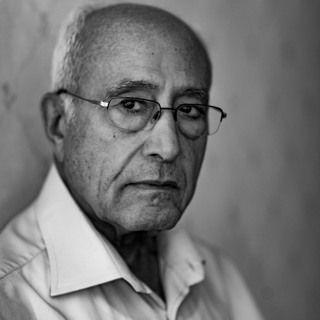
Nakba #10 - Mohamad Zarra
Överlevarna29 Joulu 2025

Nakba #10 - Mohamad Zarra

1946 ”As a boy, I remember the beach in Tantura. I was five or six years old. The sand was soft, clean, and white. The water was shallow far out. The coast consisted of alternating coves and small islands. I used to swim in the sea with my father. That is an important memory. 1948 ”I started school in March 1948, but three months later we were forced to flee. Tantura was occupied on May 24, 1948—the same day I turned seven years old. I remember how the bloody night began. I heard bursts of gunfire and the deafening thunder of cannons. The Haganah attacked from three directions. Our family—my aunts on my father’s and mother’s sides and their families—gathered in my grandmother’s house. Everyone was afraid; everyone was screaming and crying. My mother held my three youngest siblings in her arms. That night I could not sleep. Some prayed to Allah; others cursed the Jews. Even the dogs were afraid. More than one hundred villagers were killed that night. In the morning, the streets were filled with bodies. My father and some male relatives went to the school to organize resistance. Around noon the Zionists entered Tantura. The village raised a white flag; there was nothing else to do. The Jewish soldiers gathered the women and children in the square. In the chaos I spotted my mother and my younger siblings. They were searched by female soldiers looking for gold and money. They took everything—rings and necklaces. They tore off earrings so that blood spurted from the women’s and girls’ ears. The soldiers went into the houses and emptied them of everything of value—furniture, valuables, and money. The items were hauled away by horse and cart. Other soldiers collected the dead bodies scattered in the streets. They dumped the bodies in front of the women and children, as a final act of humiliation. Then some of the village’s snipers began shooting at the Zionists again, despite the white flag. They killed some Haganah soldiers, which resulted in the Jewish soldiers, in blind fury, shooting every man who came in their way. People fell like bowling pins. Meanwhile, people from a nearby Jewish settlement joined the Haganah. When things calmed somewhat, we were ordered down to the beach. On the way I saw several dead bodies, among them my maternal grandfather, Abu Hamek Jidek, and one of my uncles, Ami Abdel Aziz. Crying women wandered around looking for men and children among the bodies. The May sun was mercilessly hot. When we reached the beach, the sand was hot like fire. Everyone was barefoot. We began hopping like grasshoppers. We were hungry and thirsty, but the soldiers gave us nothing to eat or drink. My grandfather was the village mukhtar. He had smuggled weapons from Syria to Palestine, and now the Haganah wanted to make an example of him. Two soldiers took him to a house by the beach. They pushed him inside and closed the door. Shortly afterward, two pistol shots echoed out over the sea. The men—those aged sixteen and older—were lined up on the beach. A soldier whipped those who did not keep the line straight. The soldiers marched them away, ten at a time, a few hundred meters down the beach. There they were shot. The remaining men were taken to the village cemetery, lined up, and ordered to dig their own graves. When a line had finished digging, the men were shot in the back of the head and fell into the graves they had dug. We remained on the beach, paralyzed with terror. For some, their stomachs turned. Those of us who survived the massacre were forced to go to Fureidis, a neighboring village about four kilometers away. We walked on foot, and I still remember how badly my legs and feet hurt. We were guarded by soldiers. Some pleaded with the soldiers to be allowed to return to their houses to fetch clothes and other belongings, but in vain. When we arrived in Fureidis, the villagers gave us food and drink. We stayed there for a few days. We learned that the military had blown up all the houses .”

Tämä jakso on lisätty Podme-palveluun avoimen RSS-syötteen kautta eikä se ole Podmen omaa tuotantoa. Siksi jakso saattaa sisältää mainontaa.

Jaksot(323)

Överlevarna #35: Egon Brill

Överlevarna #35: Egon Brill

Du som inte tror på gud, vad tror du på? - Jag försöker tro på andra människor, trots allt, säger Egon Brill. Foto: Cato Lein. Inspelat den 13 nov 2017.

18 Touko 20181h 51min

Överlevarna #34: Adèle Schreiber

Överlevarna #34: Adèle Schreiber

- I juni 1944 blev vi deporterade från gettot i Satu Mare till Auschwitz. Jag skildes från mina föräldrar och blev inkastad i en vagn. Mitt enda sällskap var min älsklingsbok, Alice i Underlandet, säg...

12 Touko 20181h 10min

Överlevarna #33: Alexander Rothman

Överlevarna #33: Alexander Rothman

- Hur vill du uttala ditt efternamn, Rothman, med ”o” eller ”å”? - Rothman med ”o”, eftersom vi befinner oss i Sverige. - Inte tyskt uttal? - Jag avskyr ”Råtman”, för att det har en tysk anstrykning. ...

4 Touko 20181h 7min

Överlevarna #32: Walter Frankenstein

Överlevarna #32: Walter Frankenstein

- 1942 jobbade vi åt Gestapo, men våra löner betalades av judiska församlingen. Jag blev kommenderad att laga putsen i Adolf Eichmanns kontor på Kurfuerstenstrasse i Berlin. Eichmann satt bakom sitt s...

27 Huhti 20182h 25min

Överlevarna #31: Dora Bodlander

Överlevarna #31: Dora Bodlander

- När jag lämnade baracken sa en flicka: "Dora håll min hand. Jag känner att jag ska dö" Jag blev rädd och drog tillbaka min hand. När jag kom tillbaka in i baracken var hon död. Och än i dag har jag ...

21 Huhti 201855min

Överlevarna #30: Lili Jodelsohn

Överlevarna #30: Lili Jodelsohn

- Min mamma, två av mina systrar, min bror, mormor och moster åkte till gasen med samma. Det sista jag hörde min nioåriga bror Jakob säga var: "Jag vill inte dö." Foto: Cato Lein Inspelat den 25 okt...

13 Huhti 20181h 22min

Överlevarna #29: Zsuzsanna Reisch

Överlevarna #29: Zsuzsanna Reisch

- Min moster kom tillbaka från Bergen-Belsen. Hon hade överlevt, men hon var ganska förstörd och hennes huvud var också förstört. Hon fick ett svårt liv, hon blev en labil person i hela sitt liv, säge...

6 Huhti 20181h 16min

Överlevarna #28: Cyla Trus

Överlevarna #28: Cyla Trus

- Hur har du burit dig åt för att behålla din livsglädje, trots dina svåra erfarenheter? - Vad kan man göra? Man kan väl inte ta livet av sig? säger Cyla Trus Foto: Cato Lein

30 Maalis 201836min

Suosittua kategoriassa Koulutus

rss-murhan-anatomia
psykopodiaa-podcast
voi-hyvin-meditaatiot-2
adhd-podi
rss-rahamania
rss-liian-kuuma-peruna
rahapuhetta
kesken
rss-valo-minussa-2
rss-narsisti
rss-luonnollinen-synnytys-podcast
rss-tietoinen-yhteys-podcast-2
rss-vapaudu-voimaasi
rss-niinku-asia-on
filocast-filosofian-perusteet
psykologia
ihminen-tavattavissa-tommy-hellsten-instituutti
rss-duodecim-lehti
aamukahvilla
rss-elamankoulu