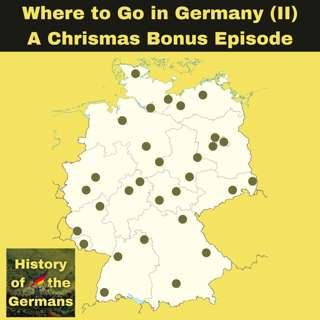
Where To Go in Germany - Part 2

One of the legacies of the Holy roman empire is that Germany does not have just one place where everything happens, where politicians, entrepreneurs, bankers, artists, and actors travel on the same underground trains and eat at the same restaurants. Berlin is the capital with its political class of members of the Bundestag, journalists and lobbyist and at the same time a major gathering place for artists, musicians and thespians of all stripes and home to many tech startups. But the bankers are in Frankfurt, the headquarters of the major companies are in Stuttgart, Munich, Düsseldorf and spread around everywhere. Several of the major publishing houses are in Hamburg, the private TV stations in Munich, but none of these places have a monopoly on any of these activities. There are banks headquartered in Munich and major corporates in Frankfurt, there is great theater in Düsseldorf, Dresden and Schwerin, there are world leading companies headquartered in tiny towns like Künzelsau.

And that cuts through to the major cultural sites. Though the quip that there were 365 states in the Holy Roman empire is vastly exaggerated, there were once a hundred capital cities, from splendid Dresden to tiny Hohenzollern-Hechingen, each with its princely residence, cathedral, grand monastery and theater. The great artists either travelled from court to court, leaving behind their works here or there, or stayed in one of the free imperial cities, operating large workshops.

Therefore what you cannot do in Germany is to go to one city and see all the major treasures the country has “collected” over the centuries, as you can do in the Louvre or the British Museum and the National Gallery. In Germany you have to move around, see one thing at the time, always in the knowledge that its significant counterpart is a few hundred miles north, south, east or west of you. This is one of the legacies of the medieval empire that Germany has in common with Italy.

And hence we are going through each of the Bundesländer trying to pick out one absolute must-see and one place where you are likely to encounter fewer people. And as we have covered 9 Bundesländer up to Mecklenburg-Vorpommern already, the next location we will have to get to is Nordrhein-Westfalen, Germany’s most populous state.

★ Support this podcast ★

Tämä jakso on lisätty Podme-palveluun avoimen RSS-syötteen kautta eikä se ole Podmen omaa tuotantoa. Siksi jakso saattaa sisältää mainontaa.

Jaksot(253)

Ep. 240 Martin Luther - His Youth and His "Anfechtungen"

Ep. 240 Martin Luther - His Youth and His "Anfechtungen"

In this episode we will look at the first 35 years of Martin Luther’s life, from his birth in 1483 to a moment sometime between 1512 and 1519 when he achieved his great theological breakthrough. This ...

17 Syys 49min
Ep. 239 The Faith of the Common People

Ep. 239 The Faith of the Common People

On 31 October 1517, an Augustinian monk carried 95 theses through the streets of Wittenberg — whether to nail them to the castle church door, post them by letter, or send them to the printers remains ...

3 Syys 34min
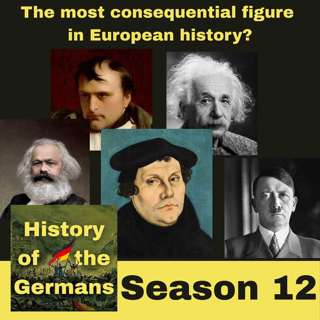
The Most Consequential Figure in European History?

The Most Consequential Figure in European History?

Who had the most lasting impact on Europe? Marx? Napoleon? Darwin? Einstein? Or was it Martin Luther? ★ Support this podcast ★

31 Elo 3min
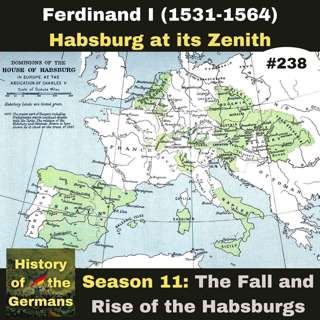
Ep. 238: The Habsburg Empire at its Zenith - Ferdinand I and the Siege of Vienna

Ep. 238: The Habsburg Empire at its Zenith - Ferdinand I and the Siege of Vienna

Today we celebrate the topping out of the Habsburg empire. By the middle of the 16th century it reached its furthest extent as a political entity ruled by one man. Over the last 42 episodes we have se...

21 Touko 53min
Ep. 237: How Italy Fell to the Habsburgs - From the Peace of Madrid to the Sack of Rome 1527.

Ep. 237: How Italy Fell to the Habsburgs - From the Peace of Madrid to the Sack of Rome 1527.

We are coming closer to the end of our series on the Fall and Rise of the House of Habsburg. We have seen the reconsolidation of Austria, the acquisition of Burgundy, the inheritance of Spain and toda...

14 Touko 36min
Ep. 236: Charles V (1520-1555) - The Battle of Pavia

Ep. 236: Charles V (1520-1555) - The Battle of Pavia

In 1521 four men dominated Europe. They were all in their twenties: King Henry VIII of England, born 1491, King Francois I of France, born 1494, Suleiman the Magnificent, Ottoman Sultan, born that sam...

7 Touko 38min
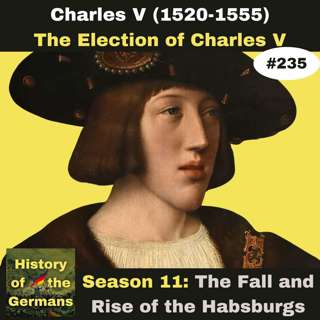
Ep. 235: The Youth and Election of the Emperor Charles V (1520-1555)

Ep. 235: The Youth and Election of the Emperor Charles V (1520-1555)

Born during a ball in Ghent on 24 February 1500, Charles of Habsburg would grow up to rule an empire stretching from the Philippines to Prague and from Lima to Lauwersoog. But who was the man behind o...

30 Huhti 40min
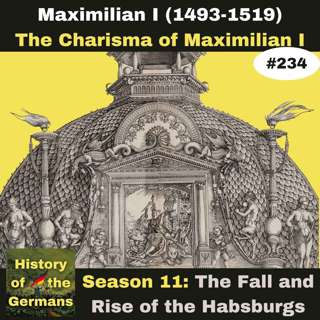
Ep. 234: The Charisma of Emperor Maximilian (1493-1519)

Ep. 234: The Charisma of Emperor Maximilian (1493-1519)

Maximilian I died on January 12th, 1519. But his likeness is everywhere. None of his predecessors left behind as many depictions of their life, from being fed by his nurse as a toddler to the Totenbil...

23 Huhti 37min
Suosittua kategoriassa Koulutus

rss-murhan-anatomia
aamukahvilla
psykopodiaa-podcast
adhd-podi
psykologia
voi-hyvin-meditaatiot-2
rss-liian-kuuma-peruna
koulu-podcast-2
rss-luonnollinen-synnytys-podcast
ilona-rauhala
kesken
rss-vapaudu-voimaasi
ihminen-tavattavissa-tommy-hellsten-instituutti
rss-duodecim-lehti
rss-koira-haudattuna
rss-narsisti
rss-arkea-ja-aurinkoa-podcast-espanjasta
rss-psykalab
rss-hereilla
rss-niinku-asia-on