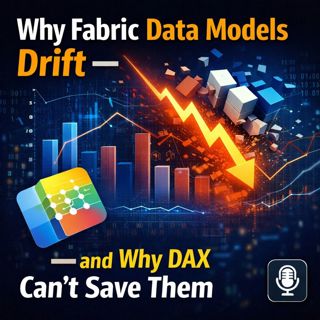
Why Fabric Data Models Drift – And Why DAX Alone Can’t Fix Broken Analytics

Why Fabric Data Models Drift – And Why DAX Alone Can’t Fix Broken Analytics

In this episode of m365.fm, we explore why so many teams treat their Fabric and BI data models as objective truth—and how that assumption quietly breaks decisions, strategy, and performance over time. Modern analytics stacks promise a “single source of truth”, but in reality, models drift away from how the business actually works, while dashboards stay polished and convincing. This conversation looks at how context, ownership, and intent shape every metric, and why DAX, SQL, or any other engine can only execute logic—not decide whether that logic still reflects reality.

THE MYTH OF THE SINGLE SOURCE OF TRUTH

Most organizations over‑trust their centralized data models because they look consistent, fast, and professionally built. Abstraction layers in Fabric, BI tools, and semantic models hide important assumptions: how customers are defined, which events count, and what “active”, “churned”, or “qualified” really mean. When those assumptions stop matching how teams work on the ground, the model becomes a historical opinion presented as current fact—leading leaders to optimize for the wrong signals while believing they are “data‑driven”.

DATA MODELS ARE OPINIONS, NOT FACTS

Every data model encodes human decisions: which sources to trust, which edge cases to ignore, which trade‑offs to accept. Business logic is never neutral; it is embedded in joins, filters, measures, and transformations. When analysts and engineers are disconnected from product, sales, finance, or operations, these opinions drift. The model keeps calculating perfectly, but what it represents becomes less and less aligned with how value is actually created and measured in the organization.

EXECUTION VS UNDERSTANDING: WHY DAX CAN’T SAVE YOU

Data engines like Fabric, Power BI, or any DAX‑based system execute logic with perfect reliability—even when that logic is outdated, incomplete, or just wrong. Dashboards can be beautifully designed, fast, and consistent across teams, while still misrepresenting reality because the underlying definitions no longer make sense. Accuracy in computation is not the same as correctness in meaning. No amount of DAX heroics can fix a model whose assumptions are broken, misaligned, or never clearly documented in the first place.

OWNERSHIP, ACCOUNTABILITY, AND METRIC GOVERNANCE

A core theme of this episode is ownership: who actually owns your key metrics, and who has the authority to change their definitions when the business changes? Many teams run on metrics nobody really owns—analytics builds them, business uses them, and nobody is formally responsible for their truthfulness. We discuss why metric and model ownership must be explicit, cross‑functional, and tied to real business outcomes, not just to the analytics or data team. Without this, every new initiative adds more tables, more measures, and more drift.

CONTEXT OVER SCALE: WHY MORE DATA ISN’T THE ANSWER

Adding more data, more events, and more integrations does not automatically create better decisions. In many cases, each new source increases ambiguity because teams can’t see which numbers matter or what they actually mean. Local knowledge—held by people close to customers, operations, and processes—often outperforms centralized models that have lost connection to context. We talk about when simplifying metrics helps, when it hides critical nuance, and how to design data models that remain explainable to non‑technical stakeholders.

PRACTICAL TAKEAWAYS
  • Treat every important metric as a product with a clear owner, roadmap, and change history.
  • Document assumptions inside your models so teams can challenge them instead of blindly trusting outputs.
  • Encourage healthy skepticism toward dashboards: always ask “what does this really represent?” before acting.
  • Build feedback loops between business and analytics so data models evolve with real‑world changes, not months later.
  • Use DAX and Fabric as execution engines for well‑understood logic, not as tools to patch over unclear definitions.
WHO THIS EPISODE IS FOR
  • Data analysts, analytics engineers, and BI developers working with Fabric, Power BI, or modern data stacks.
  • Product managers, business leaders, and operations teams who rely on dashboards, KPIs, and reports for critical decisions.
  • Data leaders and heads of analytics who want models that remain trustworthy as the organization scales.
  • Anyone frustrated by “data‑driven” decisions that feel wrong on the ground but are hard to challenge.
ABOUT THE HOST

Mirko Peters is a Microsoft 365 expert, architect, and host of m365.fm. He works with organizations from small businesses to large enterprises on Microsoft 365 architecture, security, AI integration, governance design, and system architecture. His work focuses on designing context‑driven systems that reduce complexity, enable autonomous execution, and create scalable performance across modern enterprises.

Become a supporter of this podcast: https://www.spreaker.com/podcast/m365-fm-modern-work-security-and-productivity-with-microsoft-365--6704921/support.

Tämä jakso on lisätty Podme-palveluun avoimen RSS-syötteen kautta eikä se ole Podmen omaa tuotantoa. Siksi jakso saattaa sisältää mainontaa.

Jaksot(864)

From Excel Expert to Microsoft MVP: Empowering Millions with Data, Dashboards & AI with Karen Abecia [Microsoft MVP]

From Excel Expert to Microsoft MVP: Empowering Millions with Data, Dashboards & AI with Karen Abecia [Microsoft MVP]

aren Abecia shares the remarkable journey that transformed a passion for Microsoft Excel into a global career as one of the world's best-known Excel educators. She explains how discovering creative sp...

27 Heinä 0s

The Copilot Credit Trap- Why Your AI Economy is Already Broken

The Copilot Credit Trap- Why Your AI Economy is Already Broken

For decades, enterprise software followed a predictable financial model. Organizations purchased licenses, assigned them to users, and budgeted annual IT spending with confidence. AI changes that comp...

26 Heinä 0s

The End of AI Bloat: Why Modern Agents Need Skills

The End of AI Bloat: Why Modern Agents Need Skills

Many AI agents start out fast, responsive, and surprisingly intelligent. But after a few months of real-world use, something changes. Response times increase, costs rise, prompts become enormous, and ...

26 Heinä 0s

THE DEATH OF THE PROXY: Architecting Dataverse for the Agent Fabric

THE DEATH OF THE PROXY: Architecting Dataverse for the Agent Fabric

For years, Microsoft's recommended architecture for connecting AI assistants like Claude Desktop to Dataverse relied on a local STDIO proxy. It was simple, easy to install, and perfectly suited for in...

26 Heinä 0s

The Death of the Pipeline: Why AI Agents are Replacing Traditional

The Death of the Pipeline: Why AI Agents are Replacing Traditional

For more than two decades, CI/CD pipelines have been the backbone of modern software delivery. Developers commit code, automated builds run, tests execute, security scans complete, someone approves th...

25 Heinä 0s
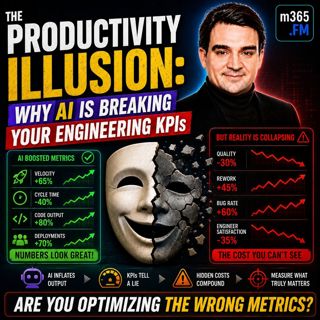
The Productivity Illusion: Why AI is Breaking Your Engineering KPIs

The Productivity Illusion: Why AI is Breaking Your Engineering KPIs

At first glance, the numbers look incredible. Deployment frequency is increasing, pull requests are being merged faster than ever, AI is generating more code, and engineering teams appear dramatically...

25 Heinä 0s
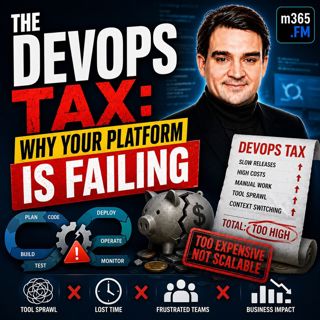
The DevOps Tax: Why Your Platform is Failing

The DevOps Tax: Why Your Platform is Failing

Welcome to another episode of Knowledge Nuggets with Mirko Peters. Today we're exploring The DevOps Tax—the hidden cost that silently reduces engineering productivity, increases cognitive overload, an...

25 Heinä 0s

Microsoft Purview Insider Risk Management - Simply Explained

Microsoft Purview Insider Risk Management - Simply Explained

Welcome to another episode of Knowledge Nuggets with Mirko Peters. Today we're exploring Microsoft Purview Insider Risk Management, Microsoft's intelligent solution for identifying risky user behavior...

24 Heinä 0s

Suosittua kategoriassa Politiikka ja uutiset

aikalisa
uutiscast
ootsa-kuullut-tasta-2
rss-ootsa-kuullut-tasta
otetaan-yhdet
rss-seksicast
rss-podme-livebox
rss-vaalirankkurit-podcast
aihe
rikosmyytit
tervo-halme
rss-girls-finish-f1rst
politiikan-puskaradio
et-sa-noin-voi-sanoo-esittaa
rss-mina-ukkola
rss-raha-talous-ja-politiikka
rss-asiastudio
rss-varsinaista-puhetta