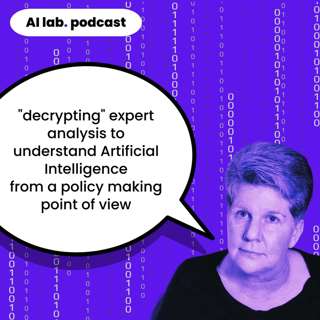
AI lab TL;DR | Jurgen Gravestein - The Intelligence Paradox

AI lab TL;DR | Jurgen Gravestein - The Intelligence Paradox

🔍 In this TL;DR episode, Jurgen Gravestein (Conversation Design Institute) discusses his Substack blog post delving into the ‘Intelligence Paradox’ with the AI lab

📌 TL;DR Highlights
⏲️[00:00] Intro
⏲️[01:08] Q1-The ‘Intelligence Paradox’:
How does the language used to describe AI lead to misconceptions and the so-called ‘Intelligence Paradox’?
⏲️[05:36] Q2-‘Conceptual Borrowing’:
What is ‘conceptual borrowing’ and how does it impact public perception and understanding of AI?
⏲️[10:04] Q3-Human vs AI ‘Learning’:
Why is it misleading to use the term ‘learning’ for AI processes and what this means for the future of AI development?
⏲️[14:11] Wrap-up & Outro

💭 Q1-The ‘Intelligence Paradox’

🗣️ What’s really interesting about chatbots and AI is that for the first time in human history, we have technology talking back at us, and that's doing a lot of interesting things to our brains.
🗣️ In the 1960s, there was an experiment with Chatbot Eliza, which was a very simple, pre-programmed chatbot (...) And it showed that when people are talking to technology, and technology talks back, we’re quite easily fooled by that technology. And that has to do with language fluency and how we perceive language.
🗣️ Language is a very powerful tool (...) there’s a correlation between perceived intelligence and language fluency (...) a social phenomenon that I like to call the ‘Intelligence Paradox’. (...) people perceive you as less smart, just because you are less fluent in how you’re able to express yourself.
🗣️ That also works the other way around with AI and chatbots (...). We saw that chatbots can now respond in extremely fluent language very flexibly. (...) And as a result of that, we perceive them as pretty smart. Smarter than they actually are, in fact.
🗣️ We tend to overestimate the capabilities of [AI] systems because of their language fluency, and we perceive them as smarter than they really are, and it leads to confusion (...) about how the technology actually works.

💭 Q2-‘Conceptual Borrowing’

🗣️ A research article (...) from two professors, Luciano Floridi and Anna Nobre, (...) explaining (...) conceptual borrowing [states]: “through extensive conceptual borrowing, AI has ended up describing computers anthropomorphically, as computational brains with psychological properties, while brain and cognitive sciences have ended up describing brains and minds computationally and informationally, as biological computers."
🗣️ Similar to the Intelligence Paradox, it can lead to confusion (...) about whether we underestimate or overestimate the impact of a certain technology. And that, in turn, informs how we make policies or regulate certain technologies now or in the future.
🗣️ A small example of conceptual borrowing would be the term “hallucinations”. (...) a common term to describe when systems like chatGPT say something that sounds very authoritative and sounds very correct and precise, but is actually made up, or partly confabulated. (...) this actually has nothing to do with real hallucinations [but] with statistical patterns that don’t match up with the question that’s being asked.

💭 Q3-Human vs AI ‘Learning’

🗣️ If you talk about conceptual borrowing, “machine learning” is a great example of that, too. (...) there's a very (...) big discrepancy between what learning is in the psychological terms and the biological terms when we talk about learning, and then when it comes to these systems.
🗣️ So if you actually start to be convinced that LLMs are as smart and learn as quickly as people or children (...) you could be over attributing qualities to these systems.
🗣️ [ARC-AGI challenge:] a $1 million USD prize pool for the first person that can build an AI to solve a new benchmark that (...) consists of very simple puzzles that a five-year old (...) could basically solve. (...) it hasn't been solved yet.
🗣️ That’s, again, an interesting way to look at learning, and especially where these systems fall short. [AI] can reason based on (...) the data that they've seen, but as soon as it (..) goes out of (...) what they've seen in their data set, they will struggle with whatever task they are being asked to perform.

📌 About Our Guest
🎙️ Jurgen Gravestein | Sr Conversation Designer, Conversation Design Institute (CDI)
𝕏 https://x.com/@gravestein1989
🌐 Blog Post | The Intelligence Paradox
https://jurgengravestein.substack.com/p/the-intelligence-paradox
🌐 Newsletter
https://jurgengravestein.substack.com
🌐 CDI
https://www.conversationdesigninstitute.com
🌐 Profs. Floridi & Nobre's article
http://dx.doi.org/10.2139/ssrn.4738331
🌐 Jurgen Gravestein
https://www.linkedin.com/in/jurgen-gravestein

Jurgen Gravestein is a writer, conversation designer and AI consultant. He works at the CDI, the world’s leading training and certification institute in conversational AI. He also runs a successful Substack newsletter “Teaching computers how to talk”.

Jaksot(37)

AI lab – AI in Action | Episode 03: AI Tokenization

AI lab – AI in Action | Episode 03: AI Tokenization

Let’s talk about AI tokenization in this third episode of our AI in Action series. Tokenization is actually pretty interesting, especially if you ever wondered how these fancy AI machines understand t...

16 Syys 20247min

AI lab TL;DR | Bertin Martens - The Economics of GenAI & Copyright

AI lab TL;DR | Bertin Martens - The Economics of GenAI & Copyright

🔍 In this TL;DR episode, Dr. Bertin Martens (Bruegel) discusses his working paper for the Brussels-based economic think tank on the economic arguments in favour of reducing copyright protection for g...

9 Syys 202413min

AI lab TL;DR | Alexander Peukert - Copyright in the Artificial Intelligence Act–A Primer

AI lab TL;DR | Alexander Peukert - Copyright in the Artificial Intelligence Act–A Primer

🔍 In this TL;DR episode, Prof. Dr. Alexander Peukert (Goethe University Frankfurt am Main) discusses his primer on copyright in the EU AI Act with the AI lab📌 TL;DR Highlights⏲️[00:00] Intro⏲️[01:26...

18 Heinä 202415min

AI lab TL;DR | Thomas Margoni - Copyright Law & the Lifecycle of Machine Learning Models

AI lab TL;DR | Thomas Margoni - Copyright Law & the Lifecycle of Machine Learning Models

🔍 In this TL;DR episode, Professor Thomas Margoni (CiTiP - Centre for IT & IP Law, KU Leuven) discusses copyright law and the lifecycle of machine learning models with the AI lab. The starting point ...

11 Heinä 202413min

AI lab - AI in Action | Episode 02: AI Terminology

AI lab - AI in Action | Episode 02: AI Terminology

Let’s talk about AI terminology in the second episode in our AI in Action series. The AI term gets thrown around more than a beach ball at a summer picnic, and it’s not always clear what people are ta...

2 Heinä 202410min

AI lab TL;DR | Elisa Giomi - The Unacknowledged AI Revolution in the Media & Creative Industries

AI lab TL;DR | Elisa Giomi - The Unacknowledged AI Revolution in the Media & Creative Industries

🔍 In this TL;DR episode, Dr Elisa Giomi, Associate Professor at the Roma Tre University and Commissioner of the Italian Communications Regulatory Authority (AGCOM), discusses her recent contribution ...

18 Kesä 202418min

AI lab TL;DR | Derek Slater - What the Copyright Case Against Ed Sheeran Can Teach Us About AI

AI lab TL;DR | Derek Slater - What the Copyright Case Against Ed Sheeran Can Teach Us About AI

🔍 In this TL;DR episode, Derek Slater (Proteus Strategies) discusses his recent blog post on the Tech Policy Press website, titled “What the Copyright Case Against Ed Sheeran Can Teach Us About AI”, ...

30 Touko 202413min

AI lab - AI in Action | Episode 01: AI History

AI lab - AI in Action | Episode 01: AI History

We are kickstarting our AI in Action series by diving headfirst into the key milestones that led to the gradual deployment of Artificial Intelligence, or AI for short. You might think it's some shiny ...

7 Touko 20249min

Suosittua kategoriassa Tiede

tiedekulma-podcast
rss-mita-tulisi-tietaa
rss-poliisin-mieli
utelias-mieli
rss-metsantuntijat-podcast
rss-duodecim-lehti
mielipaivakirja
rss-luontopodi-samuel-glassar-tutkii-luonnon-ihmeita
docemilia
filocast-filosofian-perusteet
menologeja-tutkimusmatka-vaihdevuosiin
rss-bios-podcast
rss-astetta-parempi-elama-podcast
rss-tiedetta-vai-tarinaa
rss-lapsuuden-rakentajat-podcast
rss-sosiopodi
rss-miljonaarien-tasavalta