
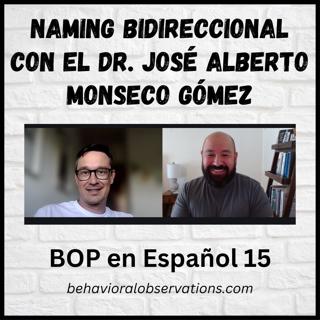
Naming Bidireccional: BOP en Español 15 con el Dr. José Alberto Monseco Gómez
En este episodio, conversamos con el Dr. José Alberto Monseco Gómez —analista de conducta, BCBA® e IBA®— sobre un proceso fascinante, aunque poco comprendido aún por muchos analistas de conducta, en la adquisición del lenguaje: el naming bidireccional. A través de una charla accesible y llena de ejemplos, exploramos qué es el naming, cómo se relaciona con conceptos fundamentales del análisis de conducta, y por qué su presencia (o ausencia) puede marcar una diferencia sustancial en el desarrollo de lenguaje complejo. Hablamos de su relevancia tanto en contextos naturales como escolares, su papel como cúspide conductual, y los procedimientos que han demostrado inducir esta habilidad cuando no está presente. José también comparte hallazgos de su propia investigación y experiencia, reflexiones personales como padre y profesional, y consejos valiosos para analistas de conducta que trabajan con población con dificultades en el desarrollo del lenguaje. Bidirectional Naming with Dr. José Alberto Monseco Gómez In this episode, we talk with Dr. José Alberto Monseco Gómez —Behavior Analyst, BCBA®, and IBA®— about a fascinating yet still under-appreciated process in language acquisition among many behavior analysts: bidirectional naming. Through an accessible and example-rich conversation, we explore what naming is, how it connects to foundational concepts in behavior analysis, and why its presence (or absence) can make a significant difference in the development of complex language. We discuss its relevance in both natural and educational settings, its role as a behavioral cusp, and the procedures shown to induce this skill when it is missing.José also shares insights from his own research and clinical experience, personal reflections as a parent and professional, and valuable advice for behavior analysts working with individuals facing challenges in language development.
15 Heinä 202557min
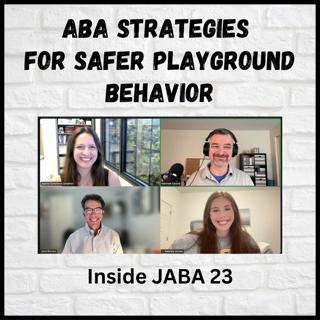
ABA Strategies for Safer Playground Behavior: Inside JABA 23
Welcome back to the Inside JABA series—this is Episode 23, and it's a must-listen for anyone interested in using Applied Behavior Analysis (ABA) to improve safety in school settings. In this episode, Dr. Jeannie Donaldson and Gabriela Gomes join Dr. John Borrero and me to discuss the paper, "Effects of differential reinforcement and time-out on the unsafe playground behavior of young children" (note: first author, Elizabeth Linton unfortunately was not able to join us). 🎯 What You'll Learn in This Episode: Playground Safety Statistics: The surprisingly high rates of injury during recess and why this matters. Behavior-Analytic Interventions: A review of previous ABA research focused on playground safety and injury prevention. Reinforcement vs. Time-Out: Pros, cons, and ethical considerations when using these strategies in natural environments. Study Design and Results: How the researchers implemented the intervention, what the data showed, and how students responded—both behaviorally and emotionally. Participant Choice & Social Validity: Insights into student preferences and recess enjoyment. Implications for Schools: How schools and practitioners can implement similar interventions and where the research should go next. As you can see below, the intervention package was quite effective: 📜 Subscribe to JABA Want access to cutting-edge research like this? Subscribe to The Journal of Applied Behavior Analysis and stay informed on the latest evidence-based practices. 📚 Resources & Research Mentioned: Linton, Gomes, and Donaldson (2025). Effects of differential reinforcement and time-out on the unsafe playground behavior of young children. Donaldson, et al. (2013). Effects of a reduced time-out interval on compliance with the time-out instruction. Chotto, Linton, and Donaldson (2024). Direct and indirect effects of and preferences for feedback during the Good Behavior Game in elementary classes. Heck, et al. (2001). Decreasing children's risk taking on the playground. Schwebel, et al. (2006). The Stamp-in-Safety Program: A Behavioral Intervention to Reduce Behaviors that Can Lead to Unintentional Playground Injury in a Preschool Setting. Peltier, et al. (2023). Effects of and preference for student- and teacher-implemented good behavior game in early elementary classes. 🎓 Earn CEUs for Listening All Inside JABA episodes are available for CEU credit! Click here to purchase and earn your CEUs.
1 Heinä 20251h 21min
Using ABA to Build Better Health and Fitness Habits: Session 303 with Michal Pollack
Michal Pollack joined me to discuss how she uses her training in Behavior Analysis to help her with her personal health and fitness goals. Michal is a Clinical Director at Apollo Behavior. In this episode, we talk about: How she got her start in Applied Behavior Analysis. How she found her way to Apollo, and what she enjoys about working there. How she realized that getting fit doesn't require playing team sports, or being an athlete more generally. How spending time abroad during a gap year motivated her to adopt a healthier lifestyle. How going to the gym regularly helped her improve her emotional wellbeing. How she developed grocery shopping habits that helped her eat healthier meals. How she doesn't weigh herself frequently, and the rationale for this practice. We both talk about the pros and cons of wearable devices, and how I use The Whoop Strap (note, this is an affiliate). I want to make clear that during this podcast, it's important to note that neither of us are health or fitness professionals. We're not attempting to provide specific advice for listeners that's outside of our scopes of expertise. Instead, a better framing of this episode is to consider this a conversation between two BCBAs talking about how they apply behavior-analytic principles in their own lives. As such, if you're looking to make changes to your fitness, please consider working with a credentialed professional, with the input of your primary care provider. You can follow Michal on TikTok or LinkedIn here and here. If you'd like to learn more about working at Apollo, you can read about them here. Articles and resources mentioned: Camp and Hayes (2012). Assessing and Increasing Physical Activity. Donaldson and Normand (2009). Using goal setting, self-monitoring, and feedback to increase calorie expenditure in obese adults. Hustyi, Normand, and Larson (2013). Behavioral assessment of physical activity in obese preschool children. The aforementioned Whoop Strap. This podcast is brought to you by: Frontera. Consider taking a demo of Frontera's Assessment Builder and see how the ethical application of AI technologies can help you serve clients and save you time! Your first assessment report is free. And if you use code BOP25 you'll get an additional five assessments for just $100. So head to fronterahealth.com to check it out! CEUs from Behavioral Observations. Learn from your favorite podcast guests while you're commuting, walking the dog, or whatever else you do while listening to podcasts. New events are being added all the time, so check them out here. HRIC Recruting. Cut out the middleman and speak directly with Barbara Voss, who's been placing BCBAs in great jobs all across the US for 15 years. Behavior University. Their mission is to provide university quality professional development for the busy Behavior Analyst. Learn about their CEU offerings, including their 8-hour Supervision Course, as well as their RBT offerings over at behavioruniversity.com/observations. Don't forget to use the coupon code, PODCAST to save at checkout! Apollo Behavior. If these Apollo Series podcasts have you wondering about what it's like to work there, check out their current job openings in the greater Atlanta area and beyond!
24 Kesä 20251h
AI, Applied Behavior Analysis, and the Future of Clinical Tools: Frontera Series on AI with Sydney Holmes
Behavior Analysis Meets Artificial Intelligence In the second installment of Behavioral Observations' Frontera Series on AI, I had the pleasure of speaking with Sydney Holmes, a Board Certified Behavior Analyst and master's level psychologist. Sydney is also the Clinical Product Lead at Frontera, where she's helping bridge the gap between behavior analysis and artificial intelligence in some really exciting ways. Did you miss the first Frontera Series interview with CEO and Founder, Amol Deshpande? Check it out here! We covered everything from using AI tools for clinical work and content creation, to how machine learning is reshaping supervision, diagnostics, and parent support. From Marine Biology to Behavior Analysis Sydney has a unique background. She started in marine biology and eventually found her way to psychology and behavior analysis. Today, she's at the forefront of tech innovation in her role at Frontera, where she combines clinical insight with product development. What is Digital Phenotyping? One of the more fascinating parts of our conversation was about digital phenotyping. Frontera is using AI to analyze real-world video data in order to track, measure, and interpret client behavior—helping clinicians make faster, more informed decisions. Teaching AI to Understand Behavior Sydney described the challenges of teaching machines to detect nuanced behaviors like crying or vocal stereotypy. It takes close collaboration between BCBAs and engineers to develop AI tools that are truly clinically useful. Enhancing Diagnostics and Supervision with AI We talked about how Frontera is helping BCBAs with autism diagnostics, supervision, and quality assurance through smart automation. Their platform supports more efficient monitoring of RBT sessions and helps maintain fidelity to treatment protocols. Real-Time RBT Session Review and Feedback Frontera's video tools allow for recording of every RBT session, making it possible to provide objective, real-time feedback. The goal is to support staff in a way that's consistent and non-punitive, which aligns with what we know about effective supervision. Improving Parent Engagement with Mobile Apps Sydney also discussed how their mobile app allows caregivers to submit short videos of their interactions with their child. This enables BCBAs to provide timely, video-based coaching and collect meaningful data outside of traditional session settings. Advice for Behavior Analysts Embracing AI Her advice for clinicians? Stay curious but skeptical, lean into collaboration, and look for ways to use technology to enhance—not replace—the human side of behavioral healthcare. Learn More To learn more about Frontera's tools and mission, visit frontera.health. You can also connect with Sydney and the team on LinkedIn and other social platforms. Thanks for listening and supporting the podcast. If you found this conversation helpful, be sure to subscribe and share it with a colleague!
12 Kesä 202542min
Supporting Parents in ABA Services with Valencia Harper from Apollo Behavior: Session 301
When it comes to Applied Behavior Analysis (ABA), much of the focus is often placed on data collection, program goals, and measurable outcomes for the child. But what about the parents? Supporting caregivers is a critical, and sometimes overlooked, component of effective ABA services. In a recent podcast episode, I had the pleasure of sitting down with Valencia Harper, a seasoned clinician from Apollo Behavior, to talk about her thoughtful approach to working with families. Long-time listeners may remember Valencia from our Apollo Case Study Series, where she and her colleagues discussed mentoring new practitioners. This time around, we shifted gears to focus on her insights into caregiver collaboration—and the conversation did not disappoint. From Smoothies to Strategy: Valencia's Journey Valencia opened up about her own career beginnings, including a memorable (and messy) first day involving a smoothie spill. That moment, though humbling, marked the start of a journey that led her to become the confident and effective BCBA she is today. Through years of experience, she has developed a deep appreciation for the unique challenges parents face—and a toolkit for meeting them with empathy, clarity, and respect. What Parents Really Need from ABA Providers Throughout the episode, Valencia shared key insights into how BCBAs can better support the families they serve. Here are a few highlights from our discussion: 1. Listening Builds Rapport Rather than jumping into solutions, Valencia emphasizes the power of active listening. Parents often come to the table with a wealth of experience and emotion. Taking time to truly hear them builds trust and sets the tone for collaboration. 2. BCBAs Don't Have to Know Everything It can be tempting to feel like we have to have all the answers. But Valencia reminds us that being transparent about what we don't know—while showing a commitment to learning—can strengthen relationships rather than weaken them. 3. Prioritize Parental Concerns Instead of sticking strictly to what the data says, Valencia encourages clinicians to take parent priorities seriously. If bedtime battles or sibling conflicts are top of mind for the family, addressing those concerns can lead to more engagement and faster progress. 4. Clarify ABA Jargon Parents may struggle with technical terms or misunderstand the purpose of certain procedures. Valencia discusses how breaking things down into digestible language helps reduce frustration and builds empowerment. 5. Combat Learned Helplessness Some caregivers come into services feeling defeated or disconnected. Valencia talks about how to gently challenge that mindset and offer small, achievable strategies that rebuild parental confidence. 6. Teach How to Set Limits Supporting families doesn't stop with behavior plans. Valencia shares tips for coaching parents on how to set clear, developmentally appropriate limits without escalating the situation. 7. Responding to "We've Already Tried That" This common phrase can be frustrating for clinicians, but Valencia reframes it as an opportunity to validate parents' experiences and reintroduce strategies with better context or support. Inside Apollo's Approach to Caregiver Training Valencia also gave us a behind-the-scenes look at how Apollo Behavior structures its caregiver support. From structured training sessions to informal check-ins, their model integrates parent collaboration as a core component of service delivery—not an afterthought. Resources Mentioned in the Episode If you're looking to dive deeper into the themes we discussed, here are a few recommended reads and links from the show: Apollo Behavior Valencia Harper on LinkedIn Tiny Humans, Big Emotions: How to Navigate Tantrums, Meltdowns, and Defiance to Raise Emotionally Intelligent Children―An Essential Guide for Caregivers of Children from Infancy to Age Eight. Managing Meltdowns and Tantrums on the Autism Spectrum. Clinical Interviewing, 7th Edition. AIM: Accept, Identify, Move. This podcast is brought to you by: Frontera. Consider taking a demo of Frontera's Assessment Builder and see how the ethical application of AI technologies can help you serve clients and save you time! Your first assessment report is free. And if you use code BOP25 you'll get an additional five assessments for just $100. So head to fronterahealth.com to check it out! CEUs from Behavioral Observations. Learn from your favorite podcast guests while you're commuting, walking the dog, or whatever else you do while listening to podcasts. New events are being added all the time, so check them out here. The Behavioral Toolbox. Check out our courses for school-based and other behavioral professionals, including our newest one, Motivational Interviewing: Getting Educator Buy-In.
29 Touko 202550min
Chronic Absenteeism and School Refusal: Session 300 with Kristen McNeely
Kristen McNeely joins me for an informative discussion about the challenging topic of School Refusal and Chronic Absenteeism. If you are in any way connected to a school community, you've probably heard about this difficult and growing problem. As we discuss in this episode, school refusal is an ever-growing concern, and it manifests itself in numerous ways. Kristen is both a BCBA and a Licensed Marital and Family Therapist in California, and she spends nearly all of her time working with parents who have children who engage in school refusal. In this episode, we cover: The distinction between the terms Chronic Absenteeism and School Refusal. How School Refusal can be thought of as a continuum of attendance patterns. The role of anxiety in these response patterns. Assessing the function of School Refusal behaviors. Helping parents intervene with School Refusal. The importance of wrap around supports for severe cases. How School Refusal can turn into what's known as Failure to Launch. You're going to want to listen all the way through to the end because she closes the show not only some awesome advice for the newly minted, but a poignant personal story. Resources mentioned in this podcast: The School Avoidance Alliance. Kearney and Silverman (2010). Measuring the Function of School Refusal Behavior: The School Refusal Assessment Scale. SPACE (Supportive Parenting for Anxious Childhood Emotions). Episode 58 of ABA Inside Track (Interview with Christopher Kearney). Kristen's website. Kristen's Instagram. This podcast is brought to you by: Frontera. Consider taking a demo of Frontera's Assessment Builder and see how the ethical application of AI technologies can help you serve clients and save you time! Your first assessment report is free. And if you use code BOP25 you'll get an additional five assessments for just $100. So head to fronterahealth.com to check it out! HRIC Recruting. Cut out the middleman and speak directly with Barbara Voss, who's been placing BCBAs in great jobs all across the US for 15 years. CEUs from Behavioral Observations. Learn from your favorite podcast guests while you're commuting, walking the dog, or whatever else you do while listening to podcasts. New events are being added all the time, so check them out here. The Behavioral Toolbox. Check out our courses for school-based and other behavioral professionals, including our newest one, Motivational Interviewing: Getting Educator Buy-In.
14 Touko 20251h 16min
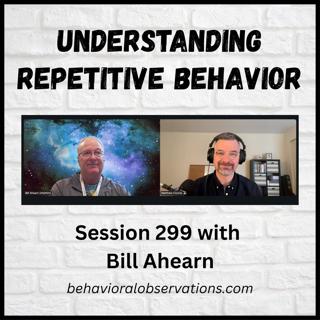
Understanding Repetitive Behavior: Session 299 with Bill Ahearn
Dr. Bill Ahearn joins me in Session 299 of Behavioral Observation. I met Bill a few times at conferences and I'm so glad we finally had a chance to sit down and record a podcast together. Bill is the Director of Research at The New England Center for Children. Long time listeners may recall that NECC sponsored a series of episodes, and in this podcast, we talked about some of the great research that has come out of that storied institution. As an aside, if you want to learn more about NECC, particularly working at NECC, you can find more information about that here. We covered a lot of ground in this conversation, including: Bill's early experiences as a grad student and clinician. His early work in addressing feeding problems. The research that he and his colleagues have conducted at NECC. How he construes stereotypic and self-injurious behavior as being forms of repetitive behavior. What he's learned about addressing stereotypy, including when and when not to intervene. We talk at length about Response Interruption and Redirection, particularly when it is and isn't necessary as an intervention. The behavioral interpretation of anxiety, and interventions that he and his team have brought to bear on related repertoires. I ask a few lighter questions on some topics of mutual interest (you'll have to listen towards the end to hear that). If you listen to nothing else from this podcast, towards the end of the show, Bill talks about why he is proud to be a Behavior Analyst. Please listen to that segment, as I think he makes some excellent points that are more than worth sharing. We also talked about tons of papers. I've done my best to track as many down as possible. Piazza et al. (2000). An evaluation of the effects of matched stimuli on behaviors maintained by automatic reinforcement. Rapp and Vollmer (2005). Stereotypy I: A review of behavioral assessment and treatment. Ahearn et al. (2007). Assessing and treating vocal stereotypy in children with autism. Colón et al. (2012). The effects of verbal operant training and response interruption and redirection on appropriate and inappropriate vocalizations. Rodriguez et al. (2013). Arranging and ordering in autism spectrum disorder: Characteristics, severity, and environmental correlates. Steinhauser et al. (2021). Examining stereotypy in naturalistic contexts: Differential reinforcement and context-specific redirection. Moore et al. (2022). Assessing and Treating Anxiety in Individuals with Autism. Fergus (2024). Functional Analysis and Delineating Subtypes of Restricted Repetitive Behavior in Individuals with Autism Spectrum Disorder. This podcast is brought to you by: Frontera. Consider taking a demo of Frontera's Assessment Builder and see how the ethical application of AI technologies can help you serve clients and save you time! Your first assessment report is free. And if you use code BOP25 you'll get an additional five assessments for just $100. So head to fronterahealth.com to check it out! CEUs from Behavioral Observations. Learn from your favorite podcast guests while you're commuting, walking the dog, or whatever else you do while listening to podcasts. New events are being added all the time, so check them out here. The Behavioral Toolbox. Check out our courses for school-based and other behavioral professionals, including our newest one, Motivational Interviewing: Getting Educator Buy-In. Behavior University. Their mission is to provide university quality professional development for the busy Behavior Analyst. Learn about their CEU offerings, including their 8-hour Supervision Course, as well as their RBT offerings over at behavioruniversity.com/observations. Don't forget to use the coupon code, PODCAST to save at checkout!
5 Touko 20251h 34min
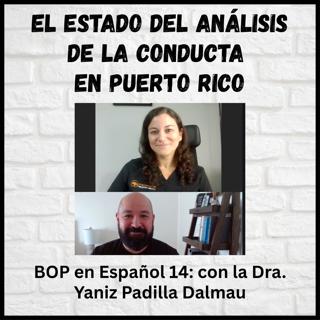
El Estado del Análisis de la Conducta en Puerto Rico con la Dra. Yaniz Padilla Dalmau: BOP en Español 14
El Estado del Análisis de la Conducta en Puerto Rico con la Dra. Yaniz Padilla Dalmau En este episodio, tuve el honor de conversar con la Dra. Yaniz Padilla Dalmau, una de las voces más comprometidas y visionarias en el desarrollo del análisis de la conducta en Puerto Rico. A través de una charla llena de realidades, aprendizajes y esperanza, exploramos el estado actual de la práctica de ABA en la isla, los desafíos sistémicos que enfrentan las familias y profesionales, y el impacto de barreras lingüísticas, económicas y estructurales. Yaniz comparte no solo el panorama de necesidades, sino también el poder de la acción colectiva, el liderazgo comunitario y la importancia de diseminar ABA de manera ética, culturalmente sensible y alejada de mentalidades colonialistas. Aprendimos sobre iniciativas locales inspiradoras, el nacimiento de PRABA, y recomendaciones esenciales para quienes desean construir cambios reales y sostenibles en nuevas comunidades. Un episodio que nos invita a reflexionar sobre cómo practicamos, para quién practicamos, y cómo podemos hacerlo mejor, siempre honrando la cultura y el valor de las comunidades que servimos. The State of Behavior Analysis in Puerto Rico with Dr. Yaniz Padilla Dalmau In this episode, I had the honor of speaking with Dr. Yaniz Padilla Dalmau, one of the most committed and visionary voices advancing the field of behavior analysis in Puerto Rico. Through a conversation filled with realities, lessons, and hope, we explore the current state of ABA practice on the island, the systemic challenges faced by families and professionals, and the impact of language, economic, and structural barriers. Yaniz not only highlights the needs but also shows the power of collective action, community leadership, and the importance of disseminating ABA ethically, with cultural sensitivity, and free from colonialist mindsets. We learn about inspiring local initiatives, the formation of PRABA, and essential recommendations for those who wish to build real, sustainable change in new communities. This episode invites us to reflect on how we practice, for whom we practice, and how we can do better—always honoring the culture and the value of the communities we serve.
28 Huhti 20251h 23min