Enterprise Cloud Strategy on Microsoft Azure: Why Cloud Governance, Identity, and Landing Zones Decide Whether Your Vision Actually Works

Enterprise Cloud Strategy on Microsoft Azure: Why Cloud Governance, Identity, and Landing Zones Decide Whether Your Vision Actually Works

Most enterprises still talk about “moving to Azure” as if it were a project you can finish. Pick a date, move the workloads, switch off the old hardware, and assume that a new cost model plus a new logo on the invoice equals a new operating model. But Azure does not execute strategy slides. It executes configuration — every permission, every policy gap, every exception request, and every landing zone decision you either made on purpose or allowed by default — until the gap between cloud vision and platform reality becomes impossible to ignore.

In this episode of M365.FM, Mirko Peters looks at enterprise cloud strategy on Microsoft Azure from the uncomfortable angle most vision decks skip: what actually happens after the migration milestone is declared “done.” This is not a conversation about picking the “right” service or chasing the latest Azure feature. It is a conversation about why cloud strategies decay when identity is treated as plumbing instead of the real control plane, why landing zones are management philosophy disguised as templates, and why governance — when designed well — increases delivery speed instead of killing it with bureaucracy.The organizations that will actually win with Microsoft cloud are not the ones that shipped the biggest migration program. They are the ones that start with different questions:
  • Who is allowed to create spend, and under which non‑negotiable guardrails?
  • Where do we centralize control, even if compute stays distributed?
  • Which decisions must be standardized once, so teams stop renegotiating them on every workload?
That means treating Azure as the execution environment for strategy, not the strategy itself, and accepting that cloud governance is less about tools and more about decision rights.

WHAT YOU WILL LEARN
  • Why many “successful” Azure migrations change invoices but not outcomes — and how that shows up in budgets, audits, and outages.
  • How to recognize when configuration, not vision, has become your real cloud strategy: exception sprawl, inconsistent landing zones, and identity patterns nobody can fully explain.
  • What a control‑plane‑first cloud strategy looks like on Azure: Entra ID as the decision engine, landing zones as enforced default paths, and governance as the way you make ambiguity disappear instead of rebranding it as “agility.”
  • How FinOps, identity, and platform teams fit together so that cost, risk, and speed stop fighting each other and start reinforcing the same operating model.
THE CORE INSIGHT

Every cloud strategy lives or dies at the point where someone with permissions does something the vision deck did not anticipate. When you allow “temporary” exceptions, undefined landing zones, or identity models that nobody owns, you are not just making local trade‑offs. You are deciding how much entropy you are willing to inject into your future Azure estate — and how hard it will be, three years from now, to answer simple questions like “who owns this, why does it exist, and what happens if we turn it off?”

Mirko argues that real cloud strategy on Microsoft Azure begins the moment you stop celebrating migration as the finish line and start treating it as the starting point for a platform that can be governed, changed, and scaled on purpose.

WHO THIS EPISODE IS FOR
  • CIOs, CTOs, and transformation leaders who have “moved to Azure” and are still waiting for the operating model to catch up.
  • Cloud platform and Azure architects responsible for landing zones, Entra ID, governance, and FinOps.
  • Enterprise and security architects trying to connect business intent with the real configuration of their Microsoft cloud estate.
  • Microsoft partners and consultants advising customers on turning Azure from a project into a durable operating model.
ABOUT THE HOST

Mirko Peters is a Microsoft 365 and Azure architect, strategist, and the host of M365.FM — a podcast focused on modern work, security, and operating model design in the Microsoft ecosystem. He works with organizations from midmarket to global enterprise to turn “we moved to Azure” projects into platforms that can actually be governed, changed, and scaled over time. His work centers on Azure landing zones, Entra ID and identity architecture, cloud governance and FinOps, and the hard reality of making Microsoft cloud strategy executable in day‑to‑day operations.

Become a supporter of this podcast: https://www.spreaker.com/podcast/m365-fm-modern-work-security-and-productivity-with-microsoft-365--6704921/support.

Tämä jakso on lisätty Podme-palveluun avoimen RSS-syötteen kautta eikä se ole Podmen omaa tuotantoa. Siksi jakso saattaa sisältää mainontaa.

Jaksot(864)

From Excel Expert to Microsoft MVP: Empowering Millions with Data, Dashboards & AI with Karen Abecia [Microsoft MVP]

From Excel Expert to Microsoft MVP: Empowering Millions with Data, Dashboards & AI with Karen Abecia [Microsoft MVP]

aren Abecia shares the remarkable journey that transformed a passion for Microsoft Excel into a global career as one of the world's best-known Excel educators. She explains how discovering creative sp...

27 Heinä 0s

The Copilot Credit Trap- Why Your AI Economy is Already Broken

The Copilot Credit Trap- Why Your AI Economy is Already Broken

For decades, enterprise software followed a predictable financial model. Organizations purchased licenses, assigned them to users, and budgeted annual IT spending with confidence. AI changes that comp...

26 Heinä 0s
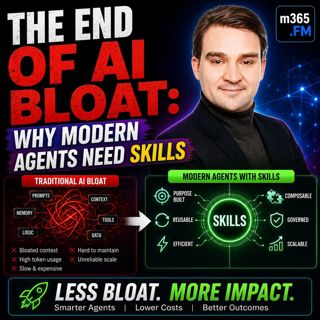
The End of AI Bloat: Why Modern Agents Need Skills

The End of AI Bloat: Why Modern Agents Need Skills

Many AI agents start out fast, responsive, and surprisingly intelligent. But after a few months of real-world use, something changes. Response times increase, costs rise, prompts become enormous, and ...

26 Heinä 0s
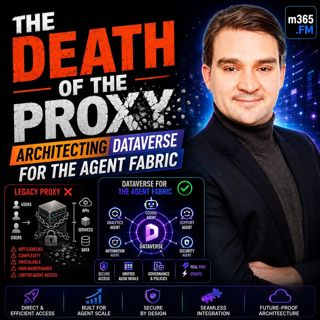
THE DEATH OF THE PROXY: Architecting Dataverse for the Agent Fabric

THE DEATH OF THE PROXY: Architecting Dataverse for the Agent Fabric

For years, Microsoft's recommended architecture for connecting AI assistants like Claude Desktop to Dataverse relied on a local STDIO proxy. It was simple, easy to install, and perfectly suited for in...

26 Heinä 0s
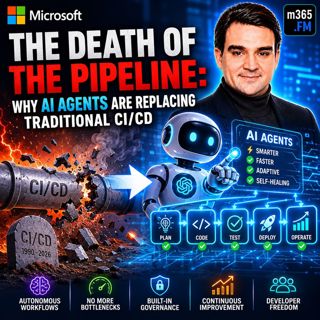
The Death of the Pipeline: Why AI Agents are Replacing Traditional

The Death of the Pipeline: Why AI Agents are Replacing Traditional

For more than two decades, CI/CD pipelines have been the backbone of modern software delivery. Developers commit code, automated builds run, tests execute, security scans complete, someone approves th...

25 Heinä 0s
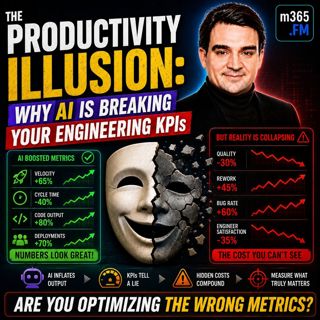
The Productivity Illusion: Why AI is Breaking Your Engineering KPIs

The Productivity Illusion: Why AI is Breaking Your Engineering KPIs

At first glance, the numbers look incredible. Deployment frequency is increasing, pull requests are being merged faster than ever, AI is generating more code, and engineering teams appear dramatically...

25 Heinä 0s
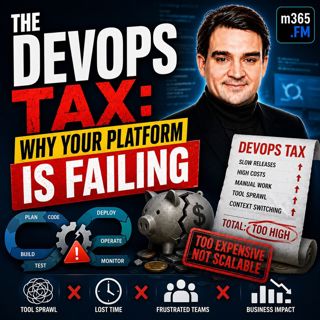
The DevOps Tax: Why Your Platform is Failing

The DevOps Tax: Why Your Platform is Failing

Welcome to another episode of Knowledge Nuggets with Mirko Peters. Today we're exploring The DevOps Tax—the hidden cost that silently reduces engineering productivity, increases cognitive overload, an...

25 Heinä 0s
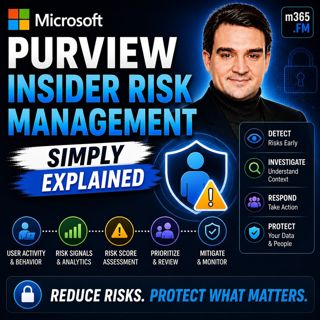
Microsoft Purview Insider Risk Management - Simply Explained

Microsoft Purview Insider Risk Management - Simply Explained

Welcome to another episode of Knowledge Nuggets with Mirko Peters. Today we're exploring Microsoft Purview Insider Risk Management, Microsoft's intelligent solution for identifying risky user behavior...

24 Heinä 0s

Suosittua kategoriassa Politiikka ja uutiset

aikalisa
uutiscast
ootsa-kuullut-tasta-2
rss-ootsa-kuullut-tasta
rss-seksicast
otetaan-yhdet
rss-vaalirankkurit-podcast
rss-podme-livebox
tervo-halme
aihe
politiikan-puskaradio
rss-girls-finish-f1rst
rikosmyytit
et-sa-noin-voi-sanoo-esittaa
rss-mina-ukkola
rss-raha-talous-ja-politiikka
rss-asiastudio
rss-varsinaista-puhetta