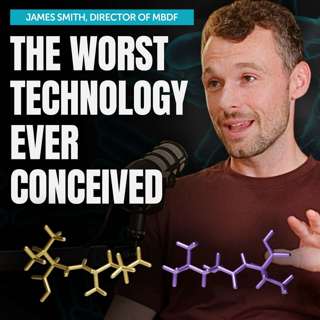
Mirror Life is the World’s Most Neglected Extinction Risk | James Smith, Mirror Biology Dialogues Fund

Mirror Life is the World’s Most Neglected Extinction Risk | James Smith, Mirror Biology Dialogues Fund

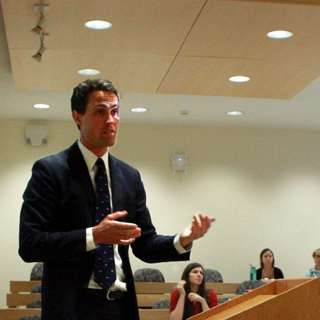
When James Smith first heard about mirror bacteria, he was sceptical. But within two weeks, he’d dropped everything to work on it full time, considering it the worst biothreat that he’d seen described. What convinced him?

Mirror bacteria would be constructed entirely from molecules that are the mirror images of their naturally occurring counterparts. This seemingly trivial difference creates a fundamental break in the tree of life. For billions of years, the mechanisms underlying immune systems and keeping natural populations of microorganisms in check have evolved to recognise threats by their molecular shape — like a hand fitting into a matching glove.

Learn more, video, and full transcript: https://80k.info/js26

Mirror bacteria would upend that assumption, creating two enormous problems:

  1. Many critical immune pathways would likely fail to activate, creating risks of fatal infection across many species.
  2. Mirror bacteria could have substantial resistance to natural predators: for example, they would be essentially immune to the viruses that currently keep bacteria populations in check. That could help them spread and become irreversibly entrenched across diverse ecosystems.

Unlike ordinary pathogens, which are typically species-specific, mirror bacteria’s reversed molecular structure means they could potentially infect humans, livestock, wildlife, and plants simultaneously. The same fundamental problem — reversed molecular structure breaking immune recognition — could affect most immune systems across the tree of life. People, animals, and plants could be infected from any contaminated soil, dust, or species.

The discovery of these risks came as a surprise. The December 2024 Science paper that brought international attention to mirror life was coauthored by 38 leading scientists, including two Nobel Prize winners and several who had previously wanted to create mirror organisms.

James is now the director of the Mirror Biology Dialogues Fund, which supports conversations among scientists and other experts about how these risks might be addressed. Scientists tracking the field think that mirror bacteria might be feasible in 10–30 years, or possibly sooner. But scientists have already created substantial components of the cellular machinery needed for mirror life. We can regulate precursor technologies to mirror life before they become technically feasible — but only if we act before the research crosses critical thresholds. Once certain capabilities exist, we can’t undo that knowledge.

Addressing these risks could actually be very tractable: unlike other technologies where massive potential benefits accompany catastrophic risks, mirror life appears to offer minimal advantages beyond academic interest.

Nonetheless, James notes that fewer than 10 people currently work full-time on mirror life risks and governance. This is an extraordinary opportunity for researchers in biosecurity, synthetic biology, immunology, policy, and many other fields to help solve an entirely preventable catastrophe — James even believes the issue is on par with AI safety as a priority for some people, depending on their skill set.

The Mirror Biology Dialogues Fund is hiring!

This episode was recorded on November 5-6, 2025.

Chapters:

  • Cold open (00:00:00)
  • Who's James Smith? (00:00:49)
  • Why is mirror life so dangerous? (00:01:12)
  • Mirror life and the human immune system (00:15:40)
  • Nonhuman animals will also be at risk (00:28:25)
  • Will plants be susceptible to mirror bacteria? (00:34:57)
  • Mirror bacteria's effect on ecosystems (00:39:34)
  • How close are we to making mirror bacteria? (00:52:16)
  • Policies for governing mirror life research (01:06:39)
  • Countermeasures if mirror bacteria are released into the world (01:22:06)
  • Why hasn't mirror life evolved on its own? (01:28:37)
  • Why wouldn't antibodies or antibiotics save us from mirror bacteria? (01:31:52)
  • Will the environment be toxic to mirror life? (01:39:21)
  • Are there too many uncertainties to act now? (01:44:18)
  • The potential benefits of mirror molecules and mirror life (01:46:55)
  • Might we encounter mirror life in space? (01:52:44)
  • Sounding the alarms about mirror life: the backstory (01:54:55)
  • How to get involved (02:02:44)

Video and audio editing: Dominic Armstrong, Milo McGuire, Luke Monsour, and Simon Monsour
Music: CORBIT
Camera operators: Jeremy Chevillotte and Alex Miles
Coordination, transcripts, and web: Katy Moore

Jaksot(315)

#2 - David Spiegelhalter on risk, stats and improving understanding of science

#2 - David Spiegelhalter on risk, stats and improving understanding of science

Recorded in 2015 by Robert Wiblin with colleague Jess Whittlestone at the Centre for Effective Altruism, and recovered from the dusty 80,000 Hours archives. David Spiegelhalter is a statistician at the University of Cambridge and something of an academic celebrity in the UK. Part of his role is to improve the public understanding of risk - especially everyday risks we face like getting cancer or dying in a car crash. As a result he’s regularly in the media explaining numbers in the news, trying to assist both ordinary people and politicians focus on the important risks we face, and avoid being distracted by flashy risks that don’t actually have much impact. Summary, full transcript and extra links to learn more. To help make sense of the uncertainties we face in life he has had to invent concepts like the microlife, or a 30-minute change in life expectancy. (https://en.wikipedia.org/wiki/Microlife) We wanted to learn whether he thought a lifetime of work communicating science had actually had much impact on the world, and what advice he might have for people planning their careers today.

21 Kesä 201733min

#1 - Miles Brundage on the world's desperate need for AI strategists and policy experts

#1 - Miles Brundage on the world's desperate need for AI strategists and policy experts

Robert Wiblin, Director of Research at 80,000 Hours speaks with Miles Brundage, research fellow at the University of Oxford's Future of Humanity Institute. Miles studies the social implications surrounding the development of new technologies and has a particular interest in artificial general intelligence, that is, an AI system that could do most or all of the tasks humans could do. This interview complements our profile of the importance of positively shaping artificial intelligence and our guide to careers in AI policy and strategy Full transcript, apply for personalised coaching to work on AI strategy, see what questions are asked when, and read extra resources to learn more.

5 Kesä 201755min

#0 – Introducing the 80,000 Hours Podcast

#0 – Introducing the 80,000 Hours Podcast

80,000 Hours is a non-profit that provides research and other support to help people switch into careers that effectively tackle the world's most pressing problems. This podcast is just one of many things we offer, the others of which you can find at 80000hours.org. Since 2017 this show has been putting out interviews about the world's most pressing problems and how to solve them — which some people enjoy because they love to learn about important things, and others are using to figure out what they want to do with their careers or with their charitable giving. If you haven't yet spent a lot of time with 80,000 Hours or our general style of thinking, called effective altruism, it's probably really helpful to first go through the episodes that set the scene, explain our overall perspective on things, and generally offer all the background information you need to get the most out of the episodes we're making now. That's why we've made a new feed with ten carefully selected episodes from the show's archives, called 'Effective Altruism: An Introduction'. You can find it by searching for 'Effective Altruism' in your podcasting app or at 80000hours.org/intro. Or, if you’d rather listen on this feed, here are the ten episodes we recommend you listen to first: • #21 – Holden Karnofsky on the world's most intellectual foundation and how philanthropy can have maximum impact by taking big risks • #6 – Toby Ord on why the long-term future of humanity matters more than anything else and what we should do about it • #17 – Will MacAskill on why our descendants might view us as moral monsters • #39 – Spencer Greenberg on the scientific approach to updating your beliefs when you get new evidence • #44 – Paul Christiano on developing real solutions to the 'AI alignment problem' • #60 – What Professor Tetlock learned from 40 years studying how to predict the future • #46 – Hilary Greaves on moral cluelessness, population ethics and tackling global issues in academia • #71 – Benjamin Todd on the key ideas of 80,000 Hours • #50 – Dave Denkenberger on how we might feed all 8 billion people through a nuclear winter • 80,000 Hours Team chat #3 – Koehler and Todd on the core idea of effective altruism and how to argue for it

1 Touko 20173min

Suosittua kategoriassa Koulutus

rss-murhan-anatomia
voi-hyvin-meditaatiot-2
psykopodiaa-podcast
rss-niinku-asia-on
rss-duodecim-lehti
rss-vapaudu-voimaasi
aloita-meditaatio
psykologia
adhd-podi
kesken
jari-sarasvuo-podcast
rss-psykalab
rss-valo-minussa-2
rss-metropolia-ammattikorkeakoulu
rss-narsisti
rss-anteeks-etukateen
rss-luonnollinen-synnytys-podcast
rss-arkea-ja-aurinkoa-podcast-espanjasta
rss-tfa-8020-podcast
rss-tietoinen-yhteys-podcast-2