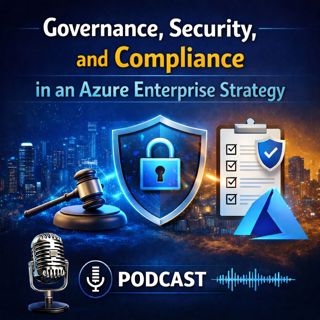
Microsoft Azure Governance: Why Security and Compliance Fail Without an Enterprise Strategy — and How to Build One

Microsoft Azure Governance: Why Security and Compliance Fail Without an Enterprise Strategy — and How to Build One

(00:00:00) Governance Beyond Documentation
(00:01:33) The Three Types of Governance Failure
(00:04:47) Governance by Design: The Deterministic Approach
(00:06:01) The Problem with Probabilistic Security
(00:08:25) Enterprise Landing Zones and Management Groups
(00:12:12) Subscription Strategy: Drawing Boundaries
(00:16:06) Role-Based Access Control and Privileged Identity Management
(00:24:23) Policy as Your Guardrail
(00:28:02) Initiatives and Exceptions in Governance
(00:32:36) Continuous Compliance and Cost Governance

Governance, security, and compliance are three words that appear together in every Azure architecture review, every cloud adoption framework, and every board-level IT risk conversation. Yet in most enterprise Azure environments, they operate as three separate workstreams with three separate teams, three separate toolsets, and no shared enforcement model. The result is predictable: security policies that are documented but not enforced, compliance postures that exist in reports but not in runtime configurations, and governance frameworks that are referenced in onboarding decks but ignored during actual workload deployment. This episode makes the architectural case for treating governance, security, and compliance as a single integrated control plane in Microsoft Azure — one that is designed once, enforced continuously, and owned structurally across the entire tenant.

WHAT YOU WILL LEARN
  • Why treating governance, security, and compliance as separate workstreams creates enterprise-scale risk in Azure
  • How Microsoft Azure Policy, Defender for Cloud, and Microsoft Purview form an integrated control plane
  • What an enterprise Azure governance strategy actually requires — beyond management groups and naming conventions
  • How Entra ID Conditional Access and Privileged Identity Management enforce zero-trust security at scale
  • Why compliance frameworks like ISO 27001, NIST, and NIS2 must be mapped to Azure Policy assignments — not spreadsheets
  • How Azure Security Benchmark and Defender for Cloud Secure Score translate into actionable governance posture
  • What continuous compliance monitoring looks like in a mature enterprise Azure environment
THE CORE INSIGHT

The separation of governance, security, and compliance into distinct organizational functions is an enterprise IT habit that dates from on-premises infrastructure. In that world, the firewall team, the compliance auditor, and the platform architect operated in genuinely different domains with genuinely different toolsets. In Microsoft Azure, those domains converge — and treating them as separate is not just inefficient. It is architecturally incoherent.

Azure Policy is simultaneously a governance tool, a security enforcement mechanism, and a compliance control. A single policy assignment that denies the creation of storage accounts without private endpoint configuration is a governance control (workloads must use approved network paths), a security control (public blob access is blocked), and a compliance control (NIST SP 800-53 AC-4 network flow enforcement). Separating governance, security, and compliance into three teams means three separate reviews of the same policy assignment — and three different answers about whether it should be enforced.

The enterprise Azure governance strategy that actually works is one built around integrated control planes. Microsoft Defender for Cloud provides the security posture management layer — continuously assessing configurations against the Azure Security Benchmark and regulatory compliance frameworks. Microsoft Purview provides the data governance and classification layer — ensuring that sensitivity labels, data residency requirements, and access policies are enforced across storage, databases, and AI workloads. Azure Policy provides the enforcement layer — converting governance decisions into runtime controls that cannot be bypassed by individual deployments. Entra ID provides the identity layer — ensuring that every access decision in the tenant is governed by conditional access policies, privileged access workflows, and regular access reviews.These four layers are not separate tools. They are an integrated control plane. And building an enterprise Azure strategy means designing that control plane deliberately, assigning ownership explicitly, and enforcing it continuously — not reviewing it quarterly.

WHY AZURE GOVERNANCE STRATEGIES FAIL
  • Management group hierarchies are designed without mapping to actual organizational accountability structures
  • Azure Policy assignments are set to audit mode indefinitely — enforcement is deferred until "later"
  • Defender for Cloud Secure Score is tracked as a KPI but remediation is never prioritized or assigned
  • Microsoft Purview is deployed but sensitivity labels are not enforced in Azure storage or AI workloads
  • Entra ID Conditional Access policies have too many exclusions to enforce zero-trust meaningfully
  • Compliance frameworks are mapped to documentation controls, not to Azure Policy assignments
  • Security Operations teams manage Sentinel alerts without integration into the governance policy lifecycle
  • Privileged Identity Management is enabled but just-in-time access is rarely used in practice
KEY TAKEAWAYS
  • Governance, security, and compliance are a single integrated control plane in Microsoft Azure — not three workstreams
  • Azure Policy is the enforcement engine: it must deny non-compliant resources, not just audit them
  • Defender for Cloud and Secure Score are posture management tools — remediation requires ownership, not dashboards
  • Entra ID zero-trust controls must be enforced without blanket exclusions to be meaningful
  • Microsoft Purview is the data governance layer that completes the Azure compliance picture — it must be actively managed
  • An enterprise Azure governance strategy is a design artifact, not a framework document — it must be enforced in runtime
WHO THIS EPISODE IS FOR
  • Azure security architects and platform engineers designing enterprise-scale governance and compliance models
  • CISO and CIO leaders setting Microsoft Azure security strategy and risk posture
  • Microsoft 365 and Azure architects integrating Purview, Defender for Cloud, and Azure Policy into unified control planes
  • Compliance and risk management professionals mapping regulatory frameworks to Azure technical controls
  • Identity and access management teams governing Entra ID zero-trust policies in enterprise tenants
  • Enterprise architects evaluating Azure governance maturity across multi-subscription and multi-region deployments
TOPICS COVERED
  • Microsoft Azure Policy governance and enforcement at enterprise scale
  • Microsoft Defender for Cloud security posture management and Secure Score
  • Microsoft Purview data governance, sensitivity labels, and compliance in Azure
  • Entra ID Conditional Access and Privileged Identity Management for zero-trust enforcement
  • Azure management group hierarchy and subscription design for governance alignment
  • NIS2, ISO 27001, and NIST compliance mapping to Azure Policy assignments
  • Microsoft Sentinel integration with Azure governance and security operations
  • Azure Security Benchmark and regulatory compliance frameworks in Defender for Cloud
  • Continuous compliance monitoring and remediation workflows in enterprise Azure
  • Integrated control plane design for governance, security, and compliance in Microsoft cloud
ABOUT THE HOST

Mirko Peters is a Microsoft 365 architect and strategist with deep expertise in Microsoft Azure governance, enterprise security architecture, compliance framework design, and AI integration. As the host of M365.FM, Mirko works with organizations ranging from SMB to global enterprise, helping them build integrated, enforceable, and audit-ready Microsoft cloud environments. His focus spans Azure security architecture, Microsoft 365 governance, Copilot strategy, Entra ID and Purview frameworks, and the design of control planes that remain enforceable as organizations scale

Become a supporter of this podcast: https://www.spreaker.com/podcast/m365-fm-modern-work-security-and-productivity-with-microsoft-365--6704921/support.

Tämä jakso on lisätty Podme-palveluun avoimen RSS-syötteen kautta eikä se ole Podmen omaa tuotantoa. Siksi jakso saattaa sisältää mainontaa.

Jaksot(865)

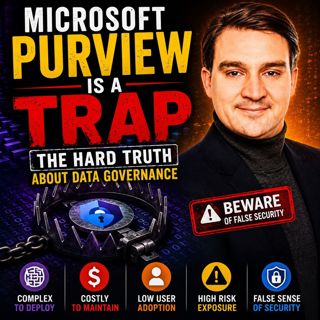
Microsoft Purview is a Trap: The Hard Truth About Data Governance

Microsoft Purview is a Trap: The Hard Truth About Data Governance

Microsoft Purview is included with many Microsoft 365 subscriptions, making it incredibly easy to enable. That convenience is also its biggest danger. Because there is no procurement process or large ...

28 Heinä 1h 1min

From Excel Expert to Microsoft MVP: Empowering Millions with Data, Dashboards & AI with Karen Abecia [Microsoft MVP]

From Excel Expert to Microsoft MVP: Empowering Millions with Data, Dashboards & AI with Karen Abecia [Microsoft MVP]

aren Abecia shares the remarkable journey that transformed a passion for Microsoft Excel into a global career as one of the world's best-known Excel educators. She explains how discovering creative sp...

27 Heinä 59min

The Copilot Credit Trap- Why Your AI Economy is Already Broken

The Copilot Credit Trap- Why Your AI Economy is Already Broken

For decades, enterprise software followed a predictable financial model. Organizations purchased licenses, assigned them to users, and budgeted annual IT spending with confidence. AI changes that comp...

26 Heinä 1h 12min
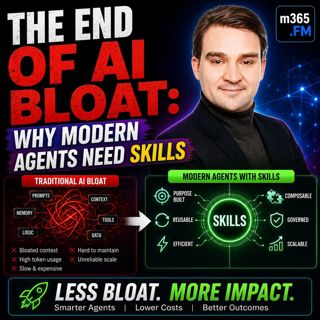
The End of AI Bloat: Why Modern Agents Need Skills

The End of AI Bloat: Why Modern Agents Need Skills

Many AI agents start out fast, responsive, and surprisingly intelligent. But after a few months of real-world use, something changes. Response times increase, costs rise, prompts become enormous, and ...

26 Heinä 1h 13min

THE DEATH OF THE PROXY: Architecting Dataverse for the Agent Fabric

THE DEATH OF THE PROXY: Architecting Dataverse for the Agent Fabric

For years, Microsoft's recommended architecture for connecting AI assistants like Claude Desktop to Dataverse relied on a local STDIO proxy. It was simple, easy to install, and perfectly suited for in...

26 Heinä 59min
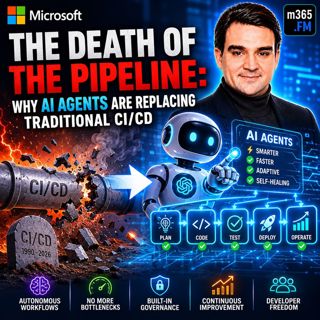
The Death of the Pipeline: Why AI Agents are Replacing Traditional

The Death of the Pipeline: Why AI Agents are Replacing Traditional

For more than two decades, CI/CD pipelines have been the backbone of modern software delivery. Developers commit code, automated builds run, tests execute, security scans complete, someone approves th...

25 Heinä 1h 9min
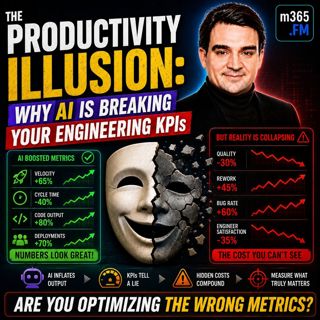
The Productivity Illusion: Why AI is Breaking Your Engineering KPIs

The Productivity Illusion: Why AI is Breaking Your Engineering KPIs

At first glance, the numbers look incredible. Deployment frequency is increasing, pull requests are being merged faster than ever, AI is generating more code, and engineering teams appear dramatically...

25 Heinä 1h 15min
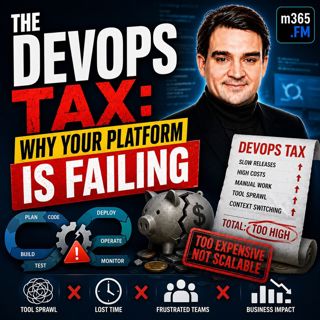
The DevOps Tax: Why Your Platform is Failing

The DevOps Tax: Why Your Platform is Failing

Welcome to another episode of Knowledge Nuggets with Mirko Peters. Today we're exploring The DevOps Tax—the hidden cost that silently reduces engineering productivity, increases cognitive overload, an...

25 Heinä 1h 18min

Suosittua kategoriassa Politiikka ja uutiset

aikalisa
uutiscast
ootsa-kuullut-tasta-2
rss-ootsa-kuullut-tasta
rss-seksicast
otetaan-yhdet
rss-vaalirankkurit-podcast
rss-podme-livebox
tervo-halme
aihe
politiikan-puskaradio
rss-girls-finish-f1rst
rikosmyytit
et-sa-noin-voi-sanoo-esittaa
rss-mina-ukkola
rss-raha-talous-ja-politiikka
rss-asiastudio
rss-varsinaista-puhetta