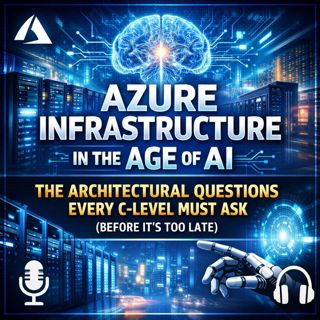

Microsoft Azure AI Infrastructure: The Strategic Questions Every C-Level Leader Must Ask Right Now

Microsoft Azure AI Infrastructure: The Strategic Questions Every C-Level Leader Must Ask Right Now

(00:00:00) The AI Challenge: Beyond Workloads
(00:00:05) AI's Autonomous Nature
(00:01:11) The Deterministic Infrastructure Trap
(00:04:14) The Loss of Determinism in AI Systems
(00:12:00) The Cost Explosion Scenario
(00:19:15) Identity Crisis: Who's in Control?
(00:23:24) The Downstream Disaster Scenario
(00:31:25) AI Gravity: The Silent Lock-in
(00:31:45) AI's Exponential Data Manipulation
(00:33:05) The Inevitability of AI Lock-in

Most organizations are making the same comfortable assumption: that AI is just another workload. It isn't. AI is not a faster application or a smarter API. It is an autonomous, probabilistic decision engine running on deterministic infrastructure that was never designed to understand intent, authority, or acceptable outcomes. Azure will let you deploy AI quickly. Azure will let you scale it globally. Azure will happily integrate it into every system you own. What Azure will not do is stop you from building something you can't explain, can't control, can't reliably afford, and can't safely govern — unless someone in the organization has made the architectural decisions that prevent those outcomes before deployment begins.

In this episode of M365.FM, Mirko Peters examines the Azure infrastructure questions that C-level leaders — CIOs, CTOs, CISOs, and CFOs — must be asking about their organization's AI readiness. Not the technical questions about GPU configurations or network topology, but the strategic architecture decisions that determine whether Azure becomes a controlled platform for enterprise AI or an accelerating source of cost, risk, and governance exposure. From Azure landing zone design and AI workload segmentation to compute cost governance, data residency, Entra ID identity architecture, and regulatory compliance for AI data flows, Mirko maps the infrastructure decisions that only leadership can own — and that leadership will be accountable for when they go wrong.

This episode is essential for any organization that is scaling AI on Microsoft Azure and has not yet asked the hard questions about whether the infrastructure underneath it is designed to support the governance, security, and financial accountability that enterprise AI actually requires.

WHAT YOU WILL LEARN
  • Why Azure infrastructure designed for traditional cloud workloads is architecturally insufficient for enterprise AI at scale
  • What the five strategic Azure infrastructure questions are that every C-level leader must be able to answer
  • How Azure landing zone design and workload segmentation directly affect AI performance, security, and governance
  • Why data residency, sovereignty, and cross-region AI data flow governance are leadership decisions with legal consequences
  • How Microsoft Entra ID identity architecture and conditional access must extend to cover AI service access and agent authentication
  • What AI compute cost governance looks like in Azure — and why uncontrolled GPU allocation creates both financial and security risk
  • How to build an Azure infrastructure cost architecture that scales with AI adoption without producing budget surprises
  • What GDPR, NIS2, and sector-specific regulatory frameworks require from AI data flow architecture in Azure environments
THE CORE INSIGHTAzure infrastructure for AI is a different discipline from traditional cloud infrastructure. The performance requirements are higher. The governance complexity is greater. The cost variability is more extreme. The security surface is larger. And the consequences of architectural failures are more visible, more damaging, and harder to reverse. Every organization that is deploying Microsoft Copilot, running Fabric analytics pipelines, or building Copilot Studio agents on Azure is making infrastructure investment decisions — whether they realize it or not. The question is whether those decisions are being made deliberately by people with the authority and information to make them well, or reactively by technical teams working without strategic direction.

Mirko argues that the infrastructure questions in this episode are not questions that technical teams can answer alone. They are questions about risk appetite, regulatory posture, financial governance, and organizational accountability — questions that require C-level ownership, not just IT awareness. The organizations that will build AI capabilities that scale reliably, govern responsibly, and perform predictably are those whose leaders are engaged in these infrastructure conversations before the architecture is locked in and the consequences become visible.

WHY AZURE AI INFRASTRUCTURE FAILS AT ENTERPRISE SCALE
  • AI workloads are deployed on infrastructure designed for SaaS applications, not for high-throughput AI inference and autonomous agent execution
  • GPU compute is allocated without a governance framework, creating cost spikes and resource contention that affect production AI reliability
  • Data flows between Azure AI services, Microsoft Fabric, OneLake, and Microsoft 365 are not mapped or governed, exposing organizations to GDPR and NIS2 compliance risk
  • Azure landing zone architecture does not segment AI workloads from operational workloads, creating security boundary failures that are difficult to remediate at scale
  • There is no cost governance model for AI compute — usage scales with adoption but budget allocation does not track it in real time
  • Microsoft Entra ID conditional access policies are not extended to cover AI service authentication, leaving agent access patterns ungoverned
  • C-level leaders are not involved in Azure AI infrastructure decisions until a failure, a compliance finding, or a budget overrun makes the gap visible
KEY TAKEAWAYS
  • Azure AI infrastructure requires deliberate strategic design — it cannot be inherited from existing cloud infrastructure
  • C-level leaders must own the decisions about data residency, cost governance, security boundaries, and regulatory compliance for AI workloads
  • Azure landing zone architecture must explicitly account for AI workload segmentation, data flow governance, and compute isolation
  • AI compute governance in Azure is both a financial and a security discipline — uncontrolled allocation creates risk on both dimensions
  • Data residency and sovereignty decisions for AI workloads have legal and regulatory consequences that go beyond technical configuration
  • Organizations that invest in Azure AI infrastructure architecture now will build compounding capability advantages; those that do not will be limited by infrastructure debt as AI demands scale
WHO THIS EPISODE IS FOR
  • CIOs, CTOs, and CISOs responsible for Azure infrastructure strategy in Microsoft 365 organizations
  • Enterprise architects designing Azure landing zones and AI workload infrastructure
  • CFOs and finance leaders evaluating Azure cost architecture for AI-driven workloads
  • Compliance and risk officers managing GDPR, NIS2, and sector-specific requirements for AI data flows in Azure
  • Microsoft partners and consultants advising on Azure AI infrastructure architecture and governance design
  • IT leaders responsible for Microsoft Fabric, Copilot Studio, and Azure AI services deployment and governance
TOPICS COVERED
  • Microsoft Azure AI infrastructure architecture and strategic design decisions
  • Azure landing zone design and AI workload segmentation and isolation
  • Azure GPU compute governance and cost architecture for enterprise AI at scale
  • Microsoft Entra ID integration and identity governance for Azure AI services and agents
  • Data residency, sovereignty, and cross-region AI data flow governance in Azure
  • GDPR, NIS2, and regulatory compliance for Azure AI workloads and data flows
  • Microsoft Fabric, OneLake, and Copilot Studio infrastructure governance on Azure
  • C-level accountability for Azure AI infrastructure decisions and strategic risk ownership
ABOUT THE HOST

Mirko Peters is a Microsoft 365 architect, strategist, and the host of M365.FM — a podcast dedicated to modern work, security, and productivity in the Microsoft ecosystem. With experience spanning small businesses to large enterprises, Mirko focuses on Microsoft 365 architecture, AI integration, governance, security, and the design of scalable, context-driven systems. M365.FM is the go-to resource for IT leaders, architects, and decision-makers navigating the Microsoft platform at scale.


Become a supporter of this podcast: https://www.spreaker.com/podcast/m365-fm-modern-work-security-and-productivity-with-microsoft-365--6704921/support.

Tämä jakso on lisätty Podme-palveluun avoimen RSS-syötteen kautta eikä se ole Podmen omaa tuotantoa. Siksi jakso saattaa sisältää mainontaa.

Jaksot(865)

Microsoft Purview is a Trap: The Hard Truth About Data Governance

Microsoft Purview is a Trap: The Hard Truth About Data Governance

Microsoft Purview is included with many Microsoft 365 subscriptions, making it incredibly easy to enable. That convenience is also its biggest danger. Because there is no procurement process or large ...

28 Heinä 1h 1min

From Excel Expert to Microsoft MVP: Empowering Millions with Data, Dashboards & AI with Karen Abecia [Microsoft MVP]

From Excel Expert to Microsoft MVP: Empowering Millions with Data, Dashboards & AI with Karen Abecia [Microsoft MVP]

aren Abecia shares the remarkable journey that transformed a passion for Microsoft Excel into a global career as one of the world's best-known Excel educators. She explains how discovering creative sp...

27 Heinä 59min

The Copilot Credit Trap- Why Your AI Economy is Already Broken

The Copilot Credit Trap- Why Your AI Economy is Already Broken

For decades, enterprise software followed a predictable financial model. Organizations purchased licenses, assigned them to users, and budgeted annual IT spending with confidence. AI changes that comp...

26 Heinä 1h 12min
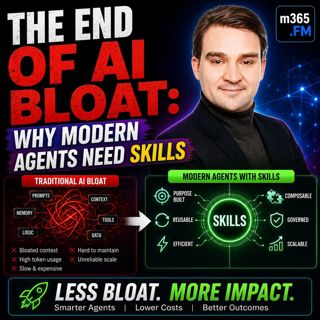
The End of AI Bloat: Why Modern Agents Need Skills

The End of AI Bloat: Why Modern Agents Need Skills

Many AI agents start out fast, responsive, and surprisingly intelligent. But after a few months of real-world use, something changes. Response times increase, costs rise, prompts become enormous, and ...

26 Heinä 1h 13min

THE DEATH OF THE PROXY: Architecting Dataverse for the Agent Fabric

THE DEATH OF THE PROXY: Architecting Dataverse for the Agent Fabric

For years, Microsoft's recommended architecture for connecting AI assistants like Claude Desktop to Dataverse relied on a local STDIO proxy. It was simple, easy to install, and perfectly suited for in...

26 Heinä 59min
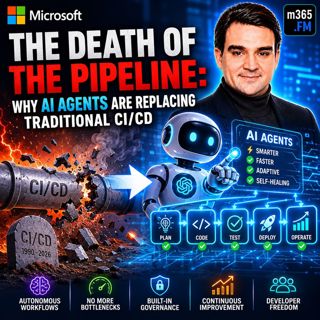
The Death of the Pipeline: Why AI Agents are Replacing Traditional

The Death of the Pipeline: Why AI Agents are Replacing Traditional

For more than two decades, CI/CD pipelines have been the backbone of modern software delivery. Developers commit code, automated builds run, tests execute, security scans complete, someone approves th...

25 Heinä 1h 9min
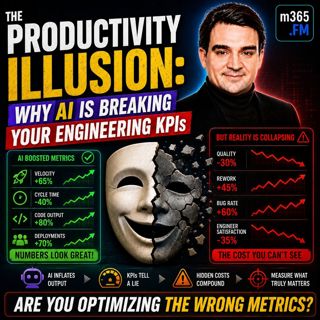
The Productivity Illusion: Why AI is Breaking Your Engineering KPIs

The Productivity Illusion: Why AI is Breaking Your Engineering KPIs

At first glance, the numbers look incredible. Deployment frequency is increasing, pull requests are being merged faster than ever, AI is generating more code, and engineering teams appear dramatically...

25 Heinä 1h 15min
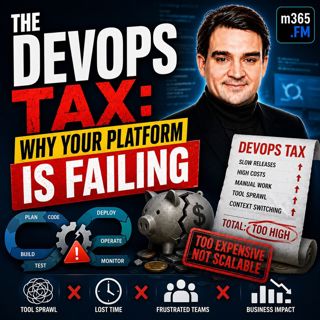
The DevOps Tax: Why Your Platform is Failing

The DevOps Tax: Why Your Platform is Failing

Welcome to another episode of Knowledge Nuggets with Mirko Peters. Today we're exploring The DevOps Tax—the hidden cost that silently reduces engineering productivity, increases cognitive overload, an...

25 Heinä 1h 18min

Suosittua kategoriassa Politiikka ja uutiset

aikalisa
uutiscast
ootsa-kuullut-tasta-2
rss-ootsa-kuullut-tasta
rss-seksicast
otetaan-yhdet
rss-vaalirankkurit-podcast
rss-podme-livebox
tervo-halme
aihe
politiikan-puskaradio
rss-girls-finish-f1rst
rikosmyytit
et-sa-noin-voi-sanoo-esittaa
rss-mina-ukkola
rss-raha-talous-ja-politiikka
rss-asiastudio
rss-varsinaista-puhetta