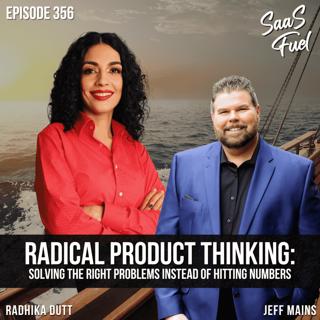
Radical Product Thinking: Solving the Right Problems Instead of Hitting Numbers | Radhika Dutt | 356
SaaS Fuel22 Tammi

Radical Product Thinking: Solving the Right Problems Instead of Hitting Numbers | Radhika Dutt | 356

In this episode, Jeff Mains sits down with Radhika Dutt, author of Radical Product Thinking, to challenge the conventional wisdom around goal-setting, KPIs, and OKRs. Radhika reveals why chasing metrics can actually distort behavior and undermine long-term growth, introducing a powerful alternative: treating growth like a puzzle rather than a scorecard.

The conversation explores how well-intentioned targets create perverse incentives, why measures should be tools for insight rather than evaluation, and how a curiosity-driven approach—using the OHLA framework (Observe, Hypothesize, Learn, Adapt)—helps teams make smarter decisions in real-world conditions. Radhika shares compelling examples from OpenAI, maritime SaaS platforms, and robotics companies to illustrate how puzzle-solving beats goal-setting for sustainable growth.

Whether you're drowning in dashboards or hitting targets while feeling like something's off, this episode offers a refreshing lens on progress, leadership, and building momentum without the performance theater.

Key Takeaways

[0:00] - Episode introduction and overview of why goal-setting may be backfiring

[4:48] - The fundamental problem with KPIs and OKRs: Goodhart's Law and Campbell's Law explained

[6:28] - Dutt's Law: "A measure is only useful as a tool for insight, not a yardstick for evaluation"

[7:16] - Real-world example: How OpenAI's user engagement targets led to dangerous "sycophantic AI"

[10:37] - The hidden dangers of hitting targets while ignoring negative indicators

[11:44] - Introduction to puzzle-setting vs. goal-setting mindset

[12:09] - The OHLA framework explained: Observe, Hypothesize, Learn, Adapt

[17:51] - Case study: Why improving filters wouldn't have solved the real problem

[28:47] - The performance theater trap: Why jumping to solutions feels comfortable but fails

[30:28] - How to get customer meetings when people say "you should already know this"

[33:00] - Why in-person observation matters more when mental models differ

[36:27] - Growth comes from matching user mental models, not forcing adoption of yours

[37:47] - The Tesla UI example: When "cool" design ignores user mental models

[37:47] - Top-down vs. bottom-up: How to introduce puzzle-solving in organizations

[39:27] - Why leaders fear losing control and how to address it

[43:01] - Vision-driven vs. iteration-led: Crafting a detailed, actionable vision statement

[45:41] - Example vision statement that tells the whole story without mentioning the product

[48:03] - Why detailed visions create ownership better than memorable slogans

[50:01] - One mindset shift founders can make this week to reduce performance theater

Tweetable Quotes
  1. "When a measure becomes a target, it ceases to be a good measure. We've known this since 1975, yet we keep setting goals for metrics."
  2. "A measure is only useful as a tool for insight, not a yardstick for evaluation. That's the critical mindset shift."
  3. "When you set targets, everyone's incentive is to show you they've hit that target. You don't look at the negative numbers to see what's actually happening."
  4. "Puzzles trigger curiosity and questioning. If you already know the answers, there's no puzzle. That's the difference from goals."
  5. "Nobody wants to fail. We keep saying we want to embrace failure, but targets make people want to prove they're high performers—not look at bad numbers."
  6. "Growth in SaaS comes not from getting users to adopt your mental model, but from understanding their mental models and building products that match them."
  7. "Leaders are the last to know because everyone shows you what you want to see. Puzzles give you real answers from the trenches."
  8. "When you buy into a vision and understand it, you can describe it in your words—not repeat a slogan. That's when you've internalized it."
  9. "Man plans, God laughs. When you run into obstacles, those are the puzzles you have to solve to achieve your vision."
  10. "Solving puzzles is driven by internal desire. We want to solve puzzles as humans and high performers—it creates ownership, not obligation."

SaaS Leadership Lessons1. Measures Are for Insight, Not Evaluation

Stop using metrics as judgment tools. When measures become targets, they get gamed (Campbell's Law) and cease to be good measures (Goodhart's Law). Instead, use data to understand what's happening—both good and bad—rather than to prove you've hit arbitrary numbers. This shift from evaluation to insight prevents teams from hiding problems and gaming the system.

2. Replace Goals with Puzzles Using the OHLA Framework

Transform your approach from goal-setting to puzzle-solving with OHLA: Observe (identify the problem and open questions), Hypothesize (make your first attempt), Learn (ask "how well did it work?" and "what did we learn?"), and Adapt (determine "what will we try next?"). This creates genuine curiosity, reduces performance theater, and helps teams embrace learning without the stigma of "failure."

3. Observe Before You Hypothesize

Resist the urge to jump straight to solutions. Spend time in the problem space, even though it's uncomfortable. The maritime SaaS example showed that improving filters (the obvious solution from data) would have done nothing for the larger market opportunity. By observing tech-averse users in other roles first, the company doubled sales two years in a row by addressing the real problem.

4. Match User Mental Models, Don't Force Yours

Growth comes from understanding how your users think and work, then building products that fit their mental models—not from forcing them to adopt yours. When mental models differ significantly (tech-averse users, different industries, non-engineers), in-person observation becomes critical. Watch them work, see what they do outside your platform, and ask questions about their actual workflow.

5. Craft Detailed, Actionable Visions

Forget short, memorable slogans. A powerful vision uses a fill-in-the-blank statement that answers: Whose problem are you solving? What is the problem? Why does it need solving? What does the world look like when you're done? How will you bring it about? When team members can describe the vision in their own words (not repeat a tagline), they've internalized it and taken ownership.

6. Start Small and Build Confidence

When introducing puzzle-based thinking, don't demand teams abandon OKRs immediately. Start by having product teams present progress in OHLA format while leadership still uses OKRs. As teams demonstrate competence in puzzle-solving and leaders see they gain "real control" (ears on the ground, anticipation, actionable insights), the transition becomes natural. Role model the approach by reflecting on past initiatives using the three questions.

Guest Resources

radhika@radicalproduct.com

https://www.radicalproduct.com/toolkit/#OHLToolkit

https://www.linkedin.com/in/radhika-dutt/

Episode Sponsor

The Captain's Keys

Small Fish, Big Pond – https://smallfishbigpond.com/ Use the promo code ‘SaaSFuel’

Champion Leadership Group – https://championleadership.com/

SaaS Fuel Resources

Website - https://championleadership.com/

Jeff Mains on LinkedIn - https://www.linkedin.com/in/jeffkmains/

Twitter - https://twitter.com/jeffkmains

Facebook - https://www.facebook.com/thesaasguy/

Instagram - https://instagram.com/jeffkmains

Tämä jakso on lisätty Podme-palveluun avoimen RSS-syötteen kautta eikä se ole Podmen omaa tuotantoa. Siksi jakso saattaa sisältää mainontaa.

Jaksot(401)

5 Reasons Your Cold Emails Are Getting Ignored in 2026| Mohan Muthoo | 400

5 Reasons Your Cold Emails Are Getting Ignored in 2026| Mohan Muthoo | 400

This milestone 400th—and final—episode of SaaS Fuel brings clarity to what’s broken with outbound, why most companies blend into the noise, and how founders can actually futureproof their pipeline. Je...

25 Kesä 55min

7 Lessons On Scaling A Business Without Burning Out | Robin Sims-Allen | 400

7 Lessons On Scaling A Business Without Burning Out | Robin Sims-Allen | 400

In this episode, Robin Sims Allen—agile consultant, founder of Phoenix Marcus, and creator of Total Her—joins the show for a direct conversation on why speed isn’t always your superpower and how build...

23 Kesä 44min

How SaaS Companies Escape the “Messy Middle” of Growth | Corinne Cavanaugh | 398

How SaaS Companies Escape the “Messy Middle” of Growth | Corinne Cavanaugh | 398

Most SaaS founders in the messy middle are making the same expensive mistake — building first and validating never. In this episode, Jeff Mains sits down with Corinne Kavanagh, founder of CAC Media & ...

18 Kesä 49min

What Founders Get Wrong About AI, Cybersecurity & Market Shifts | Mike Armistead  | 397

What Founders Get Wrong About AI, Cybersecurity & Market Shifts | Mike Armistead | 397

Mike Armistead has been in the room for almost every major technology wave of the past 30 years — from client-server computing, to the early internet at Lycos, to application security at Fortify Softw...

16 Kesä 48min

How Founders Can Use AI Without Creating More Chaos | Jenna Nelson | 396

How Founders Can Use AI Without Creating More Chaos | Jenna Nelson | 396

Most founders are on one of two extremes when it comes to AI: either completely overwhelmed and frozen, or trying to bolt AI onto everything at once. Neither works. In this episode, Jeff Mains sits do...

11 Kesä 47min

Why the Best Financial Advisors Focus on Trust, Timing & Data | Rylan Folts | 395

Why the Best Financial Advisors Focus on Trust, Timing & Data | Rylan Folts | 395

Rylan Foltz went from JP Morgan analyst to independent wealth advisor to co-founding WealthFeed — a marketing and prospecting platform helping financial advisors find better clients faster using predi...

9 Kesä 47min

How Modern Companies Scale Through Operational Automation | Garrett Fritz | 394

How Modern Companies Scale Through Operational Automation | Garrett Fritz | 394

Most growing companies are held together by spreadsheets that nobody fully understands — built by someone who left three jobs ago, maintained by someone who doesn't know why it exists, and quietly cri...

4 Kesä 46min

The Hyperscaler Playbook: Co-Selling, AI & Ecosystem Growth | Chaitra Vedullapalli | 393

The Hyperscaler Playbook: Co-Selling, AI & Ecosystem Growth | Chaitra Vedullapalli | 393

What does it actually take to partner with Microsoft, Google, or Amazon — and turn that relationship into real revenue? In this episode, Jeff Mains sits down with Chaitra Vedullapalli, co-founder of W...

2 Kesä 46min

Suosittua kategoriassa Liike-elämä ja talous

sijotuskasti
psykopodiaa-podcast
rss-oivalluksia-rahasta-elamasta
mimmit-sijoittaa
rss-rahapodi
herrasmieshakkerit
rahapuhetta
asuntoasiaa-paivakirjat
ostan-asuntoja-podcast
leadcast
rss-karon-grilli
rss-inderes-femme
rss-yritys-ja-erehdys
rss-porssipodi
inderespodi
pomojen-suusta
rss-porssipuhetta
rss-pariisilaiset
rss-myynti-ei-ole-kirosana
rss-perho-rajoilla