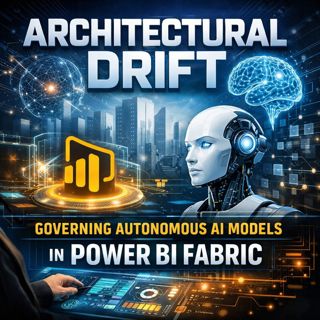

Microsoft Fabric & Power BI AI Governance: How to Detect and Prevent Architectural Drift in Autonomous AI Models

Microsoft Fabric & Power BI AI Governance: How to Detect and Prevent Architectural Drift in Autonomous AI Models

(00:00:00) The Hidden Dangers of AI in Business Intelligence
(00:00:28) The Slippery Slope of Architectural Drift
(00:01:21) Where Drift Begins: Measures and Relationships
(00:07:40) The Four Failure Modes of Measure Generation
(00:11:52) The Perils of Relationship Drift
(00:15:56) The Pitfalls of Report as Code and MCP
(00:27:40) The Security Risks of Agent Permissions
(00:31:24) A Governance Model for AI Agents
(00:31:51) The Importance of Design Gates
(00:32:12) Intent Mapping: The First Gate

Autonomous AI models do not fail suddenly. They drift. In Microsoft Fabric and Power BI environments, architectural drift is the silent process by which AI models, semantic layers, and data pipelines gradually diverge from the business logic, governance standards, and data definitions they were built to reflect — producing outputs that compile, render, and appear correct while quietly delivering answers to questions that no longer match the ones the business is asking. By the time the drift becomes visible in a business decision, a board presentation, or a regulatory audit, the underlying architecture has often been drifting for months.

In this episode of M365.FM, Mirko Peters examines the phenomenon of architectural drift in the context of Microsoft Fabric and Power BI — specifically how autonomous AI models, Fabric data pipelines, and Power BI semantic models accumulate drift over time when governance frameworks are absent or inadequate. This is a deeply important and underexplored challenge for organizations that have invested heavily in Microsoft Fabric, OneLake, and AI-driven analytics — and who assume that because the platform is performing, the architecture is healthy.

From Fabric data model governance and semantic layer management to AI model versioning, lineage tracking, and Microsoft Purview data cataloging, Mirko maps the full architecture of drift prevention — and explains why the organizations that get this right are those that treat governance not as a constraint on AI models, but as the foundational condition for their long-term reliability and trustworthiness.


WHAT YOU WILL LEARN
  • What architectural drift is in the context of Microsoft Fabric and Power BI AI models — and why it is so difficult to detect
  • How Microsoft Fabric data pipelines and OneLake data structures accumulate drift as business logic evolves without architectural updates
  • Why Power BI semantic models drift from business definitions over time and what the governance mechanisms that prevent this look like
  • How autonomous AI models in Microsoft Fabric lose alignment with their training context as underlying data distributions shift
  • What Microsoft Purview data lineage and catalog capabilities contribute to drift detection and governance in Fabric environments
  • How to design a Fabric governance architecture that makes architectural drift visible before it produces incorrect business outcomes
  • What AI model versioning, rollback capabilities, and change management processes look like in enterprise Microsoft Fabric deployments
  • How to build a continuous governance monitoring approach for Microsoft Fabric that scales with the complexity of the AI and analytics estate
THE CORE INSIGHTThe architecture of a Microsoft Fabric environment is not static. Every time a source system changes its data schema, every time a business process is redesigned, every time a new data pipeline is added without updating the downstream semantic model, and every time an AI model continues to operate on assumptions that were valid six months ago but are no longer true today, the architecture drifts slightly further from the reality it was built to represent. Individually, each of these changes is small. Collectively, over months of continuous operation, they produce an AI and analytics estate that is structurally misaligned with the business it serves.

Mirko argues that the governance frameworks that prevent architectural drift in Microsoft Fabric are not primarily technical controls — they are architectural disciplines. They require data ownership models where every semantic layer, every AI model, and every Fabric data pipeline has a named owner who is responsible for keeping it aligned with evolving business logic. They require change management processes that propagate upstream business changes through to downstream AI models before those models are used to make decisions. They require Microsoft Purview lineage tracking that makes the impact of any data change visible across the full Fabric estate before it reaches a Power BI dashboard or an autonomous AI agent. And they require a model governance cadence — a regular review cycle where the outputs of AI models are validated against current business definitions, not against the definitions that existed when the model was first trained.

WHY ARCHITECTURAL DRIFT OCCURS IN MICROSOFT FABRIC ENVIRONMENTS
  • Fabric data pipelines are updated to reflect source system changes but downstream AI models and semantic models are not refreshed accordingly
  • Power BI semantic models accumulate calculated measures and columns that reflect historical business logic no longer in use
  • AI model training data becomes stale as OneLake data distributions shift without triggering model retraining or validation workflows
  • Microsoft Purview lineage is configured but not actively monitored, so the impact of schema changes on downstream assets is not visible in time
  • There is no change management process connecting business process redesign to Fabric architecture updates
  • Data ownership is distributed but accountability is not — multiple teams contribute to the Fabric estate without a single governance owner tracking alignment
  • AI model outputs are validated against historical benchmarks rather than against current business definitions
KEY TAKEAWAYS
  • Architectural drift in Microsoft Fabric is invisible until it produces incorrect outcomes — governance must make it visible before that point
  • Every semantic model, AI model, and Fabric data pipeline must have a named owner responsible for alignment with current business logic
  • Microsoft Purview lineage tracking is the essential visibility layer for detecting upstream changes before they produce downstream drift
  • Change management processes must connect business redesign to Fabric architecture updates — not just IT system changes
  • AI model versioning and rollback capability in Microsoft Fabric are governance requirements, not optional engineering practices
  • The organizations with the most reliable AI and analytics estates treat governance as the foundational condition for model trustworthiness
WHO THIS EPISODE IS FOR
  • Microsoft Fabric architects and data engineers responsible for AI model and pipeline governance
  • Power BI administrators and semantic model owners managing analytics accuracy in enterprise environments
  • Data governance and Microsoft Purview specialists building lineage and catalog frameworks for Fabric
  • IT leaders and CDOs evaluating the governance health of their Microsoft Fabric and analytics estate
  • AI and machine learning teams deploying autonomous models on Microsoft Fabric and OneLake
  • Microsoft partners and consultants advising on Fabric governance architecture and AI model management
TOPICS COVERED
  • Microsoft Fabric architectural drift detection and AI model governance
  • Power BI semantic model governance and alignment with business definitions
  • Microsoft Fabric data pipeline change management and downstream impact tracking
  • OneLake data distribution shift and AI model retraining governance
  • Microsoft Purview data lineage, catalog, and drift detection in Fabric environments
  • AI model versioning, rollback, and validation in Microsoft Fabric deployments
  • Data ownership and accountability architecture in Microsoft Fabric estates
  • Continuous governance monitoring for Microsoft Fabric AI and analytics environments
ABOUT THE HOST

Mirko Peters is a Microsoft 365 architect, strategist, and the host of M365.FM — a podcast dedicated to modern work, security, and productivity in the Microsoft ecosystem. With experience spanning small businesses to large enterprises, Mirko focuses on Microsoft 365 architecture, AI integration, governance, security, and the design of scalable, context-driven systems. M365.FM is the go-to resource for IT leaders, architects, and decision-makers navigating the Microsoft platform at scale.

Become a supporter of this podcast: https://www.spreaker.com/podcast/m365-fm-modern-work-security-and-productivity-with-microsoft-365--6704921/support.

Tämä jakso on lisätty Podme-palveluun avoimen RSS-syötteen kautta eikä se ole Podmen omaa tuotantoa. Siksi jakso saattaa sisältää mainontaa.

Jaksot(865)

Microsoft Purview is a Trap: The Hard Truth About Data Governance

Microsoft Purview is a Trap: The Hard Truth About Data Governance

Microsoft Purview is included with many Microsoft 365 subscriptions, making it incredibly easy to enable. That convenience is also its biggest danger. Because there is no procurement process or large ...

28 Heinä 1h 1min

From Excel Expert to Microsoft MVP: Empowering Millions with Data, Dashboards & AI with Karen Abecia [Microsoft MVP]

From Excel Expert to Microsoft MVP: Empowering Millions with Data, Dashboards & AI with Karen Abecia [Microsoft MVP]

aren Abecia shares the remarkable journey that transformed a passion for Microsoft Excel into a global career as one of the world's best-known Excel educators. She explains how discovering creative sp...

27 Heinä 59min

The Copilot Credit Trap- Why Your AI Economy is Already Broken

The Copilot Credit Trap- Why Your AI Economy is Already Broken

For decades, enterprise software followed a predictable financial model. Organizations purchased licenses, assigned them to users, and budgeted annual IT spending with confidence. AI changes that comp...

26 Heinä 1h 12min
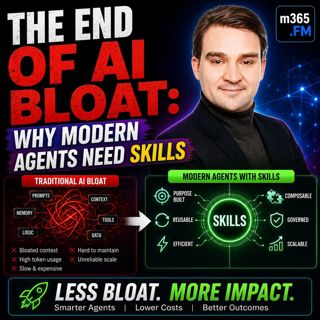
The End of AI Bloat: Why Modern Agents Need Skills

The End of AI Bloat: Why Modern Agents Need Skills

Many AI agents start out fast, responsive, and surprisingly intelligent. But after a few months of real-world use, something changes. Response times increase, costs rise, prompts become enormous, and ...

26 Heinä 1h 13min

THE DEATH OF THE PROXY: Architecting Dataverse for the Agent Fabric

THE DEATH OF THE PROXY: Architecting Dataverse for the Agent Fabric

For years, Microsoft's recommended architecture for connecting AI assistants like Claude Desktop to Dataverse relied on a local STDIO proxy. It was simple, easy to install, and perfectly suited for in...

26 Heinä 59min

The Death of the Pipeline: Why AI Agents are Replacing Traditional

The Death of the Pipeline: Why AI Agents are Replacing Traditional

For more than two decades, CI/CD pipelines have been the backbone of modern software delivery. Developers commit code, automated builds run, tests execute, security scans complete, someone approves th...

25 Heinä 1h 9min
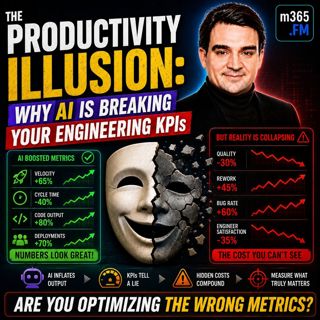
The Productivity Illusion: Why AI is Breaking Your Engineering KPIs

The Productivity Illusion: Why AI is Breaking Your Engineering KPIs

At first glance, the numbers look incredible. Deployment frequency is increasing, pull requests are being merged faster than ever, AI is generating more code, and engineering teams appear dramatically...

25 Heinä 1h 15min
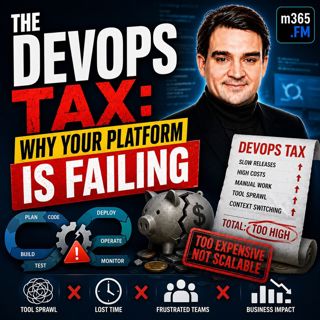
The DevOps Tax: Why Your Platform is Failing

The DevOps Tax: Why Your Platform is Failing

Welcome to another episode of Knowledge Nuggets with Mirko Peters. Today we're exploring The DevOps Tax—the hidden cost that silently reduces engineering productivity, increases cognitive overload, an...

25 Heinä 1h 18min

Suosittua kategoriassa Politiikka ja uutiset

aikalisa
uutiscast
ootsa-kuullut-tasta-2
rss-ootsa-kuullut-tasta
rss-seksicast
otetaan-yhdet
rss-vaalirankkurit-podcast
rss-podme-livebox
tervo-halme
aihe
politiikan-puskaradio
rss-girls-finish-f1rst
rikosmyytit
et-sa-noin-voi-sanoo-esittaa
rss-mina-ukkola
rss-raha-talous-ja-politiikka
rss-asiastudio
rss-varsinaista-puhetta