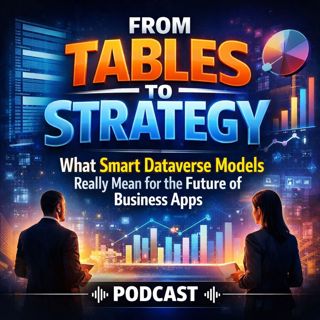
Microsoft Dataverse Architecture: Why Smart Data Models Are the Foundation of Every Scalable Business App

Microsoft Dataverse Architecture: Why Smart Data Models Are the Foundation of Every Scalable Business App

(00:00:00) The Data Verse Dilemma
(00:00:38) The Low-Code Fallacy
(00:01:56) The Model as Story
(00:04:45) Data Verse as a Semantics Engine
(00:08:02) Leadership's Role in Data Modeling
(00:12:59) The Importance of Consistent Modeling
(00:15:48) Relationships: The Backbone of Data Modeling
(00:21:00) Deployment and Governance in Data Verse
(00:32:35) The AI Imperative
(00:32:51) AI's Dependence on Clear Data Models

Most Power Platform failures begin long before a single line of code is written or a single canvas app is published. They begin at the data layer — in the moment when a team decides to treat Microsoft Dataverse as a simple table storage system rather than as the strategic data foundation it is designed to be. When Dataverse tables are created reactively, relationships are added as afterthoughts, and data models are shaped by the first app that needs them rather than by the business processes they are meant to support, the result is an application architecture that works in the short term and fails at scale. The rows multiply, the relationships become circular, the queries slow down, and the governance gaps that seemed manageable at fifty records become critical vulnerabilities at five million.

In this episode of M365.FM, Mirko Peters explores what it actually means to design Dataverse data models strategically — drawing on insights from enterprise Power Platform architecture and the kind of deep-dive thinking that separates organizations that scale their business applications successfully from those that rebuild them every eighteen months. This conversation sits above the mechanics of tables, columns, and relationships, and focuses on the architectural decisions that determine whether Dataverse becomes the business data platform an organization needs — or another layer of technical debt that limits future flexibility.

From Dataverse table design and relationship architecture to security model design, solution layering, and the integration of Dataverse with Microsoft Copilot Studio, Power Automate, and Dynamics 365, Mirko maps the strategic landscape of Dataverse architecture for organizations that are serious about building business applications that scale, govern, and perform under real enterprise conditions.

WHAT YOU WILL LEARN
  • Why Dataverse data model design is a strategic architecture decision, not a technical detail
  • How poorly designed Dataverse table relationships create application debt that compounds over time
  • What the difference is between a Dataverse model built for a single app and one built for an enterprise platform
  • How Dataverse security roles, business units, and column-level security work together to create governable data access
  • Why solution architecture and layering in Dataverse is critical for long-term maintainability and upgrade safety
  • How Dataverse integrates with Microsoft Copilot Studio, Power Automate, and Dynamics 365 as a unified data layer
  • What the performance and scalability implications of Dataverse design choices are at enterprise data volumes
  • How to evaluate an existing Dataverse environment for architectural health and identify the highest-risk design patterns
THE CORE INSIGHTDataverse is not a database. It is a business data platform — one that combines structured data storage with a native security model, a built-in API layer, an event framework, an auditing system, and deep integration with every Microsoft 365 and Power Platform service that touches it. When it is treated as a database, organizations get database problems: schema drift, query performance degradation, access control inconsistency, and integration brittleness. When it is treated as a platform and designed accordingly, Dataverse becomes the most powerful foundation available for building enterprise business applications on the Microsoft Cloud.

The strategic Dataverse data model starts with business process analysis, not app requirements. It asks: what are the entities that the business actually operates with — the accounts, the cases, the orders, the projects, the assets — and how do they relate to each other across the full scope of the organization's operations? It designs those relationships to support not just the first application but the next ten. It defines the security model before the first record is created, so that access controls are structural rather than remediated. And it establishes solution layering conventions that allow the platform to evolve without breaking existing applications every time a new requirement emerges.

Mirko argues that every organization building Power Apps, Copilot Studio agents, or Dynamics 365 customizations on Dataverse is making architectural investments — whether they know it or not. The question is whether those investments are deliberate and durable, or reactive and fragile.

WHY DATAVERSE ARCHITECTURES FAIL AT ENTERPRISE SCALE
  • Tables are created for individual app requirements without a unified entity model that reflects the broader business
  • Relationships between tables are added reactively, creating circular dependencies and query performance issues at scale
  • Security roles are configured by copying default templates rather than designed from a least-privilege access model
  • Business units are used incorrectly, creating access control structures that cannot be adapted as the organization changes
  • Solutions are not layered, meaning customizations from different teams overwrite each other without version control
  • Dataverse environments are not segmented by lifecycle stage, so development, testing, and production data intermingle
  • Copilot Studio agents are connected to Dataverse without data access governance, creating AI data exposure risks
  • Performance testing is not conducted at realistic data volumes, so architectural flaws only surface in production
KEY TAKEAWAYS
  • Dataverse is a business data platform, not a database — it must be designed as one from the beginning
  • Smart Dataverse data models start with business process analysis, not individual application requirements
  • Security architecture in Dataverse must be designed before data is created, not retrofitted after applications are built
  • Solution layering is not optional — it is the mechanism that allows Dataverse environments to scale and evolve safely
  • Every Dataverse design decision is an architectural investment that compounds positively or negatively over time
  • Organizations that treat Dataverse strategically build business applications that scale — those that do not rebuild them repeatedly
  • Copilot Studio and AI agent integration with Dataverse requires explicit data governance design, not just connectivity configuration
WHO THIS EPISODE IS FOR
  • Power Platform architects and developers designing enterprise business applications on Microsoft Dataverse
  • IT leaders responsible for Power Platform governance and Dataverse environment strategy
  • Dynamics 365 architects managing customization and data model design in Microsoft business applications
  • Copilot Studio developers building AI agents that interact with Dataverse as a data source
  • Enterprise architects evaluating Microsoft Power Platform as the foundation for line-of-business application development
  • Microsoft partners and consultants advising on Dataverse data model design, security architecture, and solution strategy
TOPICS COVERED
  • Microsoft Dataverse data model design and enterprise architecture strategy
  • Dataverse table relationships, entity modeling, and schema design for scalability
  • Dataverse security roles, business units, and column-level security architecture
  • Solution layering, ALM, and environment strategy for Microsoft Dataverse
  • Microsoft Power Apps and Power Automate integration with Dataverse as a unified data layer
  • Copilot Studio AI agent connectivity and data governance in Dataverse environments
  • Dynamics 365 and Dataverse customization architecture and upgrade safety
  • Microsoft Power Platform governance and Dataverse performance at enterprise scale
ABOUT THE HOST

Mirko Peters is a Microsoft 365 architect, strategist, and the host of M365.FM — a podcast dedicated to modern work, security, and productivity in the Microsoft ecosystem. With experience spanning small businesses to large enterprises, Mirko focuses on Microsoft 365 architecture, AI integration, governance, security, and the design of scalable, context-driven systems. M365.FM is the go-to resource for IT leaders, architects, and decision-makers navigating the Microsoft platform at scale.

Become a supporter of this podcast: https://www.spreaker.com/podcast/m365-fm-modern-work-security-and-productivity-with-microsoft-365--6704921/support.

Tämä jakso on lisätty Podme-palveluun avoimen RSS-syötteen kautta eikä se ole Podmen omaa tuotantoa. Siksi jakso saattaa sisältää mainontaa.

Jaksot(866)

From Pilot to Production: Building Enterprise AI That Actually Delivers with Leon Gordon [MVP]

From Pilot to Production: Building Enterprise AI That Actually Delivers with Leon Gordon [MVP]

Leon Gordon explains why most enterprise AI initiatives never reach production and introduces the concept of the Pilot Tax—the hidden cost organizations pay when AI projects remain stuck in proof-of-c...

28 Heinä 59min

Microsoft Purview is a Trap: The Hard Truth About Data Governance

Microsoft Purview is a Trap: The Hard Truth About Data Governance

Microsoft Purview is included with many Microsoft 365 subscriptions, making it incredibly easy to enable. That convenience is also its biggest danger. Because there is no procurement process or large ...

28 Heinä 1h 1min

From Excel Expert to Microsoft MVP: Empowering Millions with Data, Dashboards & AI with Karen Abecia [Microsoft MVP]

From Excel Expert to Microsoft MVP: Empowering Millions with Data, Dashboards & AI with Karen Abecia [Microsoft MVP]

aren Abecia shares the remarkable journey that transformed a passion for Microsoft Excel into a global career as one of the world's best-known Excel educators. She explains how discovering creative sp...

27 Heinä 59min

The Copilot Credit Trap- Why Your AI Economy is Already Broken

The Copilot Credit Trap- Why Your AI Economy is Already Broken

For decades, enterprise software followed a predictable financial model. Organizations purchased licenses, assigned them to users, and budgeted annual IT spending with confidence. AI changes that comp...

26 Heinä 1h 12min

The End of AI Bloat: Why Modern Agents Need Skills

The End of AI Bloat: Why Modern Agents Need Skills

Many AI agents start out fast, responsive, and surprisingly intelligent. But after a few months of real-world use, something changes. Response times increase, costs rise, prompts become enormous, and ...

26 Heinä 1h 13min

THE DEATH OF THE PROXY: Architecting Dataverse for the Agent Fabric

THE DEATH OF THE PROXY: Architecting Dataverse for the Agent Fabric

For years, Microsoft's recommended architecture for connecting AI assistants like Claude Desktop to Dataverse relied on a local STDIO proxy. It was simple, easy to install, and perfectly suited for in...

26 Heinä 59min
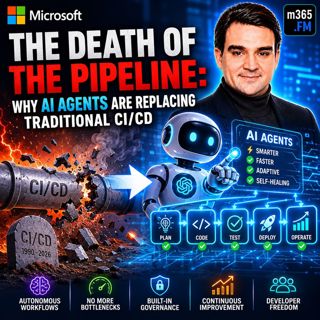
The Death of the Pipeline: Why AI Agents are Replacing Traditional

The Death of the Pipeline: Why AI Agents are Replacing Traditional

For more than two decades, CI/CD pipelines have been the backbone of modern software delivery. Developers commit code, automated builds run, tests execute, security scans complete, someone approves th...

25 Heinä 1h 9min
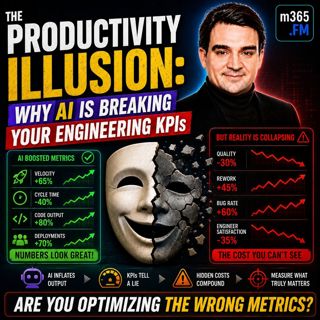
The Productivity Illusion: Why AI is Breaking Your Engineering KPIs

The Productivity Illusion: Why AI is Breaking Your Engineering KPIs

At first glance, the numbers look incredible. Deployment frequency is increasing, pull requests are being merged faster than ever, AI is generating more code, and engineering teams appear dramatically...

25 Heinä 1h 15min

Suosittua kategoriassa Politiikka ja uutiset

aikalisa
uutiscast
ootsa-kuullut-tasta-2
rss-ootsa-kuullut-tasta
rss-seksicast
otetaan-yhdet
rss-vaalirankkurit-podcast
rss-podme-livebox
tervo-halme
aihe
politiikan-puskaradio
rss-girls-finish-f1rst
rikosmyytit
et-sa-noin-voi-sanoo-esittaa
rss-mina-ukkola
rss-raha-talous-ja-politiikka
rss-asiastudio
rss-varsinaista-puhetta