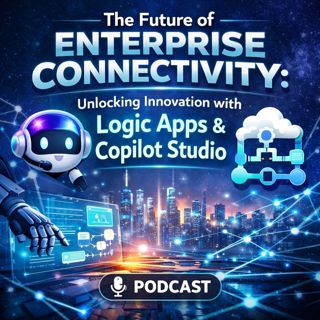
Microsoft Azure Logic Apps & Copilot Studio: How to Build the Future of Enterprise Connectivity

Microsoft Azure Logic Apps & Copilot Studio: How to Build the Future of Enterprise Connectivity

Enterprise connectivity has always been one of the most underestimated disciplines in IT architecture. The ability to reliably move data, trigger workflows, synchronize systems, and orchestrate processes across organizational boundaries is what determines whether digital transformation delivers on its promises — or simply creates a more complicated version of the same fragmented infrastructure. For decades, integration was treated as plumbing: unglamorous, expensive, and perpetually underfunded. That era is ending. With Microsoft Azure Logic Apps, Copilot Studio, the Model Context Protocol, and AI-driven orchestration, enterprise connectivity is being reimagined as a strategic capability — one that determines how fast an organization can move, how intelligently it can respond, and how effectively it can scale.

In this episode of M365.FM, Mirko Peters explores the future of enterprise connectivity through the lens of the Microsoft ecosystem — examining how Azure Logic Apps, Microsoft Copilot Studio, Power Automate, and Azure API Management are converging into a unified integration architecture that is more capable, more governable, and more intelligent than anything the integration middleware market has previously offered. From connecting Microsoft 365 and Dynamics 365 to bridging SAP, Salesforce, and legacy on-premises systems, Mirko maps the architectural patterns that define the next generation of enterprise connectivity on the Microsoft Cloud.

This is not a product walkthrough. It is a strategic architecture conversation for IT leaders, integration architects, and enterprise developers who need to understand how connectivity is being redefined in the AI era — and what that means for the Microsoft 365 and Azure investments their organizations are making today.

WHAT YOU WILL LEARN
  • Why enterprise connectivity is being redefined as a strategic capability in the Microsoft AI era
  • How Azure Logic Apps and Power Automate work together to cover both enterprise-grade and citizen-built integration scenarios
  • What Microsoft Copilot Studio adds to enterprise connectivity when deployed as an AI-driven orchestration layer
  • How the Model Context Protocol changes the way AI agents connect to enterprise data and systems
  • Why Azure API Management is the governance layer that makes scalable Microsoft integration architecture possible
  • How to design a connectivity architecture that bridges Microsoft 365, Azure, Dynamics 365, and non-Microsoft systems
  • What the integration patterns look like for connecting Microsoft environments to SAP, Salesforce, and legacy on-premises infrastructure
  • How AI-driven connectivity reduces manual integration maintenance and improves system resilience over time
THE CORE INSIGHTThe fundamental problem with enterprise connectivity has never been a shortage of tools. It has been a shortage of architectural coherence. Organizations build point-to-point integrations because they are fast to deploy. They use different tools for different teams — Power Automate for business users, custom Azure Functions for developers, Logic Apps for IT teams — without a unified governance model that makes the full integration estate visible, manageable, and secure.

Microsoft is addressing this with a converging architecture that positions Azure Logic Apps as the enterprise integration backbone, Power Automate as the citizen integration layer, Copilot Studio as the AI orchestration interface, and Azure API Management as the governance and security surface that unifies them all. When this architecture is designed deliberately, it produces an integration estate that scales with the organization, adapts to new systems without requiring custom code for every connection, and provides the audit trail and governance visibility that compliance and security teams require.

Mirko argues that the organizations that will unlock the full innovation potential of this architecture are those that stop treating integration as a project-by-project concern and start treating it as a platform capability — one that is owned, governed, and continuously improved with the same discipline applied to any other critical enterprise infrastructure.

WHY ENTERPRISE CONNECTIVITY FAILS IN MICROSOFT ENVIRONMENTS
  • Point-to-point integrations are built for speed but create unmaintainable technical debt at scale
  • Power Automate and Logic Apps are used in parallel without a governance model that defines which tool applies to which scenario
  • Azure API Management is deployed but not configured as the central governance surface for all enterprise connections
  • Copilot Studio agents are built without connectivity to the enterprise data sources that would make them genuinely useful
  • Integration estates grow without documentation, making it impossible to assess the impact of changes to connected systems
  • Security and access controls are applied inconsistently across integration layers, creating gaps that Entra ID governance cannot close
  • There is no enterprise integration architecture owner — connectivity decisions are made locally by individual teams with no system-wide view
KEY TAKEAWAYS
  • Enterprise connectivity in the Microsoft ecosystem is converging around Logic Apps, Power Automate, Copilot Studio, and Azure API Management as complementary layers
  • Azure Logic Apps is the enterprise-grade backbone for high-volume, high-reliability integration scenarios in Microsoft environments
  • Copilot Studio transforms connectivity from a plumbing concern into an AI-driven orchestration capability
  • Azure API Management must be the governance surface for all enterprise API connections — not just a developer tool
  • The Model Context Protocol provides the standard interface that AI agents need to connect to enterprise systems without custom integration code
  • Organizations that treat connectivity as a platform capability rather than a project concern will build faster, more resilient Microsoft environments
  • Integration architecture ownership is a strategic requirement — without it, Microsoft connectivity investments produce fragmentation, not leverage
WHO THIS EPISODE IS FOR
  • Enterprise architects and integration specialists designing Microsoft 365 and Azure connectivity strategies
  • IT leaders responsible for application integration, API management, and workflow orchestration
  • Copilot Studio and Power Platform developers building AI-driven connected workflows
  • CIOs and CTOs evaluating enterprise integration platform consolidation on Microsoft Azure
  • Microsoft partners and consultants advising on Logic Apps, API Management, and Copilot Studio architecture
  • Security and governance teams responsible for Microsoft integration estate oversight and compliance
TOPICS COVERED
  • Microsoft Azure Logic Apps enterprise integration architecture and design patterns
  • Microsoft Power Automate and Logic Apps governance boundary and use case definition
  • Microsoft Copilot Studio as an AI orchestration layer for enterprise connectivity
  • Azure API Management governance, security, and enterprise API strategy
  • Model Context Protocol (MCP) and AI agent connectivity in Microsoft environments
  • Microsoft 365 and Dynamics 365 integration architecture and cross-system workflows
  • SAP, Salesforce, and legacy system connectivity in Microsoft Azure environments
  • Enterprise integration platform strategy and architecture ownership in Microsoft 365 organizations
ABOUT THE HOST

Mirko Peters is a Microsoft 365 architect, strategist, and the host of M365.FM — a podcast dedicated to modern work, security, and productivity in the Microsoft ecosystem. With experience spanning small businesses to large enterprises, Mirko focuses on Microsoft 365 architecture, AI integration, governance, security, and the design of scalable, context-driven systems. M365.FM is the go-to resource for IT leaders, architects, and decision-makers navigating the Microsoft platform at scale.


Become a supporter of this podcast: https://www.spreaker.com/podcast/m365-fm-modern-work-security-and-productivity-with-microsoft-365--6704921/support.

Tämä jakso on lisätty Podme-palveluun avoimen RSS-syötteen kautta eikä se ole Podmen omaa tuotantoa. Siksi jakso saattaa sisältää mainontaa.

Jaksot(866)

From Pilot to Production: Building Enterprise AI That Actually Delivers with Leon Gordon [MVP]

From Pilot to Production: Building Enterprise AI That Actually Delivers with Leon Gordon [MVP]

Leon Gordon explains why most enterprise AI initiatives never reach production and introduces the concept of the Pilot Tax—the hidden cost organizations pay when AI projects remain stuck in proof-of-c...

28 Heinä 59min

Microsoft Purview is a Trap: The Hard Truth About Data Governance

Microsoft Purview is a Trap: The Hard Truth About Data Governance

Microsoft Purview is included with many Microsoft 365 subscriptions, making it incredibly easy to enable. That convenience is also its biggest danger. Because there is no procurement process or large ...

28 Heinä 1h 1min

From Excel Expert to Microsoft MVP: Empowering Millions with Data, Dashboards & AI with Karen Abecia [Microsoft MVP]

From Excel Expert to Microsoft MVP: Empowering Millions with Data, Dashboards & AI with Karen Abecia [Microsoft MVP]

aren Abecia shares the remarkable journey that transformed a passion for Microsoft Excel into a global career as one of the world's best-known Excel educators. She explains how discovering creative sp...

27 Heinä 59min

The Copilot Credit Trap- Why Your AI Economy is Already Broken

The Copilot Credit Trap- Why Your AI Economy is Already Broken

For decades, enterprise software followed a predictable financial model. Organizations purchased licenses, assigned them to users, and budgeted annual IT spending with confidence. AI changes that comp...

26 Heinä 1h 12min
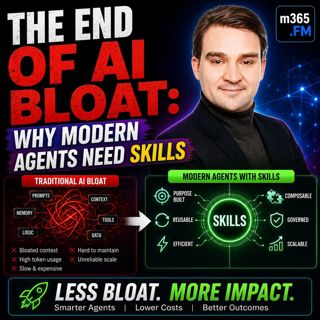
The End of AI Bloat: Why Modern Agents Need Skills

The End of AI Bloat: Why Modern Agents Need Skills

Many AI agents start out fast, responsive, and surprisingly intelligent. But after a few months of real-world use, something changes. Response times increase, costs rise, prompts become enormous, and ...

26 Heinä 1h 13min

THE DEATH OF THE PROXY: Architecting Dataverse for the Agent Fabric

THE DEATH OF THE PROXY: Architecting Dataverse for the Agent Fabric

For years, Microsoft's recommended architecture for connecting AI assistants like Claude Desktop to Dataverse relied on a local STDIO proxy. It was simple, easy to install, and perfectly suited for in...

26 Heinä 59min
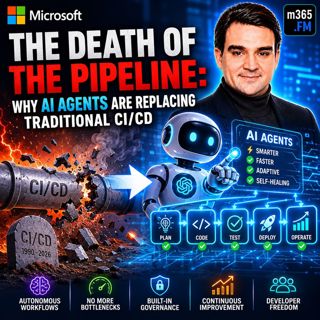
The Death of the Pipeline: Why AI Agents are Replacing Traditional

The Death of the Pipeline: Why AI Agents are Replacing Traditional

For more than two decades, CI/CD pipelines have been the backbone of modern software delivery. Developers commit code, automated builds run, tests execute, security scans complete, someone approves th...

25 Heinä 1h 9min
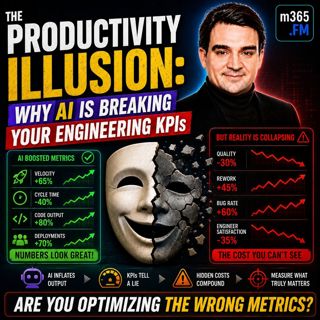
The Productivity Illusion: Why AI is Breaking Your Engineering KPIs

The Productivity Illusion: Why AI is Breaking Your Engineering KPIs

At first glance, the numbers look incredible. Deployment frequency is increasing, pull requests are being merged faster than ever, AI is generating more code, and engineering teams appear dramatically...

25 Heinä 1h 15min

Suosittua kategoriassa Politiikka ja uutiset

aikalisa
uutiscast
ootsa-kuullut-tasta-2
rss-ootsa-kuullut-tasta
rss-seksicast
otetaan-yhdet
rss-vaalirankkurit-podcast
rss-podme-livebox
tervo-halme
aihe
politiikan-puskaradio
rss-girls-finish-f1rst
rikosmyytit
et-sa-noin-voi-sanoo-esittaa
rss-mina-ukkola
rss-raha-talous-ja-politiikka
rss-asiastudio
rss-varsinaista-puhetta