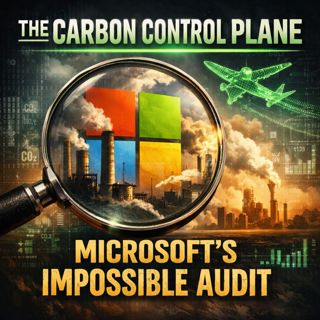
Microsoft Sustainability & Carbon Governance: Why Auditing Microsoft's Carbon Footprint Is an Impossible Challenge

Microsoft Sustainability & Carbon Governance: Why Auditing Microsoft's Carbon Footprint Is an Impossible Challenge

Microsoft has made one of the boldest sustainability commitments in corporate history — to be carbon negative by 2030 and to remove all historical carbon emissions by 2050. But as Microsoft's cloud infrastructure expands, as Azure data centers multiply to meet the surging demand for AI compute, and as Copilot workloads consume enormous amounts of power, a fundamental tension has emerged: the faster Microsoft grows, the harder the carbon audit becomes. And what is true for Microsoft is equally true for every organization running its enterprise on the Microsoft 365 and Azure ecosystem.

In this episode of M365.FM, Mirko Peters examines what it actually means to audit, govern, and report on carbon in a Microsoft enterprise environment. From the Microsoft Emissions Impact Dashboard and Azure carbon data to the governance of AI workloads in Microsoft Fabric and Copilot Studio, Mirko maps the landscape of sustainability accountability in the Microsoft ecosystem — and why it is far more complex than most organizations assume.

This episode is essential for sustainability leaders, IT architects, and compliance teams who are responsible for ESG reporting within Microsoft 365 environments — and who are discovering that the data exists, but the governance architecture to act on it often does not.

WHAT YOU WILL LEARN
  • Why carbon auditing in the Microsoft ecosystem is structurally more complex than traditional ESG reporting
  • How Microsoft's Emissions Impact Dashboard works and what its limitations are
  • What Azure carbon data actually measures — and what it misses
  • How AI workloads in Microsoft 365, Copilot, and Azure Fabric contribute to organizational carbon footprint
  • Why Microsoft's own carbon negative commitment creates governance challenges for enterprise customers
  • How to build a carbon governance architecture on top of Microsoft tools
  • What the future of sustainability compliance looks like for Microsoft enterprise customers
THE CORE INSIGHTThe carbon control plane is not a single dashboard or a single policy. It is the full architecture of how an organization measures, governs, reports, and reduces its emissions across every system it operates — including its cloud infrastructure. In the Microsoft ecosystem, that means accounting for Azure compute, Microsoft 365 workloads, Copilot AI inference, Power Platform automation runs, and every data movement across Microsoft Fabric and OneLake.

Mirko argues that the impossible audit is not impossible because the data does not exist — it is impossible because the governance architecture to collect, normalize, and act on that data has not been designed. Organizations that want to be genuinely carbon accountable in their Microsoft environments need to treat sustainability as an architectural discipline, not an annual reporting exercise. That means designing carbon governance into provisioning workflows, embedding emissions data into FinOps processes, and treating Copilot and AI workload growth as a sustainability risk to be managed alongside its business value.

WHY MICROSOFT CARBON AUDITING FAILS IN PRACTICE
  • The Microsoft Emissions Impact Dashboard provides estimates, not precise per-workload measurements
  • AI inference workloads from Copilot and Azure OpenAI are among the most energy-intensive but least visible in carbon reports
  • There is no native integration between Microsoft carbon data and enterprise ESG reporting platforms
  • Organizations treat ESG reporting as a compliance exercise rather than a governance discipline
  • Carbon data is collected annually for reports but not used to inform real-time infrastructure decisions
  • Microsoft Fabric, OneLake, and cross-region data replication create carbon footprint complexity that most teams cannot measure
  • FinOps and sustainability governance remain separate disciplines when they need to converge
KEY TAKEAWAYS
  • Carbon auditing in the Microsoft ecosystem requires architectural design, not just dashboard access
  • Microsoft's Emissions Impact Dashboard is a starting point, not a complete governance solution
  • AI workloads — especially Copilot and Azure OpenAI — must be included in organizational carbon accounting
  • Sustainability governance and FinOps must be integrated in Microsoft 365 and Azure environments
  • The organizations that will meet 2030 sustainability targets are those that treat carbon as a system design constraint today
  • Microsoft's carbon negative commitment creates both a model and a challenge for enterprise customers
WHO THIS EPISODE IS FOR
  • Sustainability and ESG leaders responsible for Microsoft 365 and Azure carbon reporting
  • Microsoft 365 architects designing governance frameworks that include sustainability accountability
  • FinOps professionals integrating carbon data into Microsoft Azure cost management
  • Compliance and risk teams navigating EU and global ESG reporting requirements
  • IT leaders evaluating the sustainability impact of Copilot and AI workload expansion
  • Microsoft partners and consultants advising on sustainable cloud architecture
TOPICS COVERED
  • Microsoft sustainability commitments and carbon negative strategy
  • Microsoft Emissions Impact Dashboard and Azure carbon data
  • Carbon governance architecture in Microsoft 365 and Azure environments
  • AI workload carbon footprint — Microsoft Copilot and Azure OpenAI
  • Microsoft Fabric, OneLake, and data replication sustainability impact
  • ESG reporting and compliance for Microsoft enterprise customers
  • FinOps and sustainability governance integration in Microsoft 365
  • Sustainable cloud architecture and carbon control plane design
ABOUT THE HOST

Mirko Peters is a Microsoft 365 architect, strategist, and the host of M365.FM — a podcast dedicated to modern work, security, and productivity in the Microsoft ecosystem. With experience spanning small businesses to large enterprises, Mirko focuses on Microsoft 365 architecture, AI integration, governance, security, and the design of scalable, context-driven systems. M365.FM is the go-to resource for IT leaders, architects, and decision-makers navigating the Microsoft platform at scale.

Become a supporter of this podcast: https://www.spreaker.com/podcast/m365-fm-modern-work-security-and-productivity-with-microsoft-365--6704921/support.

Tämä jakso on lisätty Podme-palveluun avoimen RSS-syötteen kautta eikä se ole Podmen omaa tuotantoa. Siksi jakso saattaa sisältää mainontaa.

Jaksot(868)

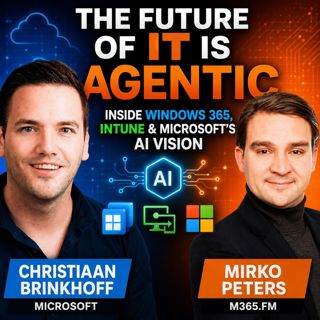
The Future of IT Is Agentic: Inside Windows 365, Intune & Microsoft's AI Vision with Christiaan Brinkhoff

The Future of IT Is Agentic: Inside Windows 365, Intune & Microsoft's AI Vision with Christiaan Brinkhoff

Christiaan Brinkhoff shares the remarkable career path that took him from speaking at community events and writing technical blogs to becoming one of the key people behind Microsoft's modern cloud des...

29 Heinä 1h 29min
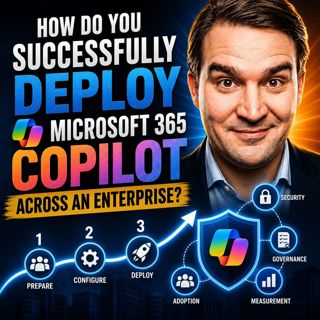
How Do You Successfully Deploy Microsoft 365 Copilot Across an Enterprise?

How Do You Successfully Deploy Microsoft 365 Copilot Across an Enterprise?

A successful Microsoft 365 Copilot deployment begins long before licenses are assigned. Organizations should first define measurable business outcomes, identify high-value use cases, and secure execut...

29 Heinä 1h 32min

From Pilot to Production: Building Enterprise AI That Actually Delivers with Leon Gordon [MVP]

From Pilot to Production: Building Enterprise AI That Actually Delivers with Leon Gordon [MVP]

Leon Gordon explains why most enterprise AI initiatives never reach production and introduces the concept of the Pilot Tax—the hidden cost organizations pay when AI projects remain stuck in proof-of-c...

28 Heinä 59min

Microsoft Purview is a Trap: The Hard Truth About Data Governance

Microsoft Purview is a Trap: The Hard Truth About Data Governance

Microsoft Purview is included with many Microsoft 365 subscriptions, making it incredibly easy to enable. That convenience is also its biggest danger. Because there is no procurement process or large ...

28 Heinä 1h 1min

From Excel Expert to Microsoft MVP: Empowering Millions with Data, Dashboards & AI with Karen Abecia [Microsoft MVP]

From Excel Expert to Microsoft MVP: Empowering Millions with Data, Dashboards & AI with Karen Abecia [Microsoft MVP]

aren Abecia shares the remarkable journey that transformed a passion for Microsoft Excel into a global career as one of the world's best-known Excel educators. She explains how discovering creative sp...

27 Heinä 59min
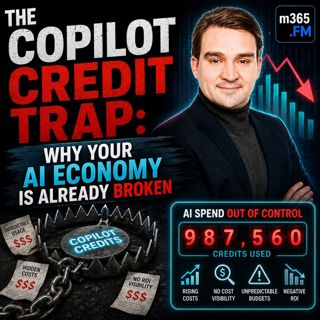
The Copilot Credit Trap- Why Your AI Economy is Already Broken

The Copilot Credit Trap- Why Your AI Economy is Already Broken

For decades, enterprise software followed a predictable financial model. Organizations purchased licenses, assigned them to users, and budgeted annual IT spending with confidence. AI changes that comp...

26 Heinä 1h 12min
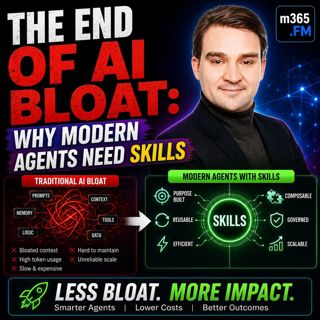
The End of AI Bloat: Why Modern Agents Need Skills

The End of AI Bloat: Why Modern Agents Need Skills

Many AI agents start out fast, responsive, and surprisingly intelligent. But after a few months of real-world use, something changes. Response times increase, costs rise, prompts become enormous, and ...

26 Heinä 1h 13min
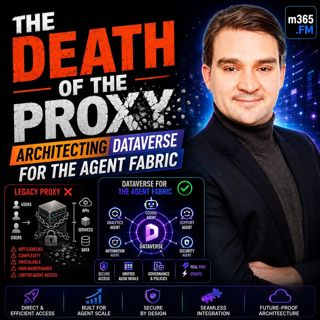
THE DEATH OF THE PROXY: Architecting Dataverse for the Agent Fabric

THE DEATH OF THE PROXY: Architecting Dataverse for the Agent Fabric

For years, Microsoft's recommended architecture for connecting AI assistants like Claude Desktop to Dataverse relied on a local STDIO proxy. It was simple, easy to install, and perfectly suited for in...

26 Heinä 59min
Suosittua kategoriassa Politiikka ja uutiset

aikalisa
rss-ootsa-kuullut-tasta
ootsa-kuullut-tasta-2
uutiscast
otetaan-yhdet
rss-vaalirankkurit-podcast
rss-seksicast
rss-podme-livebox
tervo-halme
aihe
politiikan-puskaradio
rss-girls-finish-f1rst
et-sa-noin-voi-sanoo-esittaa
linda-maria
rikosmyytit
rss-mina-ukkola
rss-raha-talous-ja-politiikka
rss-asiastudio