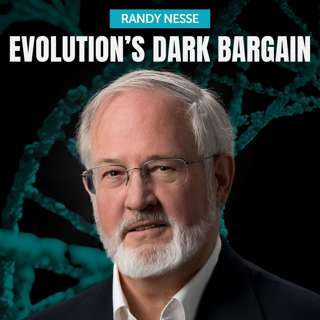
#179 Classic episode – Randy Nesse on why evolution left us so vulnerable to depression and anxiety

#179 Classic episode – Randy Nesse on why evolution left us so vulnerable to depression and anxiety

Mental health problems like depression and anxiety affect enormous numbers of people and severely interfere with their lives. By contrast, we don’t see similar levels of physical ill health in young people. At any point in time, something like 20% of young people are working through anxiety or depression that’s seriously interfering with their lives — but nowhere near 20% of people in their 20s have severe heart disease or cancer or a similar failure in a key organ of the body other than the brain.

From an evolutionary perspective, that’s to be expected, right? If your heart or lungs or legs or skin stop working properly while you’re a teenager, you’re less likely to reproduce, and the genes that cause that malfunction get weeded out of the gene pool.

So why is it that these evolutionary selective pressures seemingly fixed our bodies so that they work pretty smoothly for young people most of the time, but it feels like evolution fell asleep on the job when it comes to the brain? Why did evolution never get around to patching the most basic problems, like social anxiety, panic attacks, debilitating pessimism, or inappropriate mood swings? For that matter, why did evolution go out of its way to give us the capacity for low mood or chronic anxiety or extreme mood swings at all?

Today’s guest, Randy Nesse — a leader in the field of evolutionary psychiatry — wrote the book Good Reasons for Bad Feelings, in which he sets out to try to resolve this paradox.

Rebroadcast: This episode originally aired in February 2024.

Links to learn more, video, and full transcript: https://80k.info/rn

In the interview, host Rob Wiblin and Randy discuss the key points of the book, as well as:

  • How the evolutionary psychiatry perspective can help people appreciate that their mental health problems are often the result of a useful and important system.
  • How evolutionary pressures and dynamics lead to a wide range of different personalities, behaviours, strategies, and tradeoffs.
  • The missing intellectual foundations of psychiatry, and how an evolutionary lens could revolutionise the field.
  • How working as both an academic and a practicing psychiatrist shaped Randy’s understanding of treating mental health problems.
  • The “smoke detector principle” of why we experience so many false alarms along with true threats.
  • The origins of morality and capacity for genuine love, and why Randy thinks it’s a mistake to try to explain these from a selfish gene perspective.
  • Evolutionary theories on why we age and die.
  • And much more.

Chapters:

  • Cold Open (00:00:00)
  • Rob's Intro (00:00:55)
  • The interview begins (00:03:01)
  • The history of evolutionary medicine (00:03:56)
  • The evolutionary origin of anxiety (00:12:37)
  • Design tradeoffs, diseases, and adaptations (00:43:19)
  • The tricker case of depression (00:48:57)
  • The purpose of low mood (00:54:08)
  • Big mood swings vs barely any mood swings (01:22:41)
  • Is mental health actually getting worse? (01:33:43)
  • A general explanation for bodies breaking (01:37:27)
  • Freudianism and the origins of morality and love (01:48:53)
  • Evolutionary medicine in general (02:02:42)
  • Objections to evolutionary psychology (02:16:29)
  • How do you test evolutionary hypotheses to rule out the bad explanations? (02:23:19)
  • Striving and meaning in careers (02:25:12)
  • Why do people age and die? (02:45:16)

Producer and editor: Keiran Harris
Audio Engineering Lead: Ben Cordell
Technical editing: Dominic Armstrong
Transcriptions: Katy Moore

Jaksot(318)

#208 – Elizabeth Cox on the case that TV shows, movies, and novels can improve the world

#208 – Elizabeth Cox on the case that TV shows, movies, and novels can improve the world

"I think stories are the way we shift the Overton window — so widen the range of things that are acceptable for policy and palatable to the public. Almost by definition, a lot of things that are going...

21 Marras 20242h 22min

#207 – Sarah Eustis-Guthrie on why she shut down her charity, and why more founders should follow her lead

#207 – Sarah Eustis-Guthrie on why she shut down her charity, and why more founders should follow her lead

"I think one of the reasons I took [shutting down my charity] so hard is because entrepreneurship is all about this bets-based mindset. So you say, “I’m going to take a bunch of bets. I’m going to tak...

14 Marras 20242h 58min

Parenting insights from Rob and 8 past guests

Parenting insights from Rob and 8 past guests

With kids very much on the team's mind we thought it would be fun to review some comments about parenting featured on the show over the years, then have hosts Luisa Rodriguez and Rob Wiblin react to t...

8 Marras 20241h 35min

#206 – Anil Seth on the predictive brain and how to study consciousness

#206 – Anil Seth on the predictive brain and how to study consciousness

"In that famous example of the dress, half of the people in the world saw [blue and black], half saw [white and gold]. It turns out there’s individual differences in how brains take into account ambie...

1 Marras 20242h 33min

How much does a vote matter? (Article)

How much does a vote matter? (Article)

If you care about social impact, is voting important? In this piece, Rob investigates the two key things that determine the impact of your vote:The chances of your vote changing an election’s outcome....

28 Loka 202432min

#205 – Sébastien Moro on the most insane things fish can do

#205 – Sébastien Moro on the most insane things fish can do

"You have a tank split in two parts: if the fish gets in the compartment with a red circle, it will receive food, and food will be delivered in the other tank as well. If the fish takes the blue trian...

23 Loka 20243h 11min

#204 – Nate Silver on making sense of SBF, and his biggest critiques of effective altruism

#204 – Nate Silver on making sense of SBF, and his biggest critiques of effective altruism

Rob Wiblin speaks with FiveThirtyEight election forecaster and author Nate Silver about his new book: On the Edge: The Art of Risking Everything.Links to learn more, highlights, video, and full transc...

16 Loka 20241h 57min

#203 – Peter Godfrey-Smith on interfering with wild nature, accepting death, and the origin of complex civilisation

#203 – Peter Godfrey-Smith on interfering with wild nature, accepting death, and the origin of complex civilisation

"In the human case, it would be mistaken to give a kind of hour-by-hour accounting. You know, 'I had +4 level of experience for this hour, then I had -2 for the next hour, and then I had -1' — and you...

3 Loka 20241h 25min

Suosittua kategoriassa Koulutus

rss-murhan-anatomia
psykopodiaa-podcast
voi-hyvin-meditaatiot-2
rss-niinku-asia-on
kesken
rss-liian-kuuma-peruna
rss-narsisti
adhd-podi
psykologia
rss-duodecim-lehti
ihminen-tavattavissa-tommy-hellsten-instituutti
rss-psykalab
aamukahvilla
aloita-meditaatio
rss-honest-talk-with-laurrenna
rss-luonnollinen-synnytys-podcast
rss-tietoinen-yhteys-podcast-2
rahapuhetta
puhutaan-koiraa
rss-elamankoulu