Chuck GPT: Astrotech

Chuck GPT: Astrotech

How can a helicopter fly in space? How does LIGO detect gravitational waves? How do quantum electronic devices like Josephson junctions work? Could AI turn evil and destroy humanity? What about those grabby aliens? In this episode of Chuck GPT, Dr. Charles Liu and co-host Allen Liu answer audience questions about the technology of astronomy, astrophysics, and the future.

To read those questions, we welcome back our executive producer Leslie Mullen, community director Stacey Severn, and intern Eleanor Adams.

As always, though, we start off with the day’s joyfully cool cosmic thing: the ESA’s new Deep Space Antenna in Australia. This fourth antenna in ESA’s network will be used to manage communications for their slate of upcoming missions.

For our first audience question, Anna asks, “How is it possible that a helicopter can work in space? I heard that NASA launched a helicopter to Mars and is going to send one to Saturn in a few years.”

Leslie, who worked at JPL, talks about the Perseverance Rover and its helicopter, Ingenuity. She explains that they’re not actually flying in space, but in the atmospheres of a planet or a moon. Even so, the thin atmosphere of Mars (less than 1% of Earth’s) created unique problems that don’t exist on Earth. Leslie got to interview the inventor of Ingenuity, Bob Balaram, in her JPL podcast episode, “Flying with Ingenuity.” She describes how JPL tested the helicopter here on Earth, and what it was like the moment Ingenuity actually took flight.

The team discusses Dragonfly, the helicopter that will be flying on Saturn’s moon Titan, and how Titan’s thick methane atmosphere creates an entirely different set of engineering problems than Ingenuity faced on Mars.

Stacey reads our next question, from Joe: “Gravitational wave detectors like LIGO are said to detect changes in the length of space by less than the width of a proton. But how is that possible, if all the atoms that make up LIGO are so much bigger than protons?” Chuck explains interferometry (the I in LIGO!) and Allen offers a great analogy using a ruler.

Eleanor reads a question from TikTok, which Esmeregildo asked in response to our video about Josephson Junctions and the Nobel Prize in Physics: “What is the purpose of the insulating barrier?” Chuck’s answer takes us down a quantum tunneling rabbit hole, filled with superconductors, insulators, and quantum computing.

Diane asks: “Professor, you say that astronomers have used AI for a long time so you're not afraid of AI. But AI isn't being used by just scientists anymore, and corporations are using AI to make money now rather than to make scientific advances. So should we be afraid of AI today? Could AI turn evil soon and destroy humanity?” Allen, co-author of a soon-to-be published book about AI, offers a mostly hopeful answer, although Chuck compares AI to nuclear power and Leslie brings up real world problems AI is already creating.

Our last question from our audience is, “Hi Dr. Liu, I heard you talking about grabby aliens recently. Could you explain the concept a little more? For example, would humans be grabby aliens if we explore space and colonize Mars and we find there's life there? Would we have to destroy grabby aliens right away if we find them, or would we have to hide from them?” It’s the perfect way to end this edition of Chuck GPT!

We hope you enjoy this episode of The LIUniverse, and, if you do, please support us on Patreon.

Image Credits:

  • ESA’s first and fourth Deep Space Antennas. Credit: European Space Agency
  • Map showing locations of ESA tracking (Estrack) stations as of 2017. Credit: European Space Agency
  • Video of Perseverance landing on Mars. Credit: NASA/JPL-Caltech
  • Ingenuity on the surface of Mars. Credit: NASA/JPL-Caltech
  • Anatomy of the Mars helicopter Ingenuity. Credit: NASA/JPL-Caltech
  • Ingenuity’s Test Chamber. Credit: NASA/JPL-Caltech
  • Ingenuity in the Test Chamber. Credit: NASA/JPL-Caltech
  • Video of Ingenuity altimeter data and the first flight as seen from Perseverance. Credit: NASA/JPL-Caltech
  • Dragonfly space probe concept art. Credit: NASA/Johns Hopkins-APL
  • Titan’s thick methane atmosphere gives it a fuzzy yellow look. Credit: NASA/JPL-Caltech/Space Science Institute
  • Tuned Mass Damper used to stabilize buildings during earthquakes. Credit: CC
  • Josephson Junction. Credit: Public Domain
  • Josephson junction array chip developed by the National Institute of Standards & Technology. Credit: Public Domain

CHAPTERS

03:08 - Joyfully Cool Cosmic Thing of the Day –New ESA Deep Space Antenna

07:36 - How Can the Ingenuity Helicopter Fly on Mars?

16:26 - How Can the Dragonfly Helicopter Fly on Saturn’s Moon Titan?

19:44 - How does LIGO detect gravitational waves?

26:01 - Josephson Junctions, Quantum Tunneling, and Superconductors Explained

36:00 - Could AI Turn Evil Soon and Destroy Humanity?

44:48 - Would Humans Be Grabby Aliens if We Explore Space and Colonize Mars?

#LIUniverse #SciencePodcast #AstronomyPodcast #LIGO #ArtificialIntelligence

Tämä jakso on lisätty Podme-palveluun avoimen RSS-syötteen kautta eikä se ole Podmen omaa tuotantoa. Siksi jakso saattaa sisältää mainontaa.

Jaksot(78)

ChuckGPT - Patreon Question Edition

ChuckGPT - Patreon Question Edition

It’s time for the Season 5 finale of The LIUniverse, which means another episode of ChuckGPT where we answer our audience’s most vexing questions – this time via video from our Patreon Patrons. And to...

13 Kesä 38min
Our Weird, Wondrous Universe with Erika Hamden

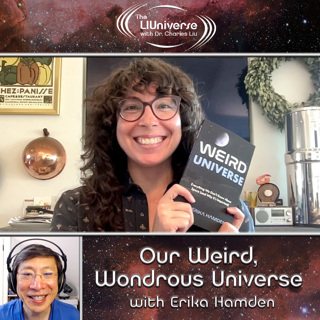
Our Weird, Wondrous Universe with Erika Hamden

How do distant galaxies form? If you have two distant clouds of hydrogen, why does one turn into a star and another doesn’t? To find out, Dr. Charles Liu and co-host Allen Liu welcome Dr. Erika Hamden...

30 Touko 43min
Ruby Raindrops and Painted Peacocks with Munazza Alam

Ruby Raindrops and Painted Peacocks with Munazza Alam

Are there really exoplanets with where it rains ruby and emerald raindrops? How do we measure the atmospheres of exoplanets light years away? To find out, Dr. Charles Liu and co-host Allen Liu welcome...

16 Touko 45min
Astrophotography with Astronaut Don Pettit

Astrophotography with Astronaut Don Pettit

Can the physics you learned in High School take you to the stars? Who is behind many of your favorite pictures of space? What is it actually like to live and work in space? You might be surprised to k...

2 Touko 47min
Finding the “Bubbles” Exoplanet and Crocheting Dinosaurs with Victoria DiTomasso

Finding the “Bubbles” Exoplanet and Crocheting Dinosaurs with Victoria DiTomasso

How do we find exoplanets? What is the Milky Way’s “Thick Disk” and what makes it so special? To find out, Dr. Charles Liu and co-host Allen Liu welcome Harvard astronomer Dr. Victoria DiTomasso, who ...

11 Huhti 47min
Supernovas and Space Gold with Dr. Ashley Villar

Supernovas and Space Gold with Dr. Ashley Villar

How do stars die? And what happens when they do? To find out, Dr. Charles Liu and co-host Allen Liu welcome Dr. Ashley Villar, who teaches astronomy at Harvard and whose team studies supernovas as the...

21 Maalis 40min
Building Worlds with Luke Skywatcher

Building Worlds with Luke Skywatcher

How do planetary systems form? If you wanted to observe them, where would you look and what would you look for? To find out, Dr. Charles Liu and co-host Allen Liu welcome Luke Keller, professor of Ast...

8 Maalis 43min

Suosittua kategoriassa Tiede

rss-poliisin-mieli
tiedekulma-podcast
rss-mita-tulisi-tietaa
docemilia
rss-hereilla
rss-bios-podcast
utelias-mieli
hippokrateen-vastaanotolla
rss-metsanomistaja-podcast
rss-lapsuuden-rakentajat-podcast
rss-sosiopodi
filocast-filosofian-perusteet
rss-tiedetta-vai-tarinaa
rss-duodecim-lehti
radio-antro
rss-totuuden-liepeilla