
Evolution "Doesn't Need" Mutation - Blaise Agüera y Arcas

Evolution "Doesn't Need" Mutation - Blaise Agüera y Arcas

What if life itself is just a really sophisticated computer program that wrote itself into existence?


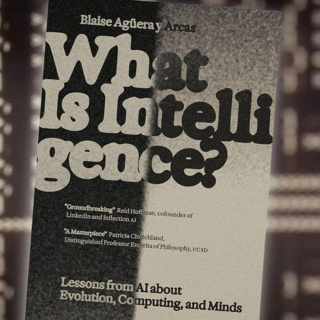
Blaise Agüera y Arcas presenting at ALife 2025 — the most technically detailed public walkthrough of the ideas in his *What is Life?* and *What is Intelligence?* books that we've come across.He covers the BFF experiments (self-replicating programs emerging spontaneously from random noise), the mathematical framework connecting Lotka-Volterra population dynamics with Smoluchowski coagulation, eigenvalue analysis of cooperation matrices, and his central claim that symbiogenesis — not mutation — is the primary engine of evolutionary novelty.The experimental results are genuinely striking: complex self-replicating code arising from random byte strings with zero mutation, a sharp phase transition that looks like gelation, and a proof that blocking deep symbiogenetic ancestry trees prevents the transition entirely.A few things worth flagging for critical viewers:— The substrate is more carefully engineered than the framing sometimes suggests. The choice of language, tape length, interaction protocol, and step limits all shape what emerges. Their own SUBLEQ counterexample (where self-replicators *don't* arise despite being theoretically possible) highlights that these design choices matter substantially — and a general theory of which substrates support this transition is still missing.— The leap from "self-replicating programs on fixed-length tapes" to "life was computational and intelligent from the start" involves significant philosophical extrapolation beyond what the experiments directly demonstrate.— The Bedau et al. (2000) open problems paper he references at the start actually sets a higher bar for Challenge 3.2 than BFF currently meets: it asks that "the internal organization of these 'organisms' and the boundaries separating them from their environment arise and be sustained through the activities of lower-level primitives" — whereas BFF's tape boundaries are fixed by design, not emergent.

---

TIMESTAMPS:

00:00:00 Introduction: From Noise to Programs & ALife History

00:03:15 Defining Life: Function as the "Spirit"

00:05:45 Von Neumann's Insight: Life is Embodied Computation

00:09:15 Physics of Computation: Irreversibility & Fallacies

00:15:00 The BFF Experiment: Spontaneous Generation of Code

00:23:45 The Mystery: Complexity Growth Without Mutation

00:27:00 Symbiogenesis: The Engine of Novelty

00:33:15 Mathematical Proof: Blocking Symbiosis Stops Life

00:40:15 Evolutionary Implications: It's Symbiogenesis All The Way Down

00:44:30 Intelligence as Modeling Others

00:46:49 Q&A: Levels of Abstraction & Definitions


---

REFERENCES:

Paper:

[00:01:16] Open Problems in Artificial Life

https://direct.mit.edu/artl/article/6/4/363/2354/Open-Problems-in-Artificial-Life

[00:09:30] When does a physical system compute?

https://arxiv.org/abs/1309.7979

[00:15:00] Computational Life

https://arxiv.org/abs/2406.19108

[00:27:30] On the Origin of Mitosing Cells

https://pubmed.ncbi.nlm.nih.gov/11541392/

[00:42:00] The Major Evolutionary Transitions

https://www.nature.com/articles/374227a0

[00:44:00] The ARC gene

https://www.nih.gov/news-events/news-releases/memory-gene-goes-viral

Person:

[00:05:45] Alan Turing

https://plato.stanford.edu/entries/turing/

[00:07:30] John von Neumann

https://en.wikipedia.org/wiki/John_von_Neumann

[00:11:15] Hector Zenil

https://hectorzenil.net/

[00:12:00] Robert Sapolsky

https://profiles.stanford.edu/robert-sapolsky


---

LINKS:

RESCRIPT: https://app.rescript.info/public/share/ff7gb6HpezOR3DF-gr9-rCoMFzzEgUjLQK6voV5XVWY

Tämä jakso on lisätty Podme-palveluun avoimen RSS-syötteen kautta eikä se ole Podmen omaa tuotantoa. Siksi jakso saattaa sisältää mainontaa.

Jaksot(271)

What Most People Get Wrong About Evolution | Akarsh Kumar

What Most People Get Wrong About Evolution | Akarsh Kumar

A lot of people in AI treat evolution as a dumb fallback, basically random search for when you can't take a gradient. Akarsh Kumar thinks that is wrong. Selection hangs on to partial solutions, so mut...

10 Loka 47min

How a Voice Agent Learns the Rhythm of Conversation — Shawn Wen

How a Voice Agent Learns the Rhythm of Conversation — Shawn Wen

Tsung-Hsien (Shawn) Wen, CTO of PolyAI, tells Tim Scarfe why voice agents are harder than text agents. Voice adds time, and a good conversation depends on adapting to the person on the line, not just ...

1 Loka 1h 10min

Who Checks a Proof No Human Can Read? — Leo de Moura

Who Checks a Proof No Human Can Read? — Leo de Moura

Leonardo de Moura created Lean and co-created Z3. ---This episode is sponsored by Parallel.Parallel, where agents find answers: web search, extraction and deep research APIs built for AI agents.Start ...

30 Syys 1h 14min

When AI Research Starts Moving Faster Than Human Research - Zhengyao Jiang

When AI Research Starts Moving Faster Than Human Research - Zhengyao Jiang

Weco let an AI coding agent rewrite the harness around another agent for eight days: its code, prompts and tools, while the underlying language model stayed fixed. Tim Scarfe asks Weco co-founder Zhen...

26 Syys 43min

How Deep Learning Finally Cracked Messy Tables - Frank Hutter

How Deep Learning Finally Cracked Messy Tables - Frank Hutter

Frank Hutter, co-founder of Prior Labs, talks about TabPFN, a tabular foundation model that makes predictions in a single forward pass, and the research behind it.TabPFN is pre-trained on synthetic da...

23 Syys 1h 53min

Why Scaling Prediction Cannot Create Intelligence - Alexander Mattick

Why Scaling Prediction Cannot Create Intelligence - Alexander Mattick

Alexander Mattick is a researcher at Fraunhofer IIS and a PhD researcher at the University of Technology Nuremberg (UTN), and a regular on Yannic Kilcher's Discord. He first came on MLST in 2022, afte...

21 Syys 2h 14min

How Physical AI Learns Across Language, Video and Action — Ming-Yu Liu

How Physical AI Learns Across Language, Video and Action — Ming-Yu Liu

The car making a left turn at the start of this episode was never filmed. Cosmos 3 generated it. Ming-Yu Liu, who leads the Cosmos research at NVIDIA, explains how one model can describe a video, gene...

15 Syys 25min

Speech Recognition Is Not a Solved Problem — Pavan Kumar Reddy

Speech Recognition Is Not a Solved Problem — Pavan Kumar Reddy

Pavan Kumar Reddy leads audio research at Mistral AI. He joins Tim Scarfe for a deep technical tour of Voxtral — and explains why the frontier of deployed voice is still a cascade of specialised model...

14 Syys 1h 42min