Free Vocal Linguistics Voice as Language Before Words | Continuum Pedagogy

Free Vocal Linguistics Voice as Language Before Words | Continuum Pedagogy

Free Vocal Linguistics: Voice as Language Before Words In much formal musical training, the voice is introduced in a restricted and highly structured way. It is treated primarily as a vehicle for lyrics: a means of delivering text clearly, pronouncing language correctly, and performing established repertoire with accuracy. Sound becomes subordinate to language, and language itself becomes subordinate to meaning. The result is a hierarchy in which expression is often filtered through correctness before it is allowed to emerge naturally. Yet this approach represents only a small portion of the voice’s historical and human function. Long before the development of written language or lyrical composition, the voice served as gesture, rhythm, breath, invocation, and emotional signal. It carried calls across landscapes, soothed children, summoned communities, and expressed feeling in forms that did not rely on words. In this deeper sense, the voice operated not merely as a delivery system for language, but as a generative instrument of thought and connection. Free vocal linguistics proposes a compositional perspective that restores the voice to this more original role. Rather than treating words as the starting point of musical expression, it recognises the voice itself as a thinking instrument — capable of producing musical structure, emotional intention, and even semantic suggestion before language is finalised, and sometimes without language at all. In this approach, the voice becomes a site of emergence rather than delivery. Most singers recognise this instinctively. Before a lyric is written or remembered, the voice often already senses the shape of something: a melodic contour, a tension in the breath, a rhythmic pulse, or a particular emotional weight. We hum fragments, repeat syllables, linger on vowels, or circle around a sound that feels meaningful even before its meaning is clear. In these moments, sound precedes explanation. The voice discovers something first, and interpretation follows later. Free vocal linguistics does not rush past this phase or treat it as a temporary inconvenience. Instead, it recognises it as a form of compositional intelligence. The voice explores its material through physical and acoustic parameters rather than through vocabulary. A singer may experiment with vowel resonance, the sharpness or softness of consonants, the length of breath phrases, shifts between registers, or the subtle hesitations and accents of rhythm. None of these elements require a dictionary. They require attention to sound itself. A practical way to begin composing in this manner is to allow provisional language to exist without correction or pressure. Early vocal sketches may contain half-phrases, phonetic fragments, invented syllables, or repeated names and sounds. A singer might sustain a vowel without any semantic obligation, or build rhythmic patterns out of syllables that carry no fixed meaning. At this stage, words behave like sketch lines in drawing: temporary structures that help shape the work without yet defining it. Importantly, such sounds are not meaningless. They represent a form of pre-linguistic sense-making. The voice is organising breath, rhythm, and emotional tone in a way that prepares the ground for language. Only later does the composer ask a different kind of question: not “What should I say here?” but “What does this sound want to say?” Traditions such as scat singing illustrate this principle clearly. Scat is often perceived as a virtuosic flourish or a decorative improvisation within jazz performance. In reality, it functions as a kind of linguistic rehearsal space. Through non-word syllables, singers map rhythmic ideas, explore harmonic movement, and test melodic pathways before committing to text. In a similar way, many chant traditions across cultures rely on repetition, elongated vowels, and a deliberately limited vocabulary. Meaning emerges through structure, breath, and resonance rather than through complex syntax. These practices reveal that vocal expression exists along a continuum. At one end lies spoken language, with its precise semantic demands. Moving along the spectrum we find poetic language, sung lyrics, chant, and finally non-word vocalisation. None of these forms is inherently superior to another; they simply occupy different cognitive and emotional registers. Free vocal linguistics recognises all of them as legitimate compositional territories. Within contemporary songwriting culture, lyrics are frequently treated as the origin of the creative process. This approach can produce clarity and narrative focus, but it may also suppress musical instinct. When words arrive first, phrasing must adapt to pre-existing sentences, and melodic exploration can become constrained by grammatical structure. By contrast, allowing lyrics to emerge later often results in phrasing that feels more natural to the voice. Repetition becomes expressive rather than redundant, ambiguity remains possible, and the singer retains a greater sense of agency within the material. In such a process, words are not selected primarily for cleverness or rhetorical impact. They are chosen because they fit the sound that has already formed. Language becomes the final crystallisation of something that began as breath and vibration. To compose lyrics in this way is not to abandon language, but to respect its emergence. The lyrical artist becomes less an author imposing statements and more a listener shaping possibilities. The composer curates sound-events, guiding them toward language rather than forcing them into it. A song, in this model, is not a closed object but an interpretive field — something that can be sung, spoken, rearranged, or reimagined without losing its identity. Within the Continuum framework you have been developing, free vocal linguistics can operate at several levels. It may serve as a foundational practice that grants permission to make sound without predetermined outcomes. It can function as a gateway to composition, allowing structure to arise from the voice itself. It may also act as a “cement module,” integrating listening, breath, rhythm, and linguistic awareness into a unified creative process. This approach is particularly supportive for learners and artists who feel constrained by traditional text-first thinking. Neurodivergent learners often respond well to sound-led exploration, where sensory and rhythmic engagement precede formal language. Instrumentalists returning to voice can rediscover vocal expression without the pressure of lyrical performance. Composers experiencing writer’s block may find that allowing the voice to lead opens pathways that purely verbal strategies cannot access. Above all, free vocal linguistics rests on a simple but often forgotten truth: the voice does not need to be trained in order to begin. It needs permission to sound and to be heard. Before we speak, we make sound. Before we explain, we sing. Before we write, the voice has already discovered something. Free vocal linguistics is therefore less a technique than a remembering — a return to an ancient human capacity in which voice, breath, and meaning arise together.


iServalan™
Music, listening, and the Continuum Approach: Exploring sound across genres, eras, and performance cultures — from Baroque to punk, hip-hop to minimalism — without hierarchy or haste.

🎧 Podcast & essays: 🎻 Music School
https://iservalan.gumroad.com/l/concervatoire?
https://iservalan.gumroad.com📚 Books & long-form work by Sarnia de la Maré FRSA:
https://www.amazon.co.uk/stores/author/B0CWGX2DJ6🎨 Professional profile:
https://www.a-n.co.uk/person/sarnia-de-la-mare-frsa-2/

#iServalan #ContinuumApproach #MusicPodcast #RadicalListening #MusicAcrossGenres
#PerformanceCulture #SarniaDeLaMaré

Jaksot(252)

Oh Me Oh Life by Walt Whitman Lyrics Songs Live Readings in the Public Domain | Continuum Approach

Oh Me Oh Life by Walt Whitman Lyrics Songs Live Readings in the Public Domain | Continuum Approach

https://iservalan.gumroad.com/l/concervatoire?iServalan™Music, listening, and the Continuum Approach: Exploring sound across genres, eras, and performance cultures — from Baroque to punk, hip-hop to m...

5 Tammi 1min

Acquainted With the Night by R Frost Live Reading Open Mic Songs and Lyrics in the Public Domain

Acquainted With the Night by R Frost Live Reading Open Mic Songs and Lyrics in the Public Domain

https://iservalan.gumroad.com/l/concervatoireiServalan™Music, listening, and the Continuum Approach: Exploring sound across genres, eras, and performance cultures — from Baroque to punk, hip-hop to mi...

5 Tammi 1min

 Image Scores: Where Improvisation Meets Composition | iServalan | Continuum Approach

 Image Scores: Where Improvisation Meets Composition | iServalan | Continuum Approach

Image Scores: Where Improvisation Meets CompositionImage scores occupy a rare and valuable space in music-making. They sit between improvisation and composition, allowing each to inform the other with...

5 Tammi 5min
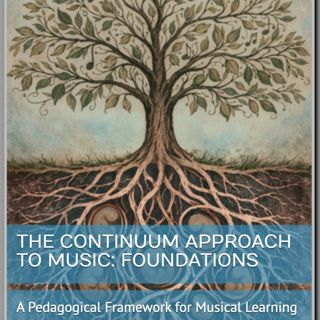
Why Visual Music Scores Might Be a Good Fit For Autistic Music Students | Continuum Approach

Why Visual Music Scores Might Be a Good Fit For Autistic Music Students | Continuum Approach

From the new Book The Continuum Approach to Music: Building: A Pedagogical Framework for Musical Learning (The Continuum Music Framework™ Part 2) Playing the Line, without reading  note.When we remove...

5 Tammi 7min

A Certain Lady D. Parker Public Domain Lyrics Poetry Song Writing | Continuum Approach | iServalan

A Certain Lady D. Parker Public Domain Lyrics Poetry Song Writing | Continuum Approach | iServalan

Words add a new dimension to music, but for some musicians, the words are difficult to render. I want to talk for a moment about writing songs before we know what they are. Not demos or tracks.Not fin...

4 Tammi 1min
Writing Songs Spoken Word Poetry and Prose Continuum Approach Pedagogy with iServalan™

Writing Songs Spoken Word Poetry and Prose Continuum Approach Pedagogy with iServalan™

Today iServalan begins the Continuum lyrical sketchbook of 2026iServalan™Music, listening, and the Continuum Approach: Exploring sound across genres, eras, and performance cultures — from Baroque to p...

4 Tammi 4min

Copyright Tips for Scores and Live Performances and creating the Bach Cello Suites for Viola Bass and Piano with iServalan™

Copyright Tips for Scores and Live Performances and creating the Bach Cello Suites for Viola Bass and Piano with iServalan™

iServalan™Music, listening, and the Continuum Approach: Exploring sound across genres, eras, and performance cultures — from Baroque to punk, hip-hop to minimalism — without hierarchy or haste.🎧 Podc...

3 Tammi 12min

Fold Up Glarry Piano Review by iServalan™ What is the music school verdict?

Fold Up Glarry Piano Review by iServalan™ What is the music school verdict?

Join the school on Patreon or GumroadiServalan™Music, listening, and the Continuum Approach: Exploring sound across genres, eras, and performance cultures — from Baroque to punk, hip-hop to minimalism...

1 Tammi 14min

Suosittua kategoriassa Koulutus

rss-murhan-anatomia
voi-hyvin-meditaatiot-2
psykopodiaa-podcast
rss-narsisti
adhd-podi
aamukahvilla
rss-rahamania
rss-vapaudu-voimaasi
rahapuhetta
rss-eron-alkemiaa
rss-koira-haudattuna
rss-liian-kuuma-peruna
rss-tietoinen-yhteys-podcast-2
kesken
mielipaivakirja
psykologia
rss-uskonto-on-tylsaa
rss-duodecim-lehti
rss-turun-yliopisto
rss-the-leafy-lounge