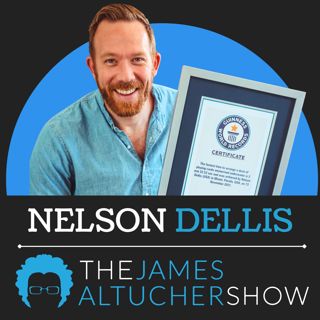
How to Improve Memory & Delay Alzheimer's with Nelson Dellis

How to Improve Memory & Delay Alzheimer's with Nelson Dellis

A Note from James:

I talked to Nelson Dellis, who’s a six-time USA Memory Champion and has broken multiple Guinness World Records. His book, Everyday Genius, makes a pretty bold claim—that with some practice and the right techniques, you can dramatically improve how your brain works.

We didn’t just talk about memory. We got into everything: mental math, focus, cold reading, even some techniques that feel almost like magic. And I’ve done a lot of episodes on memory over the years—but Nelson showed me things I hadn’t seen before.

What stood out to me is this idea that “genius” isn’t some fixed trait. It’s a collection of skills you can build. Some of them are surprisingly simple once you understand how your brain actually works.

I’m definitely going to spend more time practicing some of these techniques. There’s a lot here that’s immediately useful—and a lot that could take years to master.


Episode Description:

James sits down with world memory champion Nelson Dellis to break down what memory really is—and how far it can be pushed.

Nelson explains how his grandmother’s battle with Alzheimer’s led him into the world of memory training, eventually becoming one of the best in the world. From memorizing thousands of digits to competing in global competitions, he shows that memory is not a fixed trait—it’s a skill.

The conversation goes beyond memory into focus, reading, learning, and even social intelligence. Nelson shares practical techniques for improving recall, reading faster without losing comprehension, and using visualization to retain more information.

They also explore the edge cases—cold reading, intuition, and even experiments with “remote viewing”—where perception and cognition blur into something that feels almost supernatural.

At its core, this episode is about expanding what you believe your brain is capable of.


What You’ll Learn:

  • Why memory is a trainable skill—not something you’re born with
  • How visualization and emotional context dramatically improve recall
  • The difference between “speed reading” and “focus reading”
  • Simple techniques to retain more from books and conversations
  • How cold reading works (and why it feels like magic)
  • Why reviewing information—not cramming—is key to long-term memory
  • The mental habits that create the appearance of “genius”
  • How attention and focus are becoming rare—and valuable—skills


Timestamped Chapters:

  • 00:02:00 – Nelson’s origin story: Alzheimer’s and the motivation to master memory
  • 00:02:16 – Why reading is like living thousands of lives
  • 00:03:13 – Introducing Everyday Genius and the promise of trainable intelligence
  • 00:04:33 – Memory palace techniques and applying them to real-world skills
  • 00:05:13 – Can memory training help prevent Alzheimer’s?
  • 00:06:13 – Daily memory training routines and measurable progress
  • 00:08:16 – From beginner to USA Memory Champion
  • 00:10:00 – Memorizing 10,000 digits of pi: how it actually works
  • 00:11:31 – Turning numbers into stories: the core of memory systems
  • 00:14:28 – Why emotion and visualization drive memory
  • 00:16:00 – Memory competition benchmarks and world-class performance
  • 00:18:00 – What “genius” actually means—and how to simulate it
  • 00:20:00 – The four pillars: memory, reading, focus, and learning
  • 00:23:33 – Speed reading vs. focus reading (and why most people get it wrong)
  • 00:25:12 – The finger-tracking technique to instantly read faster
  • 00:27:16 – Why you don’t need to read every word
  • 00:30:17 – Why cramming fails (and how memory actually forms)
  • 00:31:17 – Visualization while reading: turning text into a movie
  • 00:34:00 – Active recall, note-taking, and long-term retention systems
  • 00:37:16 – Cold reading and social intelligence
  • 00:41:00 – Body language cues: attention, interest, and perception
  • 00:43:00 – How mentalists create the illusion of mind reading
  • 00:46:00 – Psychological “forcing” and influencing choices
  • 00:51:00 – Remote viewing experiments and cognitive edge cases


Additional Resources


See Privacy Policy at https://art19.com/privacy and California Privacy Notice at https://art19.com/privacy#do-not-sell-my-info.

Jaksot(1409)

Why Peter Thiel’s Founder Rules Keep Paying Off

Why Peter Thiel’s Founder Rules Keep Paying Off

A Note from James:One of my favorite conversations on this show was with Peter Thiel. Yes—PayPal, Facebook, Palantir, and a dozen other hits. I first ran this episode years ago, and the advice still h...

21 Joulu 20251h 4min

“If You’re Still Trying to Be Rational Now, You’re Crazy:” Comedian Tim Dillon on Being Informed vs. Being Ignorant

“If You’re Still Trying to Be Rational Now, You’re Crazy:” Comedian Tim Dillon on Being Informed vs. Being Ignorant

A Note from James:Tim Dillon is crazy—in the best way. Not “institution” crazy. Crazy smart. Years ago he told me things about Epstein, hustle culture, and how the world really works that felt outland...

18 Joulu 20251h 45min

How to Challenge Moon Landing Hoax Theories: Insights from Brian Keating

How to Challenge Moon Landing Hoax Theories: Insights from Brian Keating

James brings back astrophysicist Brian Keating for a practical takedown of moon-landing conspiracy claims—and a wider lesson in how to reason when everyone has a microphone. From the Van Allen belts t...

8 Joulu 202559min

Digital Social Hour Podcast by Sean Kelly: Why Gen Z Might Be the Most Talented Generation in History

Digital Social Hour Podcast by Sean Kelly: Why Gen Z Might Be the Most Talented Generation in History

Today, we're sharing the recent episode of the Digital Social Hour Podcast by Sean Kelly. James Altucher joins the show to break down why the 10,000-hour rule is a myth, how to cheat your way into the...

6 Joulu 202553min

How AI Will Change Hollywood Forever: Tye Sheridan & Nikola Todorovic on AI, VFX, and the Future of Filmmaking

How AI Will Change Hollywood Forever: Tye Sheridan & Nikola Todorovic on AI, VFX, and the Future of Filmmaking

A Note from James:Tye Sheridan is one of my favorite actors. You might know him as Cyclops in the X-Men movies (Apocalypse, etc.) or as the lead in Ready Player One—which is not only a great movie but...

25 Marras 202558min

AI That Helps, Schools That Don’t, and How Not to Go Crazy with Prof. Brian Keating

AI That Helps, Schools That Don’t, and How Not to Go Crazy with Prof. Brian Keating

Episode Description:James sits down with astrophysicist Brian Keating for a candid, useful tour through three hot zones: how to think about AI (and where it actually helps), what’s broken in higher ed...

22 Marras 20251h 37min

Kent Heckenlively on Catastrophic Disclosure: UFO Whistleblowers, Government Spin, and James’s 85% Rule

Kent Heckenlively on Catastrophic Disclosure: UFO Whistleblowers, Government Spin, and James’s 85% Rule

A Note from James:Are UFOs real or not? For 80 years there have been credible whistleblowers saying the government recovered craft—and even bodies. That’s why I wanted Kent Heckenlively on, the author...

21 Marras 202556min

Wisdom Takes Work: Ryan Holiday on What AI Can’t Teach You

Wisdom Takes Work: Ryan Holiday on What AI Can’t Teach You

A Note from James:Wisdom Takes Work is Ryan Holiday’s fourth book exploring the Stoic virtues, and this time he’s taking on the big one — wisdom. His earlier books on courage, temperance, and justice ...

11 Marras 202559min

Suosittua kategoriassa Liike-elämä ja talous

sijotuskasti
mimmit-sijoittaa
psykopodiaa-podcast
rss-rahapodi
herrasmieshakkerit
rss-rahamania
ostan-asuntoja-podcast
rss-doulapodi
rss-sami-miettinen-neuvottelija
rahapuhetta
rss-lahtijat
rss-paasipodi
juristipodi
rss-sisalto-kuntoon
inderespodi
pomojen-suusta
yrittaja
rss-uskalla-yrittaa
rss-laakispodi
rss-bisnesta-bebeja