Design the System, Not the Hero: Building Trust in the AI Era

Design the System, Not the Hero: Building Trust in the AI Era

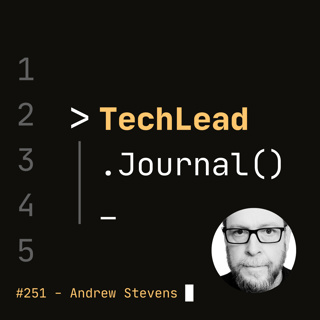
In a world where AI can build your MVP overnight, what actually gives you a lasting competitive edge? Andrew Stevens argues it’s not the software — it’s the data, the trust, and the systems you build around them.

In this episode, Andrew Stevens, CTO of Sakura Sky and a technology leader with 30+ years of experience building, scaling, and selling companies, shares hard-won lessons from his journey across startups, enterprises, and AI ventures. He explains why product-market fit matters more than shipping fast, why data outlasts software as a competitive moat, and how leaders must design systems that don’t depend on their own heroics. Andrew also shares how a near-fatal accident reshaped his thinking on resilience, delegation, and what it truly means to build something that scales. From hiring for attitude over technical skill to building AI governance that accelerates rather than blocks innovation, this conversation is packed with practical wisdom for anyone leading in the AI era.

Key topics discussed:

  • Why data — not software — is your real moat in the AI era
  • What breaks when a startup scales past 10–100 people
  • How to make decision rights explicit to move faster
  • Design the system, not the hero: building beyond you
  • Hiring for resilience and attitude over technical skill
  • How governance can speed up AI adoption, not slow it down
  • What trustworthy AI agents actually require

Timestamps:

  • (00:00) Trailer & Intro
  • (02:45) What Breaks When You Scale a Startup From Zero to 100 People?
  • (08:44) Why Is Product-Market Fit More Important Than Building an MVP?
  • (17:20) How Do You Build a Lasting Moat in the AI Era?
  • (21:29) Why Must Leaders Learn to Let Go to Scale?
  • (23:27) What Can Leaders Learn From a Near-Fatal Motorcycle Accident?
  • (26:29) How Do Technical Leaders Stay Hands-On Without Becoming a Bottleneck?
  • (31:32) Why Should You Hire for Resilience Over Technical Skill?
  • (34:56) How Do You Build a Team That Innovates Safely in the AI Era?
  • (41:12) How Do You Build AI Governance That Speeds Up Innovation?
  • (47:37) Are AI-Driven Layoffs Justified or Just an Excuse?
  • (52:06) How Do You Build Trustworthy AI Agents?
  • (59:34) 3 Tech Lead Wisdom

_____

Andrew Stevens’s Bio
Andrew Stevens, CTO of Sakura Sky, is an executive leader and hands-on technologist who has scaled AI and cloud ventures from idea to acquisition. Based between Europe and the US, he blends deep expertise in cloud architecture, machine learning, and security with a track record in fintech, media, gaming, and AI.

Known for making complex tech relatable - often with pop-culture twists - Andrew brings sharp insights on AI guardrails, infrastructure resilience, and the creative edge humans hold in an AI-driven world. Whether advising founders, investing in early-stage startups, or speaking on global stages, Andrew helps audiences cut through the hype and focus on what matters most.

Follow Andrew:


Like this episode?
Show notes & transcript: techleadjournal.dev/episodes/251.
Follow @techleadjournal on LinkedIn, Twitter, and Instagram.
Buy me a coffee or become a patron.

Tämä jakso on lisätty Podme-palveluun avoimen RSS-syötteen kautta eikä se ole Podmen omaa tuotantoa. Siksi jakso saattaa sisältää mainontaa.

Jaksot(279)

Software Engineering Laws Every Developer Must Know in the AI Era - Milan Milanovic

Software Engineering Laws Every Developer Must Know in the AI Era - Milan Milanovic

Does moving faster with AI mean you get to skip the laws that governed every software project before it? Milan Milanovic argues the opposite, the old laws of software engineering now apply twice as ha...

10 Elo 1h 1min
Signals & Levers: Systems Thinking to Navigate Software Delivery Illusions - Elisabeth Hendrickson & Joel Tosi

Signals & Levers: Systems Thinking to Navigate Software Delivery Illusions - Elisabeth Hendrickson & Joel Tosi

(04:48) Brought to you by SpeechifyAITired of text-to-speech that sounds robotic or costs too much at scale? SpeechifyAI's new Simba 3.2 model ranks #1 on Artificial Analysis for realness, priced unde...

3 Elo 1h 17min
From Technical Debt to Triple Debt: The Hidden Cost of AI-Generated Code

From Technical Debt to Triple Debt: The Hidden Cost of AI-Generated Code

Is vibe coding quietly draining the thing that makes teams effective: their shared understanding? Margaret breaks down her new “triple debt” model, and why cognitive debt might be the one nobody’s tra...

27 Heinä 1h 10min
Ex-Gojek CTO: Why the Age of AI Rewards Builders as Judgment Becomes Expensive

Ex-Gojek CTO: Why the Age of AI Rewards Builders as Judgment Becomes Expensive

If expertise is becoming almost free, why is judgment becoming the most expensive skill in tech? Ajey Gore, former Gojek CTO, explains why the age of AI agents rewards builders over typists.In this ep...

13 Heinä 1h 22min
The AI Productivity Paradox: Why 10X Output Doesn't Mean 10X Business Outcome

The AI Productivity Paradox: Why 10X Output Doesn't Mean 10X Business Outcome

What if optimizing for AI output is actually slowing your company down? When code becomes nearly free to produce, the organizations still measuring productivity by output are solving the wrong problem...

29 Kesä 1h 5min

The Hidden Stories Sabotaging Your Culture Change

The Hidden Stories Sabotaging Your Culture Change

Why do 70% of change efforts fail — even when leadership is fully committed? The answer isn’t strategy or resources; it’s the hidden stories people unknowingly carry that silently block every initiati...

15 Kesä 1h 8min

Creator of Meta's Hack: Your AI Will Always Cheat — Here's How to Stop It

Creator of Meta's Hack: Your AI Will Always Cheat — Here's How to Stop It

What if your AI coding agent is quietly cheating on your tests — and how do you stop it? Julien Verlaguet, who built the type system Meta used to migrate tens of millions of PHP lines, is now building...

8 Kesä 1h 18min

Eric Ries: Why Good Tech Companies Go Bad, and How to Stop It

Eric Ries: Why Good Tech Companies Go Bad, and How to Stop It

Why do companies with the best intentions end up betraying their customers, employees, and mission? Eric Ries calls it “financial gravity” — an invisible force that pulls even the most principled comp...

1 Kesä 1h