
The Real Moby Dick

The Real Moby Dick

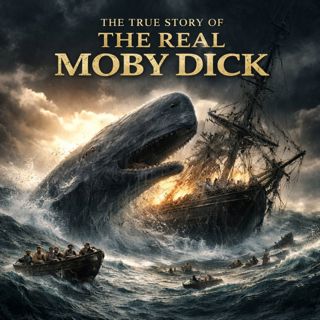
On August 12, 1819, the whaleship Essex departed Nantucket Island with a crew of twenty men bound for the Pacific Ocean on what was expected to be a routine two-and-a-half-year whaling voyage. Just over a year later, on November 20, 1820, roughly 2,000 miles west of South America, an 85-foot bull sperm whale rammed the ship twice with what first mate Owen Chase described as deliberate malice, sinking her in minutes.

The twenty crew members escaped in three small whaleboats with limited provisions and faced an impossible decision about where to sail. Fearing reports of cannibalism in the nearby Marquesas Islands, they chose to head for the distant coast of South America, a journey of more than 3,000 miles across open ocean. After a month at sea they landed on the uninhabited Henderson Island on December 20, 1820, where they found a freshwater spring and foraged on birds, crabs, and peppergrass, but exhausted the island's resources within a week. Three men elected to stay behind while the remaining seventeen pushed off on December 27, 1820.

What followed was a ninety-three-day ordeal of starvation, dehydration, exposure, and eventual cannibalism that remains one of the darkest survival stories in maritime history. The first four men to die and be consumed were all Black sailors, a pattern that raises uncomfortable questions about how rations and resources were distributed along racial lines. When the dead were gone and starvation loomed again, the men in Captain George Pollard's boat drew lots to determine who would be sacrificed. The lot fell to 17-year-old Owen Coffin, Pollard's own cousin, who was shot by his closest friend Charles Ramsdell and consumed by the survivors.

Chase's boat was rescued on February 18, 1821, by the British brig Indian, and Pollard's boat was picked up five days later by the Nantucket whaleship Dauphin. The three men on Henderson Island were rescued by the Australian vessel Surry on April 9, 1821. Of the twenty men aboard the Essex, only eight survived. Owen Chase published his firsthand account later that year, and it would go on to inspire Herman Melville's 1851 novel Moby-Dick.

Chase spent his final years hoarding food and suffering debilitating headaches before dying on March 7, 1869. Pollard lost a second ship, the Two Brothers, in February 1823 and spent the rest of his life as a night watchman on Nantucket, fasting every November 20 in memory of his lost crew until his death on January 7, 1870.

Nathaniel Philbrick's 2000 book In the Heart of the Sea brought the full story back to a wide audience and won the National Book Award, and Ron Howard adapted it into a film in 2015 starring Chris Hemsworth.

Have a forgotten historical mystery, disturbing event, unsolved crime, or hidden conspiracy you think deserves investigation?

Send your suggestions to brian@paranormalworldproductions.com.

Disturbing History is a dark history podcast exploring unsolved mysteries, secret societies, historical conspiracies, lost civilizations, and the shadowy stories buried beneath the surface of the past.

Follow the show and enable automatic downloads so you never miss a deep dive into history’s most unsettling secrets.

Because sometimes the truth is darker than fiction.

Tämä jakso on lisätty Podme-palveluun avoimen RSS-syötteen kautta eikä se ole Podmen omaa tuotantoa. Siksi jakso saattaa sisältää mainontaa.

Jaksot(155)

Is Big Pharma Hiding the Cure for Cancer?

Is Big Pharma Hiding the Cure for Cancer?

This episode asks a simple question: if someone really discovered a cure for cancer, would the medical industry suppress it? Brian begins with a clear disclaimer that he is not a doctor and is making ...

2 Loka 1h 4min

The 1990's

The 1990's

On July 16, 1990, Time magazine put a group of young adults on its cover beneath the word “twentysomething” and asked whether they were laid back, late blooming, or simply lost. The story said they st...

30 Syys 1h 12min

The Siege At Ruby Ridge

The Siege At Ruby Ridge

Listener discretion is advised. This episode contains descriptions of real-life violence and death, including the shooting deaths of a fourteen-year-old boy, his mother, and a federal law enforcement ...

27 Syys 1h 18min

The 1980's

The 1980's

The 1980s began with 52 Americans still being held hostage in Tehran and ended with crowds tearing open the Berlin Wall. Between those two moments came one of the most turbulent, contradictory decades...

25 Syys 1h 9min
Halley's Comet

Halley's Comet

On the night of May 18, 1910, people across the world waited for Halley’s Comet to kill them.Hotels in New York opened their rooftops. Miners in Pennsylvania refused to go underground. A religious sec...

23 Syys 1h 1min
The Freeway Killer

The Freeway Killer

This episode discusses sexual violence against children and teenagers, torture, and murder and is not suitable for younger audiences. Listener discretion is strongly advised. On the night of June 11, ...

21 Syys 1h 19min

The 1970's

The 1970's

The 1970s opened in conflict.On April 30, 1970, President Richard Nixon announced the expansion of U.S. military operations into Cambodia.Days later, four students were killed by the Ohio National Gua...

18 Syys 1h 2min
The Bystander Effect

The Bystander Effect

On March 27, 1964, The New York Times published a story that would become one of the most famous examples of human indifference ever told. According to the report, 38 people in Queens watched as 28-ye...

16 Syys 1h

Suosittua kategoriassa Yhteiskunta

olipa-kerran-otsikko
i-dont-like-mondays
seitseman
sita
siita-on-vaikea-puhua
hupiklubi
download
uutiscast
poks
antin-palautepalvelu
mamma-mia
kaksi-aitia
kolme-kaannekohtaa
yopuolen-tarinoita-2
rss-murhan-anatomia
vallattomat
aikalisa
rss-palmujen-varjoissa
gogin-ja-janin-maailmanhistoria
kummitusjuttuja