Supernovas and Space Gold with Dr. Ashley Villar

Supernovas and Space Gold with Dr. Ashley Villar

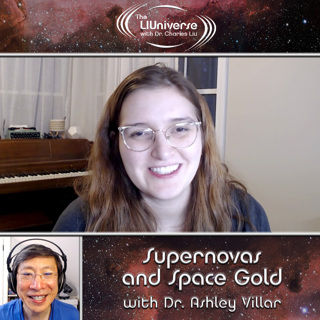
How do stars die? And what happens when they do? To find out, Dr. Charles Liu and co-host Allen Liu welcome Dr. Ashley Villar, who teaches astronomy at Harvard and whose team studies supernovas as they happen.

As always, though, we start off with the day’s joyfully cool cosmic thing, the release of a set of new Hubble Space Telescope images of the Crab Nebula and the pulsar at its center. Needless to say, it’s a great start to an episode about a team of scientists who actually study the moment a star explodes and the immediate aftermath.

Ashley explains how they have been able to use LIGO, the gravitational wave detector, as a sort of early warning detector that twice gave them enough time to set up their instruments to observe the explosion over the next few hours and days as it unfolds.

Professor Villar talks about how neutron star mergers and magnetars may be the source of heavy elements like gold and uranium. Or, as Chuck says, “A gold-filled smoke ring puffing off of a highly spinning, highly magnetic neutron star - what a great picture that would be.”

Ashley is looking forward to how the Vera Rubin Observatory is going to change the observation of these events. In the process of explaining, Professor Villar answers an audience question from Jamison, who asks how often stars explode in space. It turns out, in our observable universe, there’s a supernova every 2 seconds! We currently detect about 10,000 of these explosions every year - Vera Rubin will be able to detect 10,000 of these explosions in just two weeks.

In order to get a handle on this flood of data, Dr. Villar and her team will be looking for these exotic physics needles in a haystack using machine learning models to look for patterns and abnormalities and “go fishing.”

Charles asks Ashley for her take on AI and whether we should be afraid of it or not.(And yes, take the opportunity to plug co-host Allen Liu’s forthcoming book, “The Handy Artificial Intelligence Answer Book.”) Allen and Ashley discuss the difference between how a chatbot like ChatGPT operates and how she trains her models.

There was a second part to Jamison’s question about exploding stars: Are we in any danger. Dr. Villar explains that when we just look at our Milky Way, supernovas occur only once a century, so we’re not in any danger.

Next, Jessie asks, “How do we know the universe is infinite?” Our answer is, we don’t. That doesn’t stop us from discussing it, though, and the conversation takes us to, among other places, the Nazca lines in Peru and the quantum effect that creates iridescent blue butterfly wings. (You can read the scientific research mentioned in the episode here: https://www.nature.com/articles/ncomms8959)

We end with a discussion about supernovas, neutrinos, space dust, gamma ray bursts, and what kind of event it would take to interrupt the normal activities of space telescopes like the James Webb Space Telescope or the Vera Rubin and hijack them for a disruptive observation. And we get a book recommendation from Ashley, “Katabasis” by R. F. Kuang, about a grad student who journeys to hell to get a letter of reference from her deceased advisor.

If you’d like to know more about what Professor Villar is up to, you can check out her lab’s website at http://astrotimelab.com/.

We hope you enjoy this episode of The LIUniverse, and, if you do, please support us on Patreon.

Credits for Images Used in this Episode:

  • New Hubble mosaic of the Crab Nebula. – Credit: William P. Blair et al 2026 ApJ 997 81
  • Previous Hubble photo of the Crab Nebula. – Credit: NASA, ESA, J. Hester and A. Loll (Arizona State University)
  • The Vera Rubin Observatory. – Credit: RubinObs/NOIRLab/SLAC/NSF/DOE/AURA/P. Horálek (Institute of Physics in Opava), CC BY 4.0
  • Nazca line “The Condor”. – Credit: Photo by Roger Canals
  • Blue butterfly wings in an electron microscope. – Credit: Radislav A. Potyrailo et al.
  • Aragonite plates in a shell. – Credit: Fabian Heinemann
  • SN 1987A (Bright central “star”). – Credit: European Southern Observatory
  • Artist’s illustration of Gamma Ray Burst jets. – Credit: International Gemini Observatory/NOIRLab/NSF/AURA/J. da Silva; Image processing: M. Zamani (NSF's NOIRLab)

CHAPTERS:

00:00 - Welcome to The LIUniverse

02:14 - Joyfully Cool Cosmic Thing of the Day - Hubble Crab Nebula Images

07:06 - Neutron Star Mergers, Magnetars, and Space Gold

09:18 - How Often Do Stars Explode?

12:35 - Can AI Help Us Find Supernovas?

17:11 - Are We In Danger From Exploding Stars?

19:48 - How Do We Know the Universe Is Infinite?

24:01 - How Does Quantum Physics Impact Color in Butterflies and Supernovas?

31:16 - How to Hijack a Space Telescope

Tämä jakso on lisätty Podme-palveluun avoimen RSS-syötteen kautta eikä se ole Podmen omaa tuotantoa. Siksi jakso saattaa sisältää mainontaa.

Jaksot(78)

ChuckGPT - Patreon Question Edition

ChuckGPT - Patreon Question Edition

It’s time for the Season 5 finale of The LIUniverse, which means another episode of ChuckGPT where we answer our audience’s most vexing questions – this time via video from our Patreon Patrons. And to...

13 Kesä 38min
Our Weird, Wondrous Universe with Erika Hamden

Our Weird, Wondrous Universe with Erika Hamden

How do distant galaxies form? If you have two distant clouds of hydrogen, why does one turn into a star and another doesn’t? To find out, Dr. Charles Liu and co-host Allen Liu welcome Dr. Erika Hamden...

30 Touko 43min
Ruby Raindrops and Painted Peacocks with Munazza Alam

Ruby Raindrops and Painted Peacocks with Munazza Alam

Are there really exoplanets with where it rains ruby and emerald raindrops? How do we measure the atmospheres of exoplanets light years away? To find out, Dr. Charles Liu and co-host Allen Liu welcome...

16 Touko 45min
Astrophotography with Astronaut Don Pettit

Astrophotography with Astronaut Don Pettit

Can the physics you learned in High School take you to the stars? Who is behind many of your favorite pictures of space? What is it actually like to live and work in space? You might be surprised to k...

2 Touko 47min
Finding the “Bubbles” Exoplanet and Crocheting Dinosaurs with Victoria DiTomasso

Finding the “Bubbles” Exoplanet and Crocheting Dinosaurs with Victoria DiTomasso

How do we find exoplanets? What is the Milky Way’s “Thick Disk” and what makes it so special? To find out, Dr. Charles Liu and co-host Allen Liu welcome Harvard astronomer Dr. Victoria DiTomasso, who ...

11 Huhti 47min
Building Worlds with Luke Skywatcher

Building Worlds with Luke Skywatcher

How do planetary systems form? If you wanted to observe them, where would you look and what would you look for? To find out, Dr. Charles Liu and co-host Allen Liu welcome Luke Keller, professor of Ast...

8 Maalis 43min

Chuck GPT: Astrotech

Chuck GPT: Astrotech

How can a helicopter fly in space? How does LIGO detect gravitational waves? How do quantum electronic devices like Josephson junctions work? Could AI turn evil and destroy humanity? What about those ...

8 Helmi 55min

Suosittua kategoriassa Tiede

rss-poliisin-mieli
tiedekulma-podcast
rss-mita-tulisi-tietaa
docemilia
rss-hereilla
rss-bios-podcast
utelias-mieli
hippokrateen-vastaanotolla
rss-metsanomistaja-podcast
rss-lapsuuden-rakentajat-podcast
rss-sosiopodi
filocast-filosofian-perusteet
rss-tiedetta-vai-tarinaa
rss-duodecim-lehti
radio-antro
rss-totuuden-liepeilla