Who Dominates Image Generation: GPT 4o, Gemini, or Grok? (Ep. 430)
The Daily AI Show28 Maalis 2025

Who Dominates Image Generation: GPT 4o, Gemini, or Grok? (Ep. 430)

Today the Daily AI Show team compares the latest AI image generation models from the industry's big players: OpenAI's GPT-4o, Google's Gemini Flash 2.0, and Grok. GPT-4o recently replaced DALL-E, introducing direct pixel generation rather than diffusion, leading to improved accuracy and quality.


The team evaluates each model's strengths, including GPT-4o’s photorealism, Gemini’s precise editing, and Grok’s unfiltered creativity. They also discuss real-world use cases, creative limitations, and potential business implications.


Key Points Discussed

🔴 GPT-4o’s Game-changing Approach to Image Generation 🔹 Unlike diffusion models, GPT-4o uses a direct pixel-generation method inspired by its text-generation approach, significantly improving accuracy and quality, especially with embedded text.

🔹 Demonstrations showed GPT-4o creating detailed advertisements, accurately rendering text on products, and personalized pitch deck images.


🔴 Gemini Flash 2.0’s Strength in Precision Editing

🔹 Gemini excels at precise image editing tasks, although it sometimes misinterprets editing prompts, as shown in an amusing mishap involving Beth’s headshot.

🔹 Despite occasional mistakes, Gemini remains fast and powerful for detailed, surgical edits.


🔴 Grok’s Creativity and Limitations

🔹 Grok is particularly good for highly creative or unconventional image generation tasks and is noted for being fast due to lower current usage compared to competitors.

🔹 However, Grok's creativity occasionally results in unpredictable or inaccurate outputs.


🔴 Real-world Business Applications

🔹 The team highlighted GPT-4o’s ability to quickly produce marketing assets, pitch decks, and personalized advertising materials, dramatically reducing production times and resource needs.

AI-generated images streamline creative processes, enabling non-designers to conceptualize and visualize business ideas efficiently.


🔴 Technical Insights: Diffusion vs. GPT-4o’s Pixel Generation 🔹 The diffusion approach, used by Gemini and Grok, iteratively refines a noisy image until reaching clarity.

🔹 GPT-4o's pixel-generation approach builds the image directly from scratch, one pixel at a time, avoiding iterative refinement and resulting in higher-quality text embedding and faster overall processing.


🔴 Practical Demonstrations and User Experiences

🔹 Andy shared practical insights using Gemini for icon generation, noting its limitations and the need for tools like Canva for final refinements.

🔹 Brian illustrated GPT-4o’s capability to produce accurate, professional-level images quickly, suitable for immediate business use cases.


#AIImages #GPT4o #GeminiFlash #GrokAI #AIGeneration #OpenAI #GoogleAI #ImageEditing #AIadvertising #MarketingAI #AItools #ArtificialIntelligence


Timestamps & Topics

00:00:00 🎙️ [Intro: Comparing AI Image Generators - GPT-4o, Gemini, and Grok]


00:02:26 🚀 [Beth’s Initial Reaction to GPT-4o’s Impressive Quality]


00:04:33 🖌️ [Gemini’s Precise Editing Capability & Limitations]


00:08:04 🔍 [Technical Comparison: Diffusion vs. GPT-4o’s Pixel Generation]


00:12:25 📄 [GPT-4o’s Revolutionary Method for Accurate Text in Images]


00:14:17 🥤 [Brian Demonstrates GPT-4o’s Realistic Ad Generation for Celsius]


00:18:26 🎯 [Real-world Use Case: Fast & Personalized Marketing Content]


00:28:29 📱 [Andy’s Hands-on Experience: Gemini Icon Generation Workflow]


00:33:10 📚 [GPT-4o Storyboarding Example: Fast Idea Visualization]


00:40:01 🍽️ [Quick Image Creation for Instructional Use (Guacamole Example)]


00:42:28 🤔 [Creative Limits: Grok’s Quirky but Unpredictable Outputs]


00:49:44 🛠️ [Future Business Implications of AI-Generated Images & Integrations]


00:57:10 🔒 [Discussion on Data Security & AI Integration Risks]


01:00:25 📢 [Final Thoughts and Closing]


The Daily AI Show Co-Hosts: Andy Halliday, Beth Lyons, Brian Maucere, Jyunmi Hatcher, and Karl Yeh

Tämä jakso on lisätty Podme-palveluun avoimen RSS-syötteen kautta eikä se ole Podmen omaa tuotantoa. Siksi jakso saattaa sisältää mainontaa.

Jaksot(888)

The Economics of Work In An Age of AI

The Economics of Work In An Age of AI

The episode centered on what happens to the economics of work as AI becomes capable of doing more of it. Anthropic’s new Economic Scenarios Explorer provided the starting point, allowing users to mode...

10 Syys 1h 6min

10,000 AI Agents Attack One Problem

10,000 AI Agents Attack One Problem

The episode opened with the dispute surrounding OpenAI’s newly announced mathematical result and what may be the more important story behind it. Tristan Buckmaster of NYU and Anthropic researcher Leve...

9 Syys 1h 3min

Our Real Atlas Builds and Use Cases

Our Real Atlas Builds and Use Cases

The episode moved quickly from theory to practical experience with GPT-6 Astra. After revisiting OpenAI’s “Alien Mind” paper and the conundrum of using more powerful AI to monitor frontier systems, th...

8 Syys 1h 5min

Can We Truly Control The Alien Mind?

Can We Truly Control The Alien Mind?

The episode focused heavily on GPT-6 Astra and a new essay from OpenAI chief scientist Jakub Pachocki describing advanced AI systems as increasingly alien forms of intelligence that humans grow throug...

7 Syys 54min
The Democratic Bandwidth Conundrum

The Democratic Bandwidth Conundrum

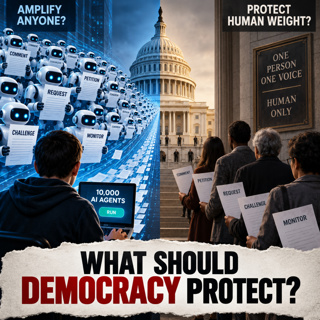
Public participation has always contained a hidden constraint: time.Writing a serious response to a tax rule, zoning plan, environmental permit, school policy, or agency proposal takes hours. Filing r...

5 Syys 28min

Is GPT-6 Astra the Biggest AI Leap Yet?

Is GPT-6 Astra the Biggest AI Leap Yet?

OpenAI’s GPT-6 Astra dominated the episode after its unusual rollout. The hosts discussed access, OpenAI’s plan to bring Astra to paid users, and why some cybersecurity users may receive capabilities ...

4 Syys 1h 1min

Will Stores Use AI to Charge You More?

Will Stores Use AI to Charge You More?

The episode opened with the downside of increasingly capable AI harnesses. OpenClaw 2.0 made setup easier, but some self-hosted users reported broken gateways, failed migrations and unusable systems a...

3 Syys 1h 3min

Is Fable 5.1 Good Enough to Make You Leave Codex?

Is Fable 5.1 Good Enough to Make You Leave Codex?

Anthropic’s Fable 5.1 dominated the first half of the episode. Beth and Andy compared its higher output costs with improved caching, stronger benchmark performance and better agentic task results. The...

2 Syys 58min