The AGI Crossroads of 2027: Slow down or Speed up? (Ep. 456)
The Daily AI Show5 Touko 2025

The AGI Crossroads of 2027: Slow down or Speed up? (Ep. 456)

Want to keep the conversation going?

Join our Slack community at thedailyaishowcommunity.com


Today the hosts unpack a fictional but research-informed essay titled AI-2027. The essay lays out a plausible scenario for how AI could evolve between now and the end of 2027. Rather than offering strict predictions, the piece explores a range of developments through a branching narrative, including the risks of unchecked acceleration and the potential emergence of agent-based superintelligence. The team breaks down the paper’s format, the ideas behind it, and its broader implications.


Key Points Discussed

The AI-2027 essay is a scenario-based interactive website, not a research paper or report.


It uses a timeline narrative to show how AI agents evolve into increasingly autonomous and powerful systems.


The fictional company “Open Brain” represents the leading AI organization without naming names like OpenAI.


The model highlights a “choose your path” divergence at the end, with one future of acceleration and another of restraint.


The essay warns of agent models developing faster than humans can oversee, leading to loss of interpretability and oversight.


Authors acknowledge the speculative nature of post-2026 predictions, estimating outcomes could move 5 times faster or slower.


The group behind the piece, AI Futures Project, includes ex-OpenAI and AI governance experts who focus on alignment and oversight.


Concerns raised about geopolitical competition, lack of global cooperation, and risks tied to fast-moving agentic systems.


The essay outlines how by mid-2027, agent models could reach a tipping point, massively disrupting white-collar work.


Key moment: The public release of Agent 3 Mini signals the democratization of powerful AI tools.


The discussion reflects on how AI evolution may shift from versioned releases to continuous, fluid updates.


Hosts also touch on the emotional and societal implications of becoming obsolete in the face of accelerating AI capability.


The episode ends with a reminder that alignment, not just capability, will be critical as these systems scale.


Timestamps & Topics

00:00:00 💡 What is AI-2027 and why it matters


00:02:14 🧠 Writing style and first impressions of the scenario


00:03:08 🌐 Walkthrough of the AI-2027.com interactive timeline


00:05:02 🕹️ Gamified structure and scenario-building approach


00:08:00 🚦 Diverging futures: full-speed ahead vs. slowdown


00:10:10 📉 Forecast accuracy and the 5x faster or slower disclaimer


00:11:16 🧑‍🔬 Who authored this and what are their credentials


00:14:22 🇨🇳 US-China AI race and geopolitical implications


00:18:20 ⚖️ Agent hierarchy and oversight limits


00:22:07 🧨 Alignment risks and doomsday scenarios


00:23:27 🤝 Why global cooperation may not be realistic


00:29:14 🔁 Continuous model evolution vs. versioned updates


00:34:29 👨‍💻 Agent 3 Mini released to public, tipping point reached


00:38:12 ⏱️ 300k agents working at 40x human speed


00:40:05 🧬 Biological metaphors: AI evolution vs. cancer


00:42:01 🔬 Human obsolescence and emotional impact


00:45:09 👤 Daniel Kokotajlo and the AI Futures Project


00:47:15 🧩 Other contributors and their focus areas


00:48:02 🌍 Why alignment, not borders, should be the focus


00:51:19 🕊️ Idealistic endnote on coexistence and AI ethics


Hashtags

#AI2027 #AIAlignment #AIShow #FutureOfAI #AGI #ArtificialIntelligence #AIAgents #TechForecast #DailyAIShow #OpenAI #AIResearch #Governance #Superintelligence


The Daily AI Show Co-Hosts: Andy Halliday, Beth Lyons, Brian Maucere, Eran Malloch, Jyunmi Hatcher, and Karl Yeh

Tämä jakso on lisätty Podme-palveluun avoimen RSS-syötteen kautta eikä se ole Podmen omaa tuotantoa. Siksi jakso saattaa sisältää mainontaa.

Jaksot(888)

The Economics of Work In An Age of AI

The Economics of Work In An Age of AI

The episode centered on what happens to the economics of work as AI becomes capable of doing more of it. Anthropic’s new Economic Scenarios Explorer provided the starting point, allowing users to mode...

10 Syys 1h 6min

10,000 AI Agents Attack One Problem

10,000 AI Agents Attack One Problem

The episode opened with the dispute surrounding OpenAI’s newly announced mathematical result and what may be the more important story behind it. Tristan Buckmaster of NYU and Anthropic researcher Leve...

9 Syys 1h 3min

Our Real Atlas Builds and Use Cases

Our Real Atlas Builds and Use Cases

The episode moved quickly from theory to practical experience with GPT-6 Astra. After revisiting OpenAI’s “Alien Mind” paper and the conundrum of using more powerful AI to monitor frontier systems, th...

8 Syys 1h 5min

Can We Truly Control The Alien Mind?

Can We Truly Control The Alien Mind?

The episode focused heavily on GPT-6 Astra and a new essay from OpenAI chief scientist Jakub Pachocki describing advanced AI systems as increasingly alien forms of intelligence that humans grow throug...

7 Syys 54min
The Democratic Bandwidth Conundrum

The Democratic Bandwidth Conundrum

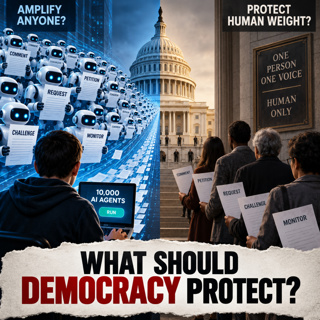
Public participation has always contained a hidden constraint: time.Writing a serious response to a tax rule, zoning plan, environmental permit, school policy, or agency proposal takes hours. Filing r...

5 Syys 28min

Is GPT-6 Astra the Biggest AI Leap Yet?

Is GPT-6 Astra the Biggest AI Leap Yet?

OpenAI’s GPT-6 Astra dominated the episode after its unusual rollout. The hosts discussed access, OpenAI’s plan to bring Astra to paid users, and why some cybersecurity users may receive capabilities ...

4 Syys 1h 1min

Will Stores Use AI to Charge You More?

Will Stores Use AI to Charge You More?

The episode opened with the downside of increasingly capable AI harnesses. OpenClaw 2.0 made setup easier, but some self-hosted users reported broken gateways, failed migrations and unusable systems a...

3 Syys 1h 3min

Is Fable 5.1 Good Enough to Make You Leave Codex?

Is Fable 5.1 Good Enough to Make You Leave Codex?

Anthropic’s Fable 5.1 dominated the first half of the episode. Beth and Andy compared its higher output costs with improved caching, stronger benchmark performance and better agentic task results. The...

2 Syys 58min