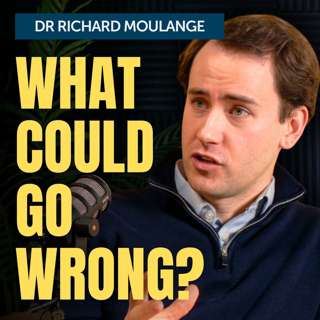

AI designs genomes from scratch & outperforms virologists at lab work. What could go wrong? | Dr Richard Moulange, CLTR

AI designs genomes from scratch & outperforms virologists at lab work. What could go wrong? | Dr Richard Moulange, CLTR

Last September, scientists used an AI model to design genomes for entirely new bacteriophages (viruses that infect bacteria). They then built them in a lab. Many were viable. And despite being entirely novel some even outperformed existing viruses from that family.


That alone is remarkable. But as today's guest — Dr Richard Moulange, one of the world's top experts on 'AI–Biosecurity' — explains, it's just one of many data points showing how AI is dissolving the barriers that have historically kept biological weapons out of reach.

For years, experts have reassured us that 'tacit knowledge' — the hands-on, hard-to-Google lab skills needed to work with dangerous pathogens — would prevent bad actors from weaponising biology. So far, they've been right.


But as of 2025 that reassurance is crumbling. The Virology Capabilities Test measures exactly this kind of troubleshooting expertise, and finds that modern AI models crushed top human virologists even in their self-declared area of greatest specialisation and expertise — 45% to 22%.

Meanwhile, Anthropic’s research shows PhD-level biologists getting meaningfully better at weapons-relevant tasks with AI assistance — with the effect growing with each new model generation.

Richard joins host Rob Wiblin to discuss all that plus:

  • What AI biology tools already exist
  • Why mid-tier actors (not amateurs) are the ones getting the most dangerous boost
  • The three main categories of defence we can pursue
  • Whether there’s a plausible path to a world where engineered pandemics become a thing of the past

This episode was recorded on January 16, 2026. Since recording this episode, Richard has seconded to the UK Government — please note that his views expressed here are entirely his own.

Links to learn more, video, and full transcript: https://80k.info/rm

Announcements:

  1. Our new book is available to preorder: 80,000 Hours: How to have a fulfilling career that does good is written by our cofounder Benjamin Todd. It’s a completely revised and updated edition of our existing career guide, with a big new updated section on AI — covering both the risks and the potential to steer it in a better direction, and how AI automation should affect your career planning and which skills one chooses to specialise in. Preorder now: https://geni.us/80000Hours
  2. We're hiring contract video editors for the podcast! For more information, check out the expression of interest page on the 80,000 Hours website: https://80k.info/video-editor

Chapters:

  • Cold open (00:00:00)
  • Who's Richard Moulange? (00:00:31)
  • AI can now design novel genomes (00:01:11)
  • The end of the 'tacit knowledge' barrier (00:04:34)
  • Are risks from bioterrorists overstated? (00:18:20)
  • The 3 key disasters AI makes more likely (00:22:41)
  • Which bad actors does AI help the most? (00:30:03)
  • Experts are more scary than amateurs (00:41:17)
  • Barriers to bioterrorists using AI (00:46:43)
  • AI biorisks are sometimes dismissed (and that's a huge mistake) (00:48:54)
  • Advanced AI biology tools we already have or will soon (01:04:10)
  • Rob argues that the situation is hopeless (01:09:49)
  • Intervention #1: Limit access (01:18:16)
  • Intervention #2: Get AIs to refuse to help (01:32:58)
  • Intervention #3: Surveillance and attribution (01:42:38)
  • Intervention #4: Universal vaccines and antivirals (01:56:38)
  • Intervention #5: Screen all orders for DNA (02:10:00)
  • AI companies talk about def/acc more than they fund it (02:19:52)
  • Can you build a profitable business solving this problem? (02:26:32)
  • This doesn't have to interfere with useful science (much) (02:30:56)
  • What are the best low-tech interventions? (02:33:01)
  • Richard's top request for AI companies (02:37:59)
  • Grok shows governments lack many legal levers (02:53:17)
  • Best ways listeners can help fix AI-Bio (02:56:24)
  • We might end all contagious disease in 20 years (03:03:37)


Video and audio editing: Dominic Armstrong, Milo McGuire, Luke Monsour, and Simon Monsour
Music: CORBIT
Camera operator: Jeremy Chevillotte
Transcripts and web: Elizabeth Cox and Katy Moore

Jaksot(327)

What the hell happened with AGI timelines in 2025?

What the hell happened with AGI timelines in 2025?

In early 2025, after OpenAI put out the first-ever reasoning models — o1 and o3 — short timelines to transformative artificial general intelligence swept the AI world. But then, in the second half of ...

10 Helmi 25min
#179 Classic episode – Randy Nesse on why evolution left us so vulnerable to depression and anxiety

#179 Classic episode – Randy Nesse on why evolution left us so vulnerable to depression and anxiety

Mental health problems like depression and anxiety affect enormous numbers of people and severely interfere with their lives. By contrast, we don’t see similar levels of physical ill health in young p...

3 Helmi 2h 51min
#234 – David Duvenaud on why 'aligned AI' would still kill democracy

#234 – David Duvenaud on why 'aligned AI' would still kill democracy

Democracy might be a brief historical blip. That’s the unsettling thesis of a recent paper, which argues AI that can do all the work a human can do inevitably leads to the “gradual disempowerment” of ...

27 Tammi 2h 31min
#145 Classic episode – Christopher Brown on why slavery abolition wasn't inevitable

#145 Classic episode – Christopher Brown on why slavery abolition wasn't inevitable

In many ways, humanity seems to have become more humane and inclusive over time. While there’s still a lot of progress to be made, campaigns to give people of different genders, races, sexualities, et...

20 Tammi 2h 56min
#233 – James Smith on how to prevent a mirror life catastrophe

#233 – James Smith on how to prevent a mirror life catastrophe

When James Smith first heard about mirror bacteria, he was sceptical. But within two weeks, he’d dropped everything to work on it full time, considering it the worst biothreat that he’d seen described...

13 Tammi 2h 9min
#144 Classic episode – Athena Aktipis on why cancer is a fundamental universal phenomena

#144 Classic episode – Athena Aktipis on why cancer is a fundamental universal phenomena

What’s the opposite of cancer? If you answered “cure,” “antidote,” or “antivenom” — you’ve obviously been reading the antonym section at www.merriam-webster.com/thesaurus/cancer.But today’s guest Athe...

9 Tammi 3h 30min
#142 Classic episode – John McWhorter on why the optimal number of languages might be one, and other provocative claims about language

#142 Classic episode – John McWhorter on why the optimal number of languages might be one, and other provocative claims about language

John McWhorter is a linguistics professor at Columbia University specialising in research on creole languages. He's also a content-producing machine, never afraid to give his frank opinion on anything...

6 Tammi 1h 35min
2025 Highlight-o-thon: Oops! All Bests

2025 Highlight-o-thon: Oops! All Bests

It’s that magical time of year once again — highlightapalooza! Stick around for one top bit from each episode we recorded this year, including:Kyle Fish explaining how Anthropic’s AI Claude descends i...

29 Joulu 20251h 40min

Suosittua kategoriassa Koulutus

rss-murhan-anatomia
voi-hyvin-meditaatiot-2
psykopodiaa-podcast
rss-narsisti
rss-liian-kuuma-peruna
adhd-podi
rss-eron-alkemiaa
rahapuhetta
aamukahvilla
kesken
rss-duodecim-lehti
rss-koira-haudattuna
psykologia
rss-tietoinen-yhteys-podcast-2
rss-vapaudu-voimaasi
rss-finnish-daily-dialogues
rss-niinku-asia-on
rss-onks-ok
rss-luonnollinen-synnytys-podcast
rss-arkea-ja-aurinkoa-podcast-espanjasta