Ep.: 231 – Maximilian I (1493-1519) - Marrying Bohemia and Hungary

Ep.: 231 – Maximilian I (1493-1519) - Marrying Bohemia and Hungary

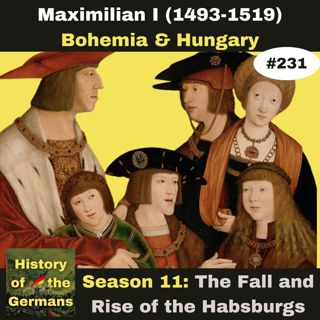
You have almost certainly seen the image in today’s episode artwork before. It is a family portrait showing Maximilian, his first wife Marie of Burgundy, his son, Philip the Handsome and three children. When Bernhard Strigel painted this image in around the year 1516, Philip the Handsome was already dead for 10 years and Marie of Burgundy had gone more than 30 years before. Then there are the inscriptions over the heads of these well-known and easily identifiable figures. There is a lot of Habsburg chin on show here. But they do not describe Maximilian as emperor, but as Cleophas, blood brother of Joseph, husband of the divine Virgin Mary, Marie of Burgundy is Mary Cleophas, sister of the Virgin Mary, and Philip the Handsome as James the Lesser, apostle and son of the other two. Two of the three little boys are named as Joseph the Just and Simon the Zealot, the cousin of the lord. Who are these saints? Well they do appear in the bible, so they are real, but in very minor roles. One of them was even rejected as an apostle. But they do have something special, they are Jesus’ aunt, uncle, nephews and cousin. And since he had died without offspring, his heirs. So this is a picture about succession and inheritance, not necessarily about family love.

Ok, making the emperor the brother in law of Joseph is quite odd already, but let’s talk about the three children. They were all alive when this picture was painted and roughly the age they are depicted as. The one in the middle is Charles, the future emperor Charles V. And the little boy cuddling up to Maximilian is his brother Ferdinand, the future emperor Ferdinand I., again identified as holy nephew and cousin. But who is the third child? Well, that is Louis, the future king Louis II of Hungary and Bohemia, son of king Vladislav II and his French wife Anne de Foix. So no close blood relation. What does he do in one of the most famous Habsburg family portraits? It must have something to do with succession and inheritance.

That is indeed what we are going to talk about today. Little Louis will be the key to the creation of the Austro-Hungarian Empire, this agglomeration of lands centered around Austria, Czechia and Hungary that stayed or was made to stay together for nearly 400 years.

The music for the show is Flute Sonata in E-flat major, H.545 by Carl Phillip Emmanuel Bach (or some claim it as BWV 1031 Johann Sebastian Bach) performed and arranged by Michel Rondeau under Common Creative Licence 3.0.

As always:

Homepage with maps, photos, transcripts and blog: www.historyofthegermans.com

If you wish to support the show go to: Support • History of the Germans Podcast

For do it yourself merchandise go to: Merchandise • History of the Germans Podcast

Facebook: @HOTGPod

Threads: @history_of_the_germans_podcast

Bluesky: @hotgpod.bsky.social

Instagram: history_of_the_germans

Twitter: @germanshistory

To make it easier for you to share the podcast, I have created separate playlists for some of the seasons that are set up as individual podcasts. they have the exact same episodes as in the History of the Germans, but they may be a helpful device for those who want to concentrate on only one season.

So far I have:

The Ottonians

Salian Emperors and Investiture Controversy

Fredrick Barbarossa and Early Hohenstaufen

Frederick II Stupor Mundi

Saxony and Eastward Expansion

The Hanseatic League

The Teutonic Knights

The Holy Roman Empire 1250-1356

The Reformation before the Reformation

The Empire in the 15th century

The Fall and Rise of the Habsburgs

Jaksot(244)

Ep. 157: The Black Death and other Calamities (1346-1400)

Ep. 157: The Black Death and other Calamities (1346-1400)

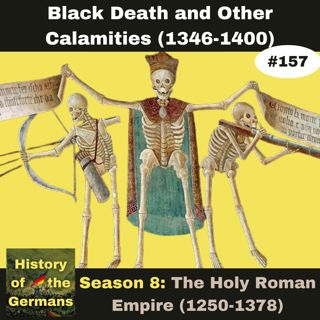
In around 1320 near the lake Issy-Kul in Kyrgysistan the rats started dying. Shortly after the inhabitants became affected with terrible diseases. Some started coughing up blood and all who did, died ...

1 Elo 202434min
Ep. 156: Karl IV (1346-1378) - What Price a Crown

Ep. 156: Karl IV (1346-1378) - What Price a Crown

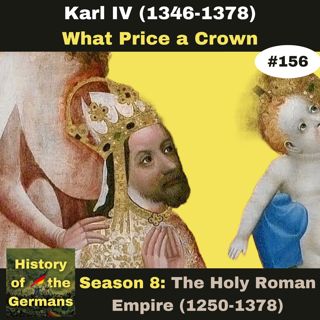
The year is 1346 and we have, yes, another succession crisis. Without checking through my 1500 pages of transcripts, I have counted a total f 14 contested imperial elections in the 427 years we have c...

25 Heinä 202425min
Ep. 155: Karl IV (1346-1378) - Youth of an Emperor

Ep. 155: Karl IV (1346-1378) - Youth of an Emperor

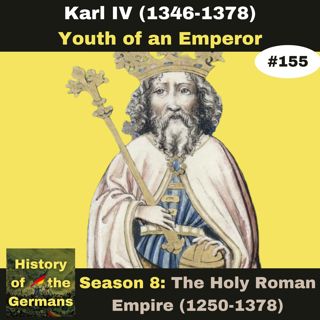
You have heard me complaining regularly over the last 154 episodes that what we report as political ambitions or strategic plans of the kings and emperors was pure conjecture derived from their action...

18 Heinä 202428min
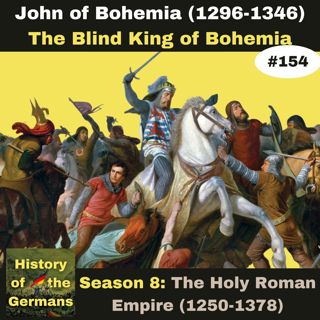
Ep. 154 - The Blind King John of Bohemia (1296-1346)

Ep. 154 - The Blind King John of Bohemia (1296-1346)

The noble and gallant King of Bohemia, also known as John of Luxemburg because he was the son of the Emperor Henry of Luxemburg, was told by his people that the battle had begun. Although he was in fu...

11 Heinä 202440min
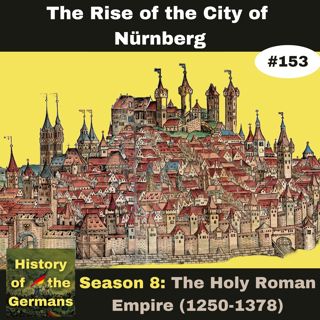
Ep. 153: The Rise of the City of Nürnberg in the 14th Century

Ep. 153: The Rise of the City of Nürnberg in the 14th Century

“In the same way that Jerusalem is the navel of the world, is Nurnberg the navel of Germany” is how Matthäus Dresser described the city in 1581. The astronomer Johannes Regiomontanus moved to Nurnberg...

27 Kesä 202427min
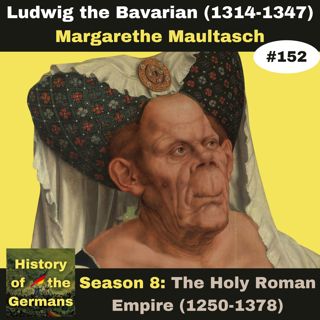
Ep.152: Ludwig the Bavarian (1314-1347) - The (not so) Ugly Duchess Margarete Maultasch

Ep.152: Ludwig the Bavarian (1314-1347) - The (not so) Ugly Duchess Margarete Maultasch

“The twelve-year-old Margarete, Princess of Carinthia and Tyrol, was travelling from her seat near Meran to Innsbruck for her wedding with the ten-year old Prince Johann of Bohemia. [..]Still and seri...

13 Kesä 202435min
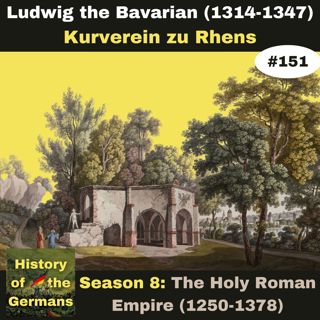
Ep. 151: Ludwig the Bavarian (1314-1347) - The Kurverein zu Rhens

Ep. 151: Ludwig the Bavarian (1314-1347) - The Kurverein zu Rhens

This week we look at the central intellectual debate of the 14th century, did Jesus own property? If yes, then it was right and proper that the church owned land, privileges, entire counties and duchi...

6 Kesä 202437min
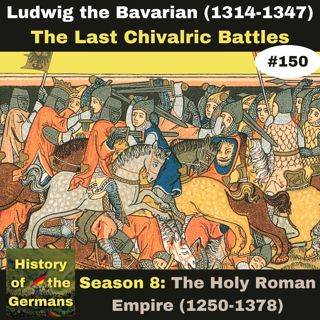
Ep. 150: Ludwig the Bavarian (1314-1347) - The Last Chivalric Battles – Morgarten and Mühldorf

Ep. 150: Ludwig the Bavarian (1314-1347) - The Last Chivalric Battles – Morgarten and Mühldorf

The 14th century is a time of fundamental change in practically all areas of social, political and economic life. It is a time when the certainties of the Middle Ages are replaced by a process of tria...

30 Touko 202438min

Suosittua kategoriassa Koulutus

rss-murhan-anatomia
psykopodiaa-podcast
voi-hyvin-meditaatiot-2
adhd-podi
rss-narsisti
rss-rahamania
rss-vapaudu-voimaasi
psykologia
rss-liian-kuuma-peruna
rss-valo-minussa-2
rahapuhetta
kesken
jari-sarasvuo-podcast
ihminen-tavattavissa-tommy-hellsten-instituutti
rss-duodecim-lehti
rss-turun-yliopisto
uskonnon-pitka-oppimaara
rss-niinku-asia-on
aamukahvilla
rss-tietoinen-yhteys-podcast-2