Comet MAPS Is Gone — What Killed It & What Comes Next + Planet Parade Tonight

Comet MAPS Is Gone — What Killed It & What Comes Next + Planet Parade Tonight

In this episode of Astronomy Daily, Anna and Avery cover six space and astronomy stories for Saturday, April 18, 2026. Comet MAPS has met its end at the Sun — the pair reflect on what happened and what comes next. Artemis III's SLS rocket stage rolls out of New Orleans on Monday. JWST and ALMA have revealed a stunning monster spiral galaxy hiding behind cosmic dust 11.5 billion years ago. An exoplanet system is changing its orbital architecture in real time. Four planets are gathering in a pre-dawn planet parade visible tonight. And 33,000 hydrogen halos have been found that solve a decades-old mystery about the early universe's fuel supply. Story 1: Comet MAPS — Death of a Sungrazer Comet C/2026 A1 (MAPS), a Kreutz sungrazer discovered on January 13, 2026 by French amateur astronomers at the AMACS1 Observatory in Chile, disintegrated during its close solar approach on April 4. The nucleus — estimated at approximately 400 metres in diameter based on JWST observations — could not survive passage just 160,000 km above the solar surface. A brief dust tail was visible in coronagraph images from SOHO and GOES-19, but the debris cloud has since dispersed. Attention now shifts to Comet C/2025 R3 (PanSTARRS) as the next comet of interest. MAPS was the furthest-discovered Kreutz sungrazer in history, spotted 81 days before perihelion. Sources: EarthSky | StarWalk Space News | Sky & Telescope Story 2: Artemis III SLS Core Stage Rollout On Monday, April 20, NASA will roll the top four-fifths of the Artemis III Space Launch System core stage — containing the liquid hydrogen tank, liquid oxygen tank, intertank, and forward skirt — out of the Michoud Assembly Facility in New Orleans and load it onto the Pegasus barge for delivery to Kennedy Space Center. The engine section is already at Kennedy Space Center's Vehicle Assembly Building. Four RS-25 engines are expected to arrive from Stennis Space Center by July 2026. Artemis III is currently targeting a 2027 launch for a crewed Earth-orbit test of Orion docking with commercial lunar landers, with a crewed Moon landing planned for 2028. Source: NASA Artemis III Media Release | nasa.gov Story 3: JWST & ALMA Reveal Monster Spiral Galaxy ADF22.A1 Using the James Webb Space Telescope and the Atacama Large Millimeter Array (ALMA), an international team led by Hideki Umehata (Nagoya University) has revealed the true nature of ADF22.A1 — a galaxy in the SSA22 protocluster from 11.5 billion years ago. Previously hidden behind heavy cosmic dust, JWST unveiled its spiral stellar structure while ALMA mapped its rotating gas disk, spinning at an extraordinary 530 km/s — more than twice our own Milky Way. With an effective radius of approximately 22,800 light years, it is nearly twice the size of typical galaxies from that era. Cold accretion from the Cosmic Web is the leading explanation for its rapid growth and spin-up. A companion study examines nine additional dusty star-forming galaxies in the same protocluster, revealing diverse evolutionary stages and morphologies. Sources: ALMA Observatory Press Release | Publications of the Astronomical Society of Japan (2025) | ApJ (2026) Story 4: TOI-201 — Shape-Shifting Exoplanet System A team led by Ismael Mireles (University of New Mexico) has published findings in Science Advances confirming three bodies in the exoplanet system TOI-201: a super-Earth (TOI-201 d, 1.4x Earth radius, 5.85-day orbit), a warm Jupiter (TOI-201 b, ~0.5 Jupiter masses, 53-day orbit), and a brown dwarf (TOI-201 c, ~7.9-year orbit). The brown dwarf's gravity is actively distorting the inner planets' orbits on human timescales — the super-Earth's transits are shifting, and within 200 years it will stop transiting the star from Earth's viewpoint. TOI-201 c is the longest-period transiting object ever discovered. The system is 372 light-years away in the constellation Pictor. Next transit of TOI-201 c: March 26, 2031. Paper: Mireles et al., Science Advances, April 15, 2026 | DOI: 10.1126/sciadv.aef2618 Story 5: April 18 Four-Planet Parade Mercury, Mars, Saturn, and Neptune are gathering in a compact cluster just 4 degrees wide in the pre-dawn eastern sky. Mercury (mag -0.1), Mars (mag 1.2), and Saturn (mag 0.9) are naked-eye targets. Neptune (mag 7.8) requires binoculars. Southern Hemisphere observers have the best view. Look east 60-90 minutes before sunrise. Peak window: April 16-23, with April 18-20 optimal. The cluster sits near the Pisces-Cetus border. App guide: Star Walk 2 / Sky Tonight | starwalk.space Story 6: 33,000 Hydrogen Halos Found in the Early Universe The Hobby-Eberly Telescope Dark Energy Experiment (HETDEX) has published a landmark study in The Astrophysical Journal identifying more than 33,000 Lyman-alpha nebulae — massive hydrogen gas halos surrounding galaxies from 10-12 billion years ago ('Cosmic Noon'). The previous known count was approximately 3,000. Lead researcher Erin Mentuch Cooper (UT Austin) described the halos as 'giant amoebas...

Tämä jakso on lisätty Podme-palveluun avoimen RSS-syötteen kautta eikä se ole Podmen omaa tuotantoa. Siksi jakso saattaa sisältää mainontaa.

Jaksot(500)

Tiny Robots, Alien Caves: NASA’s Plan for Titan

Tiny Robots, Alien Caves: NASA’s Plan for Titan

Anna and Avery cover NASA's newly funded concept for spherical, propeller-free "aerobots" that could one day explore the methane-carved cave systems of Saturn's moon Titan. Plus: SpaceX breaks its own...

17 Elo 18min
Exploring Moons with Atmospheres, Hot Jupiters, and the Mysteries of Black Holes | Space Nuts:...

Exploring Moons with Atmospheres, Hot Jupiters, and the Mysteries of Black Holes | Space Nuts:...

Sponsor Link: This Q&A episode of Space Nuts is brought to you with the support of NordVPN (https://www.nordvpn.com/spacenuts) . When you decide to get serius about your security online, do what we ...

17 Elo 34min
Is Empty Space Really Empty? A 90-Year-Old Mystery Gets Its Answer (S05E168 — The Weekend Wrap)

Is Empty Space Really Empty? A 90-Year-Old Mystery Gets Its Answer (S05E168 — The Weekend Wrap)

Today's episode — S05E168, Saturday August 15, 2026, our "Weekend Wrap": **Main story: a magnetar confirms 90-year-old vacuum birefringence prediction.** A team led by Rachael Stewart (George Washin...

15 Elo 15min
The Black Hole Wrapped in a Star: JWST’s Cosmic Dawn Discovery

The Black Hole Wrapped in a Star: JWST’s Cosmic Dawn Discovery

Anna and Avery break down JWST's discovery of MoM-BH*-1, the earliest known "black hole star" — a black hole shrouded in dense gas, glowing from just 660 million years after the Big Bang, that might e...

14 Elo 16min
Moon Crashes, Radiation-Eating Fungi, and the Quest for Habitable Worlds

Moon Crashes, Radiation-Eating Fungi, and the Quest for Habitable Worlds

SpaceTime Series 29 Episode 97 The world watches as a SpaceX rocket crashes into the Moon A disused SpaceX Falcon 9 upper stage has crashed into the Moon providing astronomers with useful data on the ...

14 Elo 20min
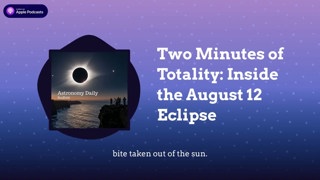
Two Minutes of Totality: Inside the August 12 Eclipse

Two Minutes of Totality: Inside the August 12 Eclipse

Anna and Avery break down yesterday's total solar eclipse — a 182-mile-wide shadow that swept from the Arctic through Greenland and Iceland to northern Spain, giving millions of people up to 2 minutes...

13 Elo 15min
The Galaxy’s Sugary Center Could Change How Life Began | Space Nuts: Astronomy Insights & Cosmic...

The Galaxy’s Sugary Center Could Change How Life Began | Space Nuts: Astronomy Insights & Cosmic...

13 Elo 27min
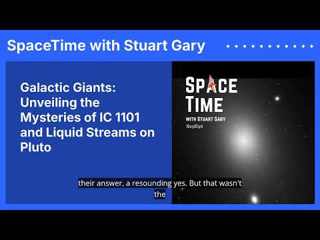
Galactic Giants: Unveiling the Mysteries of IC 1101 and Liquid Streams on Pluto

Galactic Giants: Unveiling the Mysteries of IC 1101 and Liquid Streams on Pluto

13 Elo 21min

Suosittua kategoriassa Tiede

rss-poliisin-mieli
tiedekulma-podcast
utelias-mieli
rss-mita-tulisi-tietaa
rss-tiedetta-vai-tarinaa
rss-duodecim-lehti
rss-hereilla
rss-ammamafia
rss-luontopodi-samuel-glassar-tutkii-luonnon-ihmeita
rss-astetta-parempi-elama-podcast
ihanat-ipanat
sotataidon-ytimessa
mielipaivakirja
rss-bios-podcast
rss-tervetta-skeptisyytta
docemilia