Beyond Governance: How To Build A Self-Healing Microsoft 365 Architecture For Scale

Beyond Governance: How To Build A Self-Healing Microsoft 365 Architecture For Scale

Your Microsoft 365 tenant is growing faster than your governance model can keep up. The first thing that breaks isn’t security tooling — it’s the assumption that people can review everything manually. You write policies. You define standards. You build governance frameworks. And then the tenant changes anyway. That’s the core problem. Governance, as most organizations implement it, doesn’t operate in real time. It reacts after the fact. And by the time reviews happen, drift has already spread. Prevention still matters. You need it. But prevention only defines what “good” looks like. Self-healing is what keeps the tenant alive.

⚠️ GOVERNANCE HAS BECOME ARCHITECTURE DEBT

Most governance models were built like documentation projects. They describe an ideal environment, but they don’t enforce reality. That gap is where risk grows. In modern Microsoft 365 tenants, change is constant. Teams are created daily. Private channels multiply. SharePoint permissions evolve. External sharing expands. Ownership becomes unclear. What starts as a small inconsistency doesn’t explode immediately. It sits quietly, accumulating exposure until it becomes a real issue. This is what governance debt looks like in practice:
  • A Team gets created for a project
  • Private channels are added later
  • Permissions drift from the original intent
  • External sharing remains open too long
  • Owners leave and nobody replaces them
The issue isn’t one bad configuration. It’s the time it stays uncorrected.

🔄 THE SHIFT: FROM MANUAL GOVERNANCE TO RUNTIME SYSTEMS

The solution isn’t better documentation or more reviews. It’s a different model entirely. A self-healing Microsoft 365 architecture operates as a continuous loop:
Desired State → Detection → Decision → Remediation
Instead of describing the environment, the system actively maintains it. That shift changes everything. Governance stops being a static layer around the platform and becomes part of the runtime itself.

🧠 HOW A SELF-HEALING MICROSOFT 365 SYSTEM WORKS

A working model separates responsibilities into clear layers, each with a specific role. The system starts with signals — the events that indicate something has changed. That might be a missing owner, broken inheritance, a removed sensitivity label, or unusual access patterns tied to AI usage. It then compares that signal against a defined state. This is the machine-readable definition of what “correct” looks like. It can come from tools like M365 DSC, emerging capabilities like UTCM, or custom Graph-based logic. From there, orchestration takes over. Logic Apps or similar workflows evaluate the situation and decide what kind of response is appropriate. Not every issue should be treated the same. Some require notification. Others require immediate containment. Finally, enforcement applies the fix. Permissions are corrected, labels restored, sharing restricted, or ownership reassigned. And every action is logged for audit and trust.

📉 THE METRICS THAT ACTUALLY MATTER

Most organizations still measure governance maturity based on documentation or policy coverage. That doesn’t reflect reality. What matters instead are operational metrics:
  • MTTR for drift
    How long does it take to detect and fix permission or configuration issues?
  • Copilot-safe coverage
    What percentage of your content is properly secured and ready for AI access?
These numbers reflect exposure, not intention. And that’s what leadership actually cares about.

🤫 FAILURE MODE #1: COPILOT EXPOSING HIDDEN DRIFT

Copilot doesn’t create risk. It accelerates visibility. A user asks a simple question and gets an answer built from content they technically had access to — but shouldn’t have been able to discover so easily. Nothing breaks. No alert fires. But the architecture reveals its weakness. This usually traces back to familiar issues:
  • Old SharePoint permissions that were never cleaned up
  • Broken inheritance structures
  • Stale sharing links
  • Missing or incorrect sensitivity labels
Before AI, these problems were slow-moving risks. Now they surface instantly. That’s why Copilot-safe coverage is critical. If your environment isn’t clean, AI will expose that faster than any audit ever could.

🔥 FAILURE MODE #2: TEAMS AND PRIVATE CHANNEL SPRAWL

The second failure mode is less subtle and far more visible. As Teams usage grows, organizations lose track of structure. Workspaces multiply. Ownership becomes inconsistent. Private channels introduce hidden complexity. This isn’t just clutter. It’s structural breakdown. You start seeing patterns like:
  • Teams without valid owners
  • Private channel sites with inconsistent permissions
  • Workspaces that remain active long after projects end
  • Increasing difficulty in compliance and search
Manual cleanup can’t keep up because creation always outpaces review. The problem isn’t naming conventions. It’s the lack of continuous state management.

🚧 THE HIDDEN LIMIT: MICROSOFT GRAPH THROTTLING

Even when organizations build automation, many systems fail under scale. At small volumes, scripts and workflows work fine. But as activity increases, Microsoft Graph begins to enforce limits. Requests get throttled. Write operations slow down. Retry logic becomes inefficient. What looks like a resilient system quickly becomes fragile. Common issues include:
  • Excessive polling instead of event-driven design
  • No prioritization between critical and low-risk fixes
  • Poor retry strategies without backoff or jitter
  • Ignoring pagination, leading to incomplete coverage
At that point, the system isn’t solving drift. It’s adding delay to it.

⚙️ BUILDING A RESILIENT REMEDIATION ENGINE

To scale effectively, the architecture needs to handle pressure, not just normal conditions. That means designing for:
  • Queue-based processing to avoid bursts
  • Backoff strategies that prevent retry storms
  • Separation of high-risk and low-priority workloads
  • Event-driven triggers instead of constant polling
  • Full coverage using paginated Graph queries
This is where many implementations fail — not in logic, but in execution under load.

🏗️ THE MICROSOFT 365 SELF-HEALING STACK

A practical implementation relies on a clear and maintainable stack. Microsoft Graph acts as the control plane, providing visibility and action across workloads. Logic Apps orchestrate decisions and workflows. Managed identity ensures secure, scalable authentication without the risks of stored secrets. Managed identity isn’t just cleaner — it removes a major failure point. No expired credentials. No hidden dependencies. No silent outages caused by forgotten secrets.

🚀 HOW TO START WITHOUT OVERCOMPLICATING IT

You don’t need to transform everything at once. Start with a single high-impact loop where drift is already visible. Focus areas often include:
  • Copilot-related exposure risks
  • Orphaned Teams ownership
  • Permission drift in SharePoint
Once one loop works reliably, expand gradually. Add more state definitions. Introduce prioritization. Improve resilience under load. The goal isn’t perfection. It’s consistent correction at scale.

🎯 FINAL THOUGHT

For years, governance was about preventing failure. Now it’s about responding to it fast enough that it doesn’t spread. Because in modern Microsoft 365 environments, change is constant. And the only systems that scale are the ones that can heal themselves in real time.

Become a supporter of this podcast: https://www.spreaker.com/podcast/m365-fm-modern-work-security-and-productivity-with-microsoft-365--6704921/support.

Tämä jakso on lisätty Podme-palveluun avoimen RSS-syötteen kautta eikä se ole Podmen omaa tuotantoa. Siksi jakso saattaa sisältää mainontaa.

Jaksot(869)

The Death of the Chatbot: Why Your Dataverse Strategy Is Broken

The Death of the Chatbot: Why Your Dataverse Strategy Is Broken

Microsoft Copilot has transformed how organizations interact with AI, making conversational experiences more accessible than ever. But while chat-based AI delivers immediate productivity gains, it doe...

29 Heinä 1h 41min

The Future of IT Is Agentic: Inside Windows 365, Intune & Microsoft's AI Vision with Christiaan Brinkhoff

The Future of IT Is Agentic: Inside Windows 365, Intune & Microsoft's AI Vision with Christiaan Brinkhoff

Christiaan Brinkhoff shares the remarkable career path that took him from speaking at community events and writing technical blogs to becoming one of the key people behind Microsoft's modern cloud des...

29 Heinä 1h 29min
How Do You Successfully Deploy Microsoft 365 Copilot Across an Enterprise?

How Do You Successfully Deploy Microsoft 365 Copilot Across an Enterprise?

A successful Microsoft 365 Copilot deployment begins long before licenses are assigned. Organizations should first define measurable business outcomes, identify high-value use cases, and secure execut...

29 Heinä 1h 32min

From Pilot to Production: Building Enterprise AI That Actually Delivers with Leon Gordon [MVP]

From Pilot to Production: Building Enterprise AI That Actually Delivers with Leon Gordon [MVP]

Leon Gordon explains why most enterprise AI initiatives never reach production and introduces the concept of the Pilot Tax—the hidden cost organizations pay when AI projects remain stuck in proof-of-c...

28 Heinä 59min

Microsoft Purview is a Trap: The Hard Truth About Data Governance

Microsoft Purview is a Trap: The Hard Truth About Data Governance

Microsoft Purview is included with many Microsoft 365 subscriptions, making it incredibly easy to enable. That convenience is also its biggest danger. Because there is no procurement process or large ...

28 Heinä 1h 1min

From Excel Expert to Microsoft MVP: Empowering Millions with Data, Dashboards & AI with Karen Abecia [Microsoft MVP]

From Excel Expert to Microsoft MVP: Empowering Millions with Data, Dashboards & AI with Karen Abecia [Microsoft MVP]

aren Abecia shares the remarkable journey that transformed a passion for Microsoft Excel into a global career as one of the world's best-known Excel educators. She explains how discovering creative sp...

27 Heinä 59min

The Copilot Credit Trap- Why Your AI Economy is Already Broken

The Copilot Credit Trap- Why Your AI Economy is Already Broken

For decades, enterprise software followed a predictable financial model. Organizations purchased licenses, assigned them to users, and budgeted annual IT spending with confidence. AI changes that comp...

26 Heinä 1h 12min
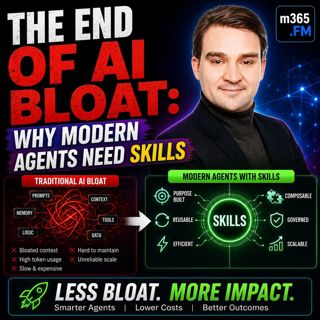
The End of AI Bloat: Why Modern Agents Need Skills

The End of AI Bloat: Why Modern Agents Need Skills

Many AI agents start out fast, responsive, and surprisingly intelligent. But after a few months of real-world use, something changes. Response times increase, costs rise, prompts become enormous, and ...

26 Heinä 1h 13min

Suosittua kategoriassa Politiikka ja uutiset

aikalisa
rss-ootsa-kuullut-tasta
ootsa-kuullut-tasta-2
uutiscast
rss-vaalirankkurit-podcast
otetaan-yhdet
rss-seksicast
tervo-halme
rss-podme-livebox
aihe
rss-girls-finish-f1rst
politiikan-puskaradio
et-sa-noin-voi-sanoo-esittaa
lotta-paakkunainen
rss-mina-ukkola
rss-kovin-paikka
rss-kuka-mina-olen
rss-raha-talous-ja-politiikka
rss-asiastudio
rss-pinnalla