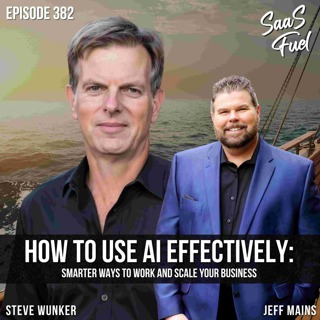
How to Use AI Effectively: Smarter Ways to Work and Scale Your Business | Steve Wunker | 382
SaaS Fuel23 Huhti

How to Use AI Effectively: Smarter Ways to Work and Scale Your Business | Steve Wunker | 382

What if AI isn't just a tool to plug into your business — but a reason to redesign the entire thing? In this episode, Jeff Mains sits down with Steven Wunker, managing director of New Markets Advisors and bestselling author of AI and the Octopus Organization: Building the Super Intelligent Firm. Steven has been working in AI since 2012 and has advised dozens of Fortune 500 companies on how to unlock real growth through transformation — not just optimization.

Steven challenges the "AI magic dust" approach most companies default to — sprinkling AI on top of existing workflows for marginal gains — and makes the case for something far more powerful: using AI to take over entire classes of tasks, redistribute decision-making to the front lines, and redesign how organizations actually work.

Whether you're a SaaS founder thinking about your product roadmap or a leader rethinking your org structure, this episode will challenge you to think way bigger.

Key Takeaways

4:13 — AI is the biggest shift of our lifetimes — bigger than smartphones Steve has been in AI since 2012 and helped launch one of the first smartphones in 1999. He says this is still bigger — not just in breadth of adoption, but in depth: changing strategies, org structures, and roles within companies.

7:14 — Stop using AI as "magic dust" Sprinkling AI on top of existing workflows only yields marginal gains. The real transformation happens when AI takes over entire tasks that humans won't do (too tedious), shouldn't do (not the best use of their skills), or can't do (too high volume). That's when organizations must fundamentally rethink how work gets done.

9:55 — The Octopus Organization: distributed intelligence in action The octopus has nine brains — one central brain and one in each arm. Each arm can sense, think, and act independently while remaining contextually aware of the whole. That biological model is the blueprint for how AI-powered organizations should be structured: parallel execution, distributed decision-making, and strategic focus at the center.

11:25 — Why authority hasn't truly been devolved — and how AI finally changes that For 40 years, leaders have talked about flattening orgs and devolving decision-making. It hasn't happened for two reasons: humans resist giving up authority, and front-line workers have lacked the contextual awareness to make good autonomous decisions. AI solves the second problem — and also gives leaders visibility to veto in near real-time rather than always having to pre-approve.

16:48 — Map the "work chart," not the org chart Microsoft calls it the "work chart" — how work actually flows through the organization, cross-functionally, in reality. That's what needs to be mapped and redesigned. Layering AI onto the org chart misses the point entirely. Change happens workflow by workflow, tranche by tranche.

26:29 — Three questions every leader must answer right now

  1. How does the competitive landscape change? (Include DIY and AI-native startups)
  2. What makes you special in an AI world?
  3. How do you get work done — what behaviors, culture, and structure do you need?

32:19 — Everyone in management is now a change manager It doesn't matter how technical your role is — if you have people reporting to you, you must become a change manager. That skill can no longer be confined to a C-suite priesthood. Psychological safety for AI adoption and rethinking how good work is incentivized are critical.

32:58 — The LUCK framework for strategic serendipity Derived from workforce survey research, four patterns that separate successful AI adopters:

  • L — Leverage help (stay connected, workflows are increasingly cross-functional)
  • U — Unexpected connections (be open to signals outside the average case)
  • C — Control chaos (build systems to absorb the disruption coming)
  • K — Know what's missing (AI is only as good as its data; humans must fill the gaps)

34:57 — Don't chase glamorous AI use cases first IBM's Watson failed spectacularly by targeting cancer diagnoses — the world's best oncologists didn't need it. The win? Recording doctor-patient conversations so doctors can actually practice medicine instead of typing. Low risk, high utility, high return. Start there.

38:05 — The most valuable AI use cases are unglamorous Things humans won't do: take notes after every meeting and distribute them. Things humans shouldn't do: type during patient consultations. Things humans can't do: transcribe and summarize 40 simultaneous three-person breakout groups and track individual commitments. AI can do all of this — none of it is flashy, all of it is high-value.

28:10 — Build in AI optionality from the start Upwork re-engineered their stack with an AI optionality layer — flexible to swap between small LLMs, large LLMs, agents, or other AI systems. You can't predict where AI goes. Build optionality in. Don't make bespoke bets you can't unwind.

Tweetable Quotes"AI has this ability to take over certain tasks entirely — things humans wouldn't do, shouldn't do, or simply can't do at scale. That's when it gets truly transformative." — Steven Wunker"We've been talking about devolving authority and de-siloing organizations since 'In Search of Excellence' in the 1980s. It just hasn't happened. AI finally changes the equation." — Steven Wunker"The octopus is 300 million years old — 70 million years older than the dinosaurs — and it has survived because it is so darn adaptable. We need to be like that." — Steven Wunker"AI magic dust — sprinkling it on top of what you're currently doing — will get you marginal improvements. That's nice. But it won't fundamentally change how organizations work." — Steven Wunker"Don't be Adobe in the face of Figma. That has already played out. It would be very easy for that to play out again in innumerable SaaS markets unless we think transformatively." — Steven Wunker"Every person in any management position is now a change manager. It doesn't matter how specialized your technical skill is." — Steven Wunker"Features are only as good as their adoption." — Steven Wunker"AI is only as good as the data that's in it — so it's the role of the human to think about what's NOT in that AI system that needs to complete the picture." — Steven WunkerSaaS Leadership Lessons

1. Redesign the work, don't just automate it. The companies that win with AI aren't the ones that add AI features — they're the ones that fundamentally rethink how work flows through the organization. Map your "work chart" (how work actually happens cross-functionally) and redesign it workflow by workflow. Layering AI on your existing org chart is the surest path to becoming the next Kmart.

2. Your installed base is an asset — but only if you act transformatively. Existing SaaS companies have something AI startups don't: data, customer relationships, and deep domain context. That is an enormous advantage — but only if you think transformatively. AI-native disruptors are watching your market. Your data moat only protects you if you use it to reimagine what you build, not just improve what you have.

3. Prioritize low-risk, high-utility AI use cases first. Resist the temptation to prove what AI can do with your most complex, high-stakes problem. Start where the utility is obvious and the risk is low. Prove value there. Build trust with customers and your team. Then expand. IBM's Watson at MD Anderson is a $62M cautionary tale. The doctor who gets to practice medicine instead of typing is the win.

4. Build optionality into your AI architecture. You cannot predict where AI capabilities are heading. Large models, small models, agents, new paradigms — the landscape is shifting too fast to make permanent bets. Build your product and internal systems with an optionality layer that stays flexible. Businesses that hard-code their AI assumptions will face expensive rebuilds. Those who build for adaptability will compound their advantage.

5. Transform your go-to-market alongside your product. AI transformation isn't just a product problem — it's a sales, marketing, and customer success problem. The companies that win aren't just selling software; they're selling a changed way of getting something done. That means customer success becomes more important, not less. Sales cycles involve more change management. Proving economic value requires new evidence. Think Workfront, not the feature-obsessed competitor it acquired.

6. Make change management everyone's job. The old model — change management as a C-suite discipline — is dead. In an AI-first organization, every manager at every level must develop the skills to lead people through uncertainty, redesign workflows, and create psychological safety for new ways of working. If you're building or leading a SaaS company, start developing these muscles now — in your leaders, your managers, and yourself.

Guest Resources

swunker@newmarketsadvisors.com

Book: AI and the Octopus Organization: Building the Super Intelligent Firm — Available on Amazon in all formats (print, ebook, audio)

Book Website:

Jaksot(385)

Overcoming Fear in Sales and Entrepreneurship: How to Build Confidence and Take Action | Jim Effner | 384

Overcoming Fear in Sales and Entrepreneurship: How to Build Confidence and Take Action | Jim Effner | 384

Jeff Mains sits down with Jim Effner, founder of P2P Group and a 36-year veteran of Northwestern Mutual, where he grew a firm from 63 to 127 financial advisors and nearly 400 total staff before sellin...

30 Huhti 44min

The Future of Legacy: How AI Can Preserve Your Story Forever | Brian Will | 383

The Future of Legacy: How AI Can Preserve Your Story Forever | Brian Will | 383

Brian Will — Wall Street Journal bestselling author, serial entrepreneur, and founder/CEO of Living Forever AI — joins host Jeff Mains for a wide-ranging conversation on entrepreneurship, scaling, sal...

28 Huhti 43min

New Competitive Moats in AI: Why Trust and Relationships Matter More Than Ever | Nikki Barua | 381

New Competitive Moats in AI: Why Trust and Relationships Matter More Than Ever | Nikki Barua | 381

Nikki Barua — immigrant, serial entrepreneur, and CEO of Flip Work — joins Jeff Mains for a conversation on what it truly takes to build something outsized in the AI age. Drawing on two decades of exp...

21 Huhti 45min

Ship, Learn, Repeat: The Real Growth Strategy for Startup Founders | Mike Collins | 380

Ship, Learn, Repeat: The Real Growth Strategy for Startup Founders | Mike Collins | 380

Mike Collins is a serial entrepreneur turned venture capitalist who has spent his career at the intersection of technology, innovation, and investing. Starting at a VC firm right out of college in 198...

16 Huhti 52min

How to Turn Customers into Brand Advocates and Drive Word-of-Mouth Growth | Ken Rapp | 379

How to Turn Customers into Brand Advocates and Drive Word-of-Mouth Growth | Ken Rapp | 379

Most SaaS founders obsess over acquisition — but what happens after the sale is where loyalty is either built or silently lost. In this episode, Jeff Mains sits down with Ken Rapp, CEO and co-founder ...

14 Huhti 46min

How Tech Professionals Can Avoid Concentration Risk and Build Financial Freedom | Stanley Leong | 378

How Tech Professionals Can Avoid Concentration Risk and Build Financial Freedom | Stanley Leong | 378

In this episode, Jeff Mains sits down with Stanley Leong — former IBM/Agilent engineer turned bestselling author and private wealth advisor — to explore what it truly means to engineer your finances. ...

9 Huhti 45min

AI and Emotional Intelligence: Finding the Balance in Modern Research | James Warren | 377

AI and Emotional Intelligence: Finding the Balance in Modern Research | James Warren | 377

What if the most valuable data in your company isn't in a dashboard — it's buried in stories no one is asking for?In this episode, Jeff Mains sits down with James Warren, founder and CEO of Share More...

7 Huhti 52min

Suosittua kategoriassa Liike-elämä ja talous

sijotuskasti
mimmit-sijoittaa
rss-rahapodi
psykopodiaa-podcast
hyva-paha-johtaminen
rss-oivalluksia-rahasta-elamasta
rss-rahamania
inderespodi
rss-lahtijat
ostan-asuntoja-podcast
rahapuhetta
oppimisen-psykologia
lakicast
rss-bisnesta-bebeja
rss-sisalto-kuntoon
rss-inderes
leadcast
mihin-sita-saastais
rss-rikasta-elamaa
rss-40-ajatusta-aanesta