BONUS: Swine Design Secrets: Eli Berant Discusses the Optimus Swine

BONUS: Swine Design Secrets: Eli Berant Discusses the Optimus Swine

Episode Overview

The Butcher Shop goes deep on one of the Great Lakes predator fly world's most distinctive patterns in this conversation with Eli Berant, the Michigan-based fly designer and founder of Great Lakes Fly. Eli is the creator of the Optimus Swine — a reverse foam head-embedded, side-kicking musky streamer that has been turning heads and producing fish since around 2009. In this episode, host Marvin Cash walks Eli through the full arc of the pattern: the lake musky problem it was designed to solve, the unconventional decision to reverse a foam popper head to create a slower fall and a pronounced glide-bait wiggle, the material choices that define the fly's profile and movement and the step-by-step construction logic from spinner bait hook to laser dub head.

The conversation covers the full Swine family — the original 8–9 inch version on a 6/0 Mustad, the scaled-down Swine Junior for river smallmouth and stripers, the fettuccine-foam Pot Belly Swine for subsurface river applications, and the articulated Maximus Swine and Maximus Swine Junior, which remain something of a "secret menu" offering. Eli also addresses color selection by region — from olive-and-pink for fired-up Tennessee muskies to the Wisconsin-proven Willen's Villain black-white-yellow combo and his own favorite Mardi Gras pattern — and breaks down his preferred line and leader systems for lake musky versus river smallmouth applications. Throughout, the discussion grounds fly design theory in direct, tactical fishing application.

Key Takeaways
  • How reversing a foam popper head toward the rear of the hook creates a slower fall rate and induces the Optimus Swine's distinctive side-to-side glide-bait action.
  • Why proportionality in bucktail application — specifically how much material per section and how many sections — is the most common failure point for tiers attempting the Swine for the first time.
  • How to tune the Pot Belly Swine's fettuccine foam piece by removing individual strips to achieve neutral balance and proper swim orientation before fishing.
  • Why a jerk-strip retrieve with a sinking line (350–450 grain tip) is the preferred delivery system for lake musky, allowing the sink tip to hold depth while the fly kicks side to side on each pull.
  • When to dial back retrieve aggression and employ a stutter-strip or extended pause with the Swine Junior, particularly during cold-water conditions when bass are holding and waiting.
  • Why sharing newly discovered synthetic fly tying materials openly — rather than hoarding them — is essential to keeping those materials in production and available to the broader tying community.

Techniques & Gear Covered

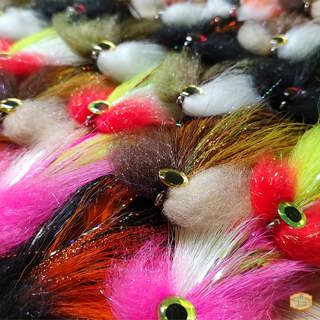
The Optimus Swine is designed around a jerk-strip retrieve that drives its foam-induced side-to-side action, and Eli breaks down exactly how to execute it — stripping two feet with the line hand in alternating pulls, roughly like ripping a bag open. For lake musky, he runs a 10-weight with a 350–450 grain sinking tip, paired with a short 3–4 foot leader from loop to fly — a butt section of 40-pound to wire, finished with cross-lock snaps for fast fly changes. River smallmouth and striper applications drop to a 7- or 8-weight with a 200–350 grain tip depending on conditions. Construction-specific details are substantial: Mustad 32608 spinner bait hook (6/0 for the original), Rainy's Mini Me medium foam popper head reversed and goop-set with silicone adhesive, synthetic yak hair blended with flash for the tail, grizzly saddle feathers as flanks, Magnum Flashabou, everyday bucktail applied in top-and-bottom sections, laser dub for the head, and 1/2-inch eyes pressed and held in a two-touch goop cure process. Anadromous Fly Company tungsten carbide scissors get a specific callout as Eli's go-to cutting tool for heavy production tying.

Locations & Species

The Optimus Swine was developed specifically for lake musky, with Lake Saint Clair in Michigan serving as the primary proving ground — a relatively snag-free fishery that allows anglers to fish sinking lines freely across the water column. The pattern's documented multi-species versatility extends to Great Lakes migratory species, pike, lake trout, stripers on the East Coast and river smallmouth, including Eli's personal use of the Swine Junior on Lake Saint Clair for targeting large smallmouth by eliminating the smaller fish. Color selection is explicitly regional in the episode: olive-and-pink for fired-up Tennessee fish, pink-and-chartreuse or the Willen's Villain black-white-yellow for Wisconsin tannic water, and Mardi Gras (pink, chartreuse, black head) as a broadly effective pattern.

FAQ / Key Questions AnsweredHow does the reversed foam popper head make the Optimus Swine swim differently than other musky flies?

Positioning the foam head toward the rear of the hook — rather than at the front — reduces the fly's sink rate compared to a traditional epoxy-head pattern and shifts the center of buoyancy rearward. This causes the fly to kick side to side with a pronounced glide-bait cadence on a jerk-strip retrieve, rather than simply pushing water or diving. The effect is amplified when fishing a sinking tip, which holds the running line low and forces the rear of the fly to tip upward and roll on each strip.

What are the most common mistakes tiers make when tying the Optimus Swine?

Eli identifies two primary failure points: applying bucktail in clumps that are too large, which destroys proportionality, and using too much laser dub in the head, which throws the silhouette out of balance. The fix for bucktail is learning to feel the correct bundle size — roughly the width of a toothpick at the pinch, the width of a popsicle stick at the ends — and building five top-and-bottom sections before reaching the laser dub head on the original Swine. Managing the laser dub means stacking it, pulling off loose fibers and removing material rather than adding more.

How do you tune the Pot Belly Swine to swim correctly for river applications?

Because the Pot Belly Swine uses fettuccine foam strips in place of the reversed popper head, Eli ties in more foam strips than needed — six to eight — and tells buyers they may need to remove one to four strips to get the fly to balance and swim true. The goal is first to eliminate any spin or tilt, then to dial in the side-to-side action. This is the same principle as Barry Reynolds's flash philosophy applied to buoyancy: put in more than you need because you can always remove it, but you can't add it once the fly is finished.

What line and leader setup does Eli prefer for lake musky with the Optimus Swine?

For open lake musky fishing on snag-light water, Eli runs a 10-weight with a Scientific Anglers sinking tip in the 350–450 grain range, specifically preferring striper-style lines with a long 26–28 foot tip section. Leaders are intentionally short — 3–4 feet total from loop to fly — built with a 2-foot 40-pound butt section going straight to wire, then a cross-lock snap at the fly. The short leader keeps the fly in the sink tip's depth zone and maximizes the kicking action on the jerk-strip retrieve.

How should retrieve style change when downsizing to the Swine Junior for smallmouth or stripers?

Moving to the smaller patterns calls for a less aggressive retrieve cadence overall, but Eli emphasizes breaking out of monotonous repetition — consciously varying the retrieve is as important as the base technique. Key adjustments include a stutter-strip (half-length pulls done twice in quick succession) and extended pauses, which become particularly effective in cold water when bass are holding and watching the fly. The foam piece in all Swine variants allows the fly to hang suspended during a pause without sinking, which is the primary trigger for following fish.

Sponsors

Thanks to TroutRoutes for sponsoring this episode. Use ARTFLY20 to get 20% off of your TroutRoutes Pro membership.

Related Content

S1, Ep 2: The T-Bone: A Deep Dive with Blane Chocklett - The Butcher Shop

BONUS: Shack Nasties and the Drunk & Disorderly: A Winter Chat with Tommy Lynch

BONUS: Crafting The Nut Job: A Deep Dive with Brendan Ruch

BONUS: A Deep Dive into the Swingin' D: Techniques and Tips with Mike Schultz

S6, Ep 124: Fly Tying with Chase Smith

Connect with Our Guest

Follow Eli on

Tämä jakso on lisätty Podme-palveluun avoimen RSS-syötteen kautta eikä se ole Podmen omaa tuotantoa. Siksi jakso saattaa sisältää mainontaa.

Jaksot(1088)

S8, Ep 59: Pennsylvania Smallmouth Report: Captain Brian Shumaker's Late Summer Strategies

S8, Ep 59: Pennsylvania Smallmouth Report: Captain Brian Shumaker's Late Summer Strategies

Episode OverviewOn this Pennsylvania Smallmouth Report from The Articulate Fly fly fishing podcast, host Marvin Cash checks in with Captain Brian Shumaker of Susquehanna River Guides for a mid-August ...

12 Elo 7min

S8, Ep 58: Central PA Fishing Report: George Costa's Summer Strategies for Success

S8, Ep 58: Central PA Fishing Report: George Costa's Summer Strategies for Success

Episode OverviewGeorge Costa of TCO Fly Shop returns to The Articulate Fly fly fishing podcast for another Central PA Fishing Report with host Marvin Cash, checking in on mid-summer conditions across ...

7 Elo 4min

S8, Ep 57: The Power of Habit: Mac Brown's Strategies for Fishing Success

S8, Ep 57: The Power of Habit: Mac Brown's Strategies for Fishing Success

Episode OverviewHow can anglers turn a slow, hot summer on the water into long-term improvement? On this Casting Angles installment of The Articulate Fly fly fishing podcast, host Marvin Cash and Mast...

6 Elo 9min

BONUS: The Science of Streamers (Pt I): Kirk Klingensmith on Jigging and Wrecking Flies

BONUS: The Science of Streamers (Pt I): Kirk Klingensmith on Jigging and Wrecking Flies

Episode OverviewOn this episode of The Butcher Shop fly fishing podcast, host Marvin Cash sits down with Kirk Klingensmith, a retired Corning engineer and lifelong angler, for a physics-driven breakdo...

1 Elo 1h 1min

S8, Ep 56: Topwater Tactics: Captain Brian Shumaker's Pennsylvania Smallmouth Report

S8, Ep 56: Topwater Tactics: Captain Brian Shumaker's Pennsylvania Smallmouth Report

Episode OverviewOn this Pennsylvania Smallmouth Report from The Articulate Fly fly fishing podcast, host Marvin Cash checks in with Captain Brian Shumaker of Susquehanna River Guides for a peak-summer...

29 Heinä 10min

S8, Ep 55: Summer Secrets: George Costa's Central PA Fishing Report

S8, Ep 55: Summer Secrets: George Costa's Central PA Fishing Report

Episode OverviewIn this Central PA Fishing Report on The Articulate Fly fly fishing podcast, host Marvin Cash checks in with George Costa of TCO Fly Shop in State College, Pennsylvania, for an end-of-...

25 Heinä 3min

S8, Ep 54: Weathering the Storm: Matt Reilly on Adapting to Summer Fishing Conditions

S8, Ep 54: Weathering the Storm: Matt Reilly on Adapting to Summer Fishing Conditions

Episode OverviewWhat happens to smallmouth bass fishing in Southwest Virginia when a big summer rain event hits after weeks of low, clear water? On this Southwest Virginia Fishing Report from The Arti...

24 Heinä 11min

S8, Ep 53: Cool Waters and Hot Days: Mac Brown’s Guide to Summer Fishing

S8, Ep 53: Cool Waters and Hot Days: Mac Brown’s Guide to Summer Fishing

Episode OverviewWith freestone trout streams across the Southeast pushing into the upper 60s and low 70s by mid-morning, serious anglers need a plan for beating the summer heat. On this Casting Angles...

22 Heinä 6min

Suosittua kategoriassa Koulutus

rss-murhan-anatomia
psykopodiaa-podcast
voi-hyvin-meditaatiot-2
rss-arkea-ja-aurinkoa-podcast-espanjasta
kesken
rss-vapaudu-voimaasi
rss-niinku-asia-on
rss-liian-kuuma-peruna
adhd-podi
rss-suomen-aa-podcast
jari-sarasvuo-podcast
aamukahvilla
psykologia
rahapuhetta
rss-luonnollinen-synnytys-podcast
rss-duodecim-lehti
rss-laadukasta-ensihoitoa
solu-ja-molekyylibiologian-perusteet
rss-johtajatabut-aiheita-joista-ei-ole-tapana-puhua
rss-nyt-puhutaan-ulosotosta