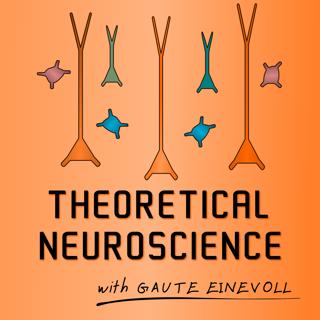
On smelling your way to the fruit with ring models - with Katherine Nagel - #40

On smelling your way to the fruit with ring models - with Katherine Nagel - #40

Fruit flies need a short-term (working) memory to keep their direction when they navigate their way to the fruit by smelling.

Mean-field ring models was theoretically suggested to encode stimulus orientations 30 years and was observed in fruit-fly compass neurons 10 years ago. But how does odor input come into the picture to set the compass course?

The group of the guest has studied the question with a host of different experimental and theoretical methods.

Tämä jakso on lisätty Podme-palveluun avoimen RSS-syötteen kautta eikä se ole Podmen omaa tuotantoa. Siksi jakso saattaa sisältää mainontaa.

Jaksot(43)

On the computational neuroscience legacy of Valentino Braitenberg - with Ad Aertsen - #43

On the computational neuroscience legacy of Valentino Braitenberg - with Ad Aertsen - #43

The prominent and colorful neuroscientist Valentino Braitenberg was born 100 years ago. He co-founded the Max Planck Institute of Biological Cybernetics in Tübingen in Germany, where he made seminal c...

25 Heinä 1h 10min

On neuronal identity and representational drift - with Timothy O'Leary - #42

On neuronal identity and representational drift - with Timothy O'Leary - #42

A bursting neuron can maintain its firing-pattern identity throughout an animal's life, even though the ion-channel proteins underlying this identity are turned over on the timescale of days.   Today'...

20 Kesä 1h 43min

On functional effects of neuronal heterogeneity - with David Dahmen - #41

On functional effects of neuronal heterogeneity - with David Dahmen - #41

Most neural network models till date have assumed all neurons to be identical, or at least that all neurons within a population are identical. In reality, no two neurons are completely the same. Is th...

23 Touko 1h 29min

On modeling neural population activity with mean-field models - with Tilo Schwalger - #39

On modeling neural population activity with mean-field models - with Tilo Schwalger - #39

Starting with the work of pioneers like Wilson and Cowan in the 1970s, mean‑field models have become a dominant tool for modeling neural activity at the level of neuronal populations. Despite their p...

28 Maalis 2h 18min

On extracting spiking network models from experiments - with Richard Gao - #38

On extracting spiking network models from experiments - with Richard Gao - #38

While some models aim to explain qualitative features of brain activity, other aim to reproduce experimental data quantitatively. If so, model parameters must be adjusted to make the model predictions...

28 Helmi 1h 35min
On reproducibility of modeling and 10 years with the Potjans-Diesmann network model - with Hans Ekkehard Plesser - #37

On reproducibility of modeling and 10 years with the Potjans-Diesmann network model - with Hans Ekkehard Plesser - #37

Reproducibility is key for scientific progress. If research results cannot be reproduced and trusted, other researchers cannot build on them. Reproducibility is a challenge also in computational neuro...

31 Tammi 1h 28min

On low-dimensional manifolds in motor cortex - with Sara Solla - #36

On low-dimensional manifolds in motor cortex - with Sara Solla - #36

Historically, the analysis of neural recordings focused on responses of single neurons recorded by single-contact electrodes. Modern electrodes with multiple electrode contacts can instead record spik...

3 Tammi 2h 4min

Suosittua kategoriassa Tiede

tiedekulma-podcast
rss-poliisin-mieli
rss-mita-tulisi-tietaa
rss-hereilla
rss-bios-podcast
filocast-filosofian-perusteet
hippokrateen-vastaanotolla
rss-sosiopodi
rss-duodecim-lehti
rss-murremyytin-murtajat
utelias-mieli
rss-astetta-parempi-elama-podcast
rss-totuuden-liepeilla
rss-metsanomistaja-podcast
rss-lapsuuden-rakentajat-podcast