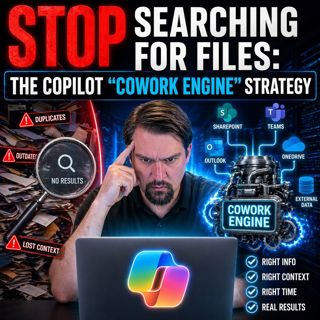

Stop Searching for Files: The Copilot "Cowork Engine" Strategy

Stop Searching for Files: The Copilot "Cowork Engine" Strategy

Search is not a feature.
It is a failure signal. If your day starts with a search bar, your system is already working against you. What most organizations call “document management” is, in reality, a high-density storage system for dead data. Files are stored, duplicated, renamed, and forgotten—while the burden of finding meaning is pushed entirely onto the human. You are expected to remember:
  • where something was saved
  • which version is correct
  • whether “Final_v2” is actually final
That’s not productivity. That’s manual retrieval labor disguised as knowledge work. The gap becomes obvious when you compare it to consumer search. At home, you find what you need in seconds. At work, the same action can take twenty minutes—and still end in uncertainty. That gap isn’t about technology capability. It’s about architectural failure. This is the Search Tax. It shows up quietly, but its impact is massive. Time lost to searching compounds across teams, turning highly skilled employees into navigators of clutter instead of decision-makers. It also creates dependency loops—people interrupt colleagues because they can’t trust what they find. And most dangerously, when the “right” version isn’t obvious, people guess. And guessing in business is expensive.

FROM ASSISTANT TO ARCHITECT: THE COWORK ENGINE SHIFT

Most companies are still using Copilot like an assistant—reactive, prompt-driven, and dependent on human direction. That model doesn’t remove the Search Tax.
It just speeds up the wrong process. To actually eliminate search, you need a different paradigm: the Cowork Engine. This is not a chatbot. It’s an execution layer. Instead of waiting for instructions, the engine:
  • understands relationships between data
  • assembles context automatically
  • executes tasks in the background
At the core of this model is what we can call Work IQ—a system-level understanding of how information connects across your organization. It doesn’t just see files; it sees:
  • how emails relate to documents
  • how meetings influence decisions
  • how timelines connect across systems
This is where the shift becomes real. You’re no longer asking: “Where is the file?” You’re saying: “Prepare the output.” And the system does the rest.

STRUCTURED CONTEXT: FROM DATA GRAVEYARD TO SIGNAL LAYER

The biggest mistake organizations make is giving AI access to everything and expecting clarity. That approach creates noise—not intelligence. If your system contains thousands of outdated or duplicate files, the model doesn’t magically filter them. It gets confused by them. The result is inconsistent outputs, outdated insights, and a growing lack of trust. The solution is not more data. It’s better context. A Cowork Engine requires a curated layer where:
  • authoritative sources are defined
  • duplicates are removed
  • external systems are connected intentionally
This is where structured platforms and connectors come into play. Instead of forcing users to jump between tools, the system pulls in:
  • live operational data
  • verified documents
  • relevant communication threads
The key shift is simple but powerful: The system assembles context so the user never has to search for it. Work no longer starts with navigation.
It starts with ready-made understanding.

GOVERNANCE-BY-DESIGN: TRUST AS INFRASTRUCTURE

Speed without control is risk. That’s why governance in this model isn’t an afterthought—it’s built directly into how the system operates. Permissions define visibility. Identity shapes context. Sensitivity travels with the data. This means:
  • the system only sees what the user is allowed to see
  • outputs inherit classification automatically
  • compliance is enforced during execution—not after
Instead of auditing after the fact, the system ensures correctness in real time. This is what turns AI from a liability into a trusted coworker.

FROM SEARCH RESULTS TO EXECUTION: THE AUDIT PACK EXAMPLE

The difference between old and new architecture becomes obvious in high-pressure scenarios. Take a compliance audit. In the traditional model, this triggers a manual process:
  • searching multiple systems
  • downloading files
  • reconciling versions
  • building reports manually
It’s slow, fragmented, and error-prone. In a Cowork Engine model, the workflow flips. You provide intent: “Build an audit pack for Vendor X.” The system:
  • retrieves authoritative contracts
  • scans relevant email threads
  • extracts decisions from Teams conversations
  • compiles a structured, validated output
What you receive is not a list of links. It’s a decision-ready artifact, complete with traceability back to source data. The human role shifts from searching to validating.

MEMORY AND RAG: HOW THE SYSTEM GETS SMARTER

What makes this model scalable is not just retrieval—it’s learning. Traditional AI resets with every interaction. The Cowork Engine does not. It builds a persistent memory layer that:
  • captures corrections
  • stores preferred formats
  • learns decision patterns
Over time, the system evolves:
  • fewer errors
  • less rework
  • more alignment with business expectations
This transforms AI from a tool into a living system of institutional knowledge. Your data may be shared across competitors. Your memory layer is not.

MEASURING SUCCESS: FROM SEARCH TIME TO DECISION SPEED

You can’t measure this transformation by counting prompts or outputs. The real metric is:
TIME-TO-DECISION
How long does it take to go from request → to trusted action? Supporting this are two critical indicators:
  • Rework Rate
    How often outputs need correction
  • Search Dependency
    How often humans still need to “look things up”
When the architecture is right:
  • decision cycles shrink dramatically
  • rework approaches zero
  • search becomes irrelevant
That’s when you know the Search Tax is gone.

FINAL TAKEAWAY

Search was designed for a slower world. A world where:
  • data was smaller
  • decisions were slower
  • navigation was acceptable
That world no longer exists. Today, speed comes from context, not discovery. If your system still requires people to hunt for information, you are operating at a structural disadvantage. The companies that win in 2026 will not be better at searching. They will be better at not needing to search at all.

Become a supporter of this podcast: https://www.spreaker.com/podcast/m365-fm-modern-work-security-and-productivity-with-microsoft-365--6704921/support.

Tämä jakso on lisätty Podme-palveluun avoimen RSS-syötteen kautta eikä se ole Podmen omaa tuotantoa. Siksi jakso saattaa sisältää mainontaa.

Jaksot(869)

The Death of the Chatbot: Why Your Dataverse Strategy Is Broken

The Death of the Chatbot: Why Your Dataverse Strategy Is Broken

Microsoft Copilot has transformed how organizations interact with AI, making conversational experiences more accessible than ever. But while chat-based AI delivers immediate productivity gains, it doe...

29 Heinä 1h 41min

The Future of IT Is Agentic: Inside Windows 365, Intune & Microsoft's AI Vision with Christiaan Brinkhoff

The Future of IT Is Agentic: Inside Windows 365, Intune & Microsoft's AI Vision with Christiaan Brinkhoff

Christiaan Brinkhoff shares the remarkable career path that took him from speaking at community events and writing technical blogs to becoming one of the key people behind Microsoft's modern cloud des...

29 Heinä 1h 29min
How Do You Successfully Deploy Microsoft 365 Copilot Across an Enterprise?

How Do You Successfully Deploy Microsoft 365 Copilot Across an Enterprise?

A successful Microsoft 365 Copilot deployment begins long before licenses are assigned. Organizations should first define measurable business outcomes, identify high-value use cases, and secure execut...

29 Heinä 1h 32min

From Pilot to Production: Building Enterprise AI That Actually Delivers with Leon Gordon [MVP]

From Pilot to Production: Building Enterprise AI That Actually Delivers with Leon Gordon [MVP]

Leon Gordon explains why most enterprise AI initiatives never reach production and introduces the concept of the Pilot Tax—the hidden cost organizations pay when AI projects remain stuck in proof-of-c...

28 Heinä 59min

Microsoft Purview is a Trap: The Hard Truth About Data Governance

Microsoft Purview is a Trap: The Hard Truth About Data Governance

Microsoft Purview is included with many Microsoft 365 subscriptions, making it incredibly easy to enable. That convenience is also its biggest danger. Because there is no procurement process or large ...

28 Heinä 1h 1min

From Excel Expert to Microsoft MVP: Empowering Millions with Data, Dashboards & AI with Karen Abecia [Microsoft MVP]

From Excel Expert to Microsoft MVP: Empowering Millions with Data, Dashboards & AI with Karen Abecia [Microsoft MVP]

aren Abecia shares the remarkable journey that transformed a passion for Microsoft Excel into a global career as one of the world's best-known Excel educators. She explains how discovering creative sp...

27 Heinä 59min

The Copilot Credit Trap- Why Your AI Economy is Already Broken

The Copilot Credit Trap- Why Your AI Economy is Already Broken

For decades, enterprise software followed a predictable financial model. Organizations purchased licenses, assigned them to users, and budgeted annual IT spending with confidence. AI changes that comp...

26 Heinä 1h 12min
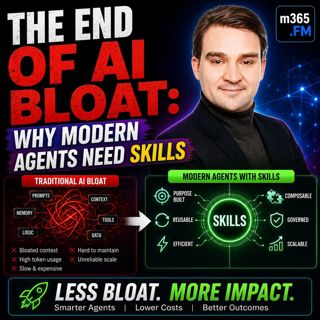
The End of AI Bloat: Why Modern Agents Need Skills

The End of AI Bloat: Why Modern Agents Need Skills

Many AI agents start out fast, responsive, and surprisingly intelligent. But after a few months of real-world use, something changes. Response times increase, costs rise, prompts become enormous, and ...

26 Heinä 1h 13min
Suosittua kategoriassa Politiikka ja uutiset

aikalisa
rss-ootsa-kuullut-tasta
ootsa-kuullut-tasta-2
uutiscast
rss-vaalirankkurit-podcast
otetaan-yhdet
rss-seksicast
tervo-halme
rss-podme-livebox
aihe
rss-girls-finish-f1rst
politiikan-puskaradio
et-sa-noin-voi-sanoo-esittaa
lotta-paakkunainen
rss-mina-ukkola
rss-kovin-paikka
rss-kuka-mina-olen
rss-raha-talous-ja-politiikka
rss-asiastudio
rss-pinnalla