Why Your Enterprise AI is Blind: The Case for Graph Connectors

Why Your Enterprise AI is Blind: The Case for Graph Connectors

Your enterprise AI isn’t failing because the model is bad.
It’s failing because it can’t see. Most organizations think they’ve “enabled AI” by connecting Copilot to SharePoint and OneDrive. They clean up documents, organize folders, and assume the job is done. But that’s only a fraction of the actual business reality. The majority of critical context lives outside that world. It’s in ticketing systems, ERPs, CRMs, approval tools, and legacy databases. If that data isn’t indexed into the Microsoft Graph, your AI doesn’t know it exists. So when you ask for insights, summaries, or recommendations, the AI responds with confidence—but without the full picture. It produces answers that look right, sound right, and are completely disconnected from real-time business conditions. That’s not intelligence. That’s a liability. In this episode, we break down why most enterprise AI is fundamentally blind and how Graph connectors are the missing layer that turns isolated data into real awareness.

WHAT’S REALLY HAPPENING

Right now, most AI implementations rely on static knowledge. Documents, PDFs, and stored content act as the source of truth. But business doesn’t run on static files. It runs on live systems, changing states, and real-time signals.
  • AI is trained on snapshots, not reality
  • Critical updates happen outside its field of view
  • Decisions are made on outdated or incomplete data
This creates a dangerous gap between what the AI “knows” and what is actually happening inside the business at that moment.

THE THREE MAJOR BLIND SPOTS

Across organizations, the same visibility gaps keep appearing. The first is approvals. Decisions that control money, deployments, or contracts often live in external systems or email threads. If the AI can’t see approval status, it assumes everything is ready to proceed. The second is the customer journey. Sales, support, and delivery data are split across different platforms. Without a unified view, the AI might recommend a sales action while the customer is actively dealing with a critical issue. The third is risk and exceptions. The real guardrails of a business—waivers, audit notes, special conditions—are rarely stored in standard document libraries. Without access to these, AI recommends the “standard” path, even when it shouldn’t. In all three cases, the issue isn’t logic. It’s missing context.

WHY CONNECTORS CHANGE EVERYTHING

Graph connectors solve a very specific problem. They don’t just move data. They make that data visible and usable for AI reasoning. By bringing external systems into the Microsoft Graph, you give the AI access to:
  • Live status instead of static documents
  • Process signals like approvals and exceptions
  • End-to-end context across systems
This turns the AI from a document reader into something far more powerful—a system that understands how your business actually operates. Instead of answering based on isolated content, it starts reasoning across workflows, states, and dependencies.

THE SHIFT FROM STATIC TO LIVE INTELLIGENCE

We are moving away from a model where AI searches for answers in files.
We are moving toward a model where AI continuously understands what is happening. That requires a different architecture. Instead of periodic uploads and manual indexing, you need event-driven ingestion. When something changes in your systems, that change needs to be reflected immediately. Identity, permissions, and data structure all need to align so the AI can interpret and secure that information correctly. This is no longer about storing knowledge. It’s about streaming reality.

GOVERNANCE IS THE DIFFERENTIATOR

As soon as AI has access to more data, trust becomes the critical factor. If users aren’t confident that permissions are respected, adoption slows down. If sensitive data is exposed incorrectly, the risk is immediate. That’s why governance isn’t a blocker. It’s an accelerator. When connectors are built with proper identity mapping, access control, and data boundaries, the organization gains something far more valuable than speed. It gains confidence. Confidence allows scale.

FROM AUTOMATION TO AWARENESS

Most companies are still using AI as a faster way to generate content. Draft emails, summarize documents, answer questions. But the real value comes from awareness. An AI that understands approvals, customer context, and risk signals can guide decisions, not just respond to prompts. It becomes part of the operational flow instead of sitting on top of it. That’s the difference between a chatbot and a true intelligence layer.

FINAL THOUGHT

If your AI can only see documents, it’s operating in the past. If it can see your systems, your states, and your signals, it can operate in the present. That’s the shift. Stop treating the Microsoft Graph as a storage layer.
Start treating it as the nervous system of your business. Because intelligence without visibility isn’t intelligence at all. It’s just guessing—at scale.

Become a supporter of this podcast: https://www.spreaker.com/podcast/m365-fm-modern-work-security-and-productivity-with-microsoft-365--6704921/support.

Tämä jakso on lisätty Podme-palveluun avoimen RSS-syötteen kautta eikä se ole Podmen omaa tuotantoa. Siksi jakso saattaa sisältää mainontaa.

Jaksot(869)

The Death of the Chatbot: Why Your Dataverse Strategy Is Broken

The Death of the Chatbot: Why Your Dataverse Strategy Is Broken

Microsoft Copilot has transformed how organizations interact with AI, making conversational experiences more accessible than ever. But while chat-based AI delivers immediate productivity gains, it doe...

29 Heinä 1h 41min

The Future of IT Is Agentic: Inside Windows 365, Intune & Microsoft's AI Vision with Christiaan Brinkhoff

The Future of IT Is Agentic: Inside Windows 365, Intune & Microsoft's AI Vision with Christiaan Brinkhoff

Christiaan Brinkhoff shares the remarkable career path that took him from speaking at community events and writing technical blogs to becoming one of the key people behind Microsoft's modern cloud des...

29 Heinä 1h 29min
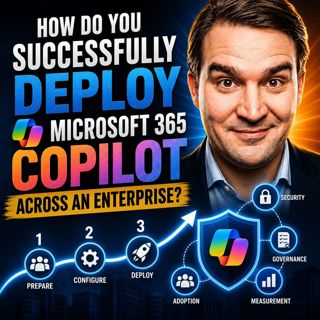
How Do You Successfully Deploy Microsoft 365 Copilot Across an Enterprise?

How Do You Successfully Deploy Microsoft 365 Copilot Across an Enterprise?

A successful Microsoft 365 Copilot deployment begins long before licenses are assigned. Organizations should first define measurable business outcomes, identify high-value use cases, and secure execut...

29 Heinä 1h 32min

From Pilot to Production: Building Enterprise AI That Actually Delivers with Leon Gordon [MVP]

From Pilot to Production: Building Enterprise AI That Actually Delivers with Leon Gordon [MVP]

Leon Gordon explains why most enterprise AI initiatives never reach production and introduces the concept of the Pilot Tax—the hidden cost organizations pay when AI projects remain stuck in proof-of-c...

28 Heinä 59min

Microsoft Purview is a Trap: The Hard Truth About Data Governance

Microsoft Purview is a Trap: The Hard Truth About Data Governance

Microsoft Purview is included with many Microsoft 365 subscriptions, making it incredibly easy to enable. That convenience is also its biggest danger. Because there is no procurement process or large ...

28 Heinä 1h 1min

From Excel Expert to Microsoft MVP: Empowering Millions with Data, Dashboards & AI with Karen Abecia [Microsoft MVP]

From Excel Expert to Microsoft MVP: Empowering Millions with Data, Dashboards & AI with Karen Abecia [Microsoft MVP]

aren Abecia shares the remarkable journey that transformed a passion for Microsoft Excel into a global career as one of the world's best-known Excel educators. She explains how discovering creative sp...

27 Heinä 59min

The Copilot Credit Trap- Why Your AI Economy is Already Broken

The Copilot Credit Trap- Why Your AI Economy is Already Broken

For decades, enterprise software followed a predictable financial model. Organizations purchased licenses, assigned them to users, and budgeted annual IT spending with confidence. AI changes that comp...

26 Heinä 1h 12min
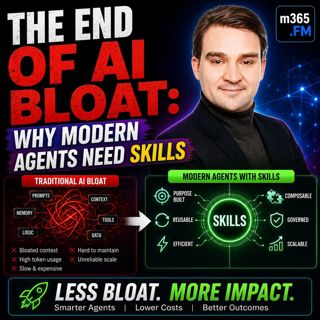
The End of AI Bloat: Why Modern Agents Need Skills

The End of AI Bloat: Why Modern Agents Need Skills

Many AI agents start out fast, responsive, and surprisingly intelligent. But after a few months of real-world use, something changes. Response times increase, costs rise, prompts become enormous, and ...

26 Heinä 1h 13min

Suosittua kategoriassa Politiikka ja uutiset

aikalisa
rss-ootsa-kuullut-tasta
ootsa-kuullut-tasta-2
uutiscast
rss-vaalirankkurit-podcast
otetaan-yhdet
rss-seksicast
tervo-halme
rss-podme-livebox
aihe
rss-girls-finish-f1rst
politiikan-puskaradio
et-sa-noin-voi-sanoo-esittaa
lotta-paakkunainen
rss-mina-ukkola
rss-kovin-paikka
rss-kuka-mina-olen
rss-raha-talous-ja-politiikka
rss-asiastudio
rss-pinnalla