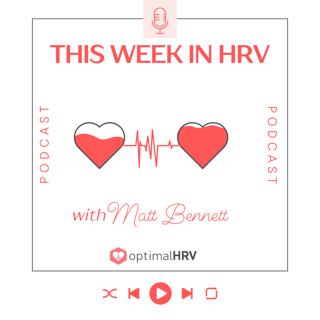
This Week In HRV - Episode 35

This Week In HRV - Episode 35

This episode of This Week in Heart Rate Variability takes four very different windows into the autonomic nervous system and finds a single coherent message: your HRV is tracking the full texture of your life, not just your sleep or your workouts. We look at which psychosocial job demands most damage parasympathetic tone, how COPD reshapes autonomic regulation over time, whether walking through nature at night changes how your heart recovers, and what your facial micro-movements might reveal about your heart during pain. Pull up a chair — this one goes deep.

Research Highlights This Week

1. The Stressors That Actually Suppress Your Vagus Nerve

Publication: Journal of Occupational Health

Authors: Kati Karhula, Maria Hirvonen, Hanna Jantunen, Maria Sihvola, Jarno Turunen, Piia Seppälä

KEY FINDING: In a study of 163 municipal employees wearing ECG monitors over four consecutive nights, dominance analysis revealed that, after age, the psychosocial job demands most strongly associated with reduced parasympathetic HRV were encountering bullying, facing violence or threats at work, experiencing ethically challenging situations, and effort-reward imbalance — not workload or time pressure.

SIGNIFICANCE: The interpersonal and moral dimensions of work may carry more autonomic weight than its sheer volume or pace. This reframes how workplace wellbeing initiatives should prioritize their efforts — and raises the possibility that chronic HRV suppression in workers may reflect relational and ethical harm, not just busyness.

Read full study: https://doi.org/10.1093/joccuh/uiag025

2. How Long You've Had COPD May Matter More Than How Severe It Is

Publication: Cureus Journal of Medical Science

Authors: Dinakaran Umashankar, Karthikeyan Ramaraju, Anupama Murthy, Nagashree R

KEY FINDING: Among 47 patients with stable chronic obstructive pulmonary disease, HRV parameters did not significantly correlate with spirometric severity, BODE index, or ABCD phenotype classification. However, longer disease duration was significantly negatively correlated with both RMSSD (r = −0.324, p = 0.026) and pNN50 (r = −0.332, p = 0.027), and greater quality-of-life impact correlated negatively with SDNN (r = −0.294, p = 0.043).

SIGNIFICANCE: Autonomic dysregulation in COPD tracks time-in-disease and quality-of-life burden more than it tracks standard lung function metrics. HRV may capture aspects of COPD's systemic toll that spirometry misses, suggesting a potential role as a complementary biomarker in clinical monitoring.

Read full study: https://doi.org/10.7759/cureus.107493


2. Walk in the Woods, Recover at Night

Publication: npj Urban Sustainability

Authors: Karl Samuelsson, Matteo Giusti, David M. Hallman, Sarah Koch, Elena Farahbakhsh Touli, Joren Buekers, Matilda van den Bosch, Anna Bornioli, Payam Dadvand, Stephan Barthel

KEY FINDING: Across ten months of GPS and heart rate data from 45 individuals in Sweden, within-person analysis showed that active movement in nature — but not passive time in nature or active movement in non-natural settings — was associated with lower-than-usual resting heart rate and higher-than-usual HRV the following night. Effects were significant in the full sample and in female participants specifically.

SIGNIFICANCE: The combination of physical activity and natural environment appears to be the operative factor for nighttime cardiac regulation benefit — neither element alone produces the same effect. This is real-world, l...

Jaksot(106)

Stephanie White Talks HRV Science and Heart Health

Stephanie White Talks HRV Science and Heart Health

In this episode, Stephanie White joins Matt Bennett to discuss fascinating science related to heart health and HRV at the cellular level.

30 Huhti 1h 11min

Stephan Streuber talks HRV and Physiological Synchrony in Virtual Reality

Stephan Streuber talks HRV and Physiological Synchrony in Virtual Reality

In this episode, Stephan Streuber joins Matt Bennett to discuss the role heart rate variability played in his recent research and article Remote collaboration in virtual reality induces physiological ...

23 Huhti 57min

This Week In HRV - Episode 34

This Week In HRV - Episode 34

Heart rate variability science is moving in several directions at once this week — deeper into neural mechanisms, broader across clinical populations, and more precise in its analytical tools. Episode...

21 Huhti 53min

This Week In HRV - Episode 33

This Week In HRV - Episode 33

Needles, Treadmills, Wearables, and Operating Rooms: Four Ways the Autonomic Nervous System Shows Up Where You Least Expect It This week's episode covers four studies across four completely different ...

14 Huhti 38min

HRV Special Episode about Polyvagal Theory

HRV Special Episode about Polyvagal Theory

In this week’s episode of The Heart Rate Variability Podcast, we step away from our usual multi-paper review to focus on a singular, defining debate in the field: the current controversy surrounding P...

9 Huhti 12min

This Week In HRV - Episode 32

This Week In HRV - Episode 32

This week's edition of This Week in HRV examines nine new studies that push the boundaries of what heart rate variability can tell us — from the psychology lab to the emergency department, the running...

7 Huhti 54min

This Week In HRV - Episode 31

This Week In HRV - Episode 31

This week’s edition of This Week in HRV dives into ten fresh studies that illustrate how heart rate variability is being used to decode everything from the heat of the climate to the heat of a high-st...

31 Maalis 49min

Suosittua kategoriassa Liike-elämä ja talous

sijotuskasti
mimmit-sijoittaa
rss-rahapodi
psykopodiaa-podcast
hyva-paha-johtaminen
rss-oivalluksia-rahasta-elamasta
rss-rahamania
inderespodi
rss-lahtijat
ostan-asuntoja-podcast
rahapuhetta
oppimisen-psykologia
lakicast
rss-bisnesta-bebeja
rss-sisalto-kuntoon
rss-inderes
leadcast
mihin-sita-saastais
rss-rikasta-elamaa
rss-40-ajatusta-aanesta