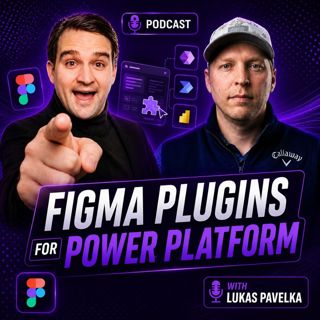
From Figma design to the PowerApps with Lukas Pavelka [MVP]

From Figma design to the PowerApps with Lukas Pavelka [MVP]

Development is changing faster than most teams can process. A few years ago, building enterprise applications meant long development cycles, hand-coded UI layers, endless testing loops, and massive backlogs between design teams and developers. Now AI agents can write code, generate layouts, repair syntax, optimize workflows, and even help translate entire applications into more than one hundred languages. But that shift creates a new question: If AI can generate applications faster than ever before, what actually separates good development from dangerous development? In this episode of the M365 FM Podcast, Mirko Peters sits down with Microsoft MVP Lukas Pavelka to explore the intersection of Figma, PowerApps, AI-assisted coding, Power BI, and the rapidly changing future of enterprise application development. The conversation goes far beyond low-code hype. This episode explores what really happens when AI agents enter the development lifecycle, how Figma is evolving into a complete ecosystem, why governance and security still matter deeply in AI-driven coding, and how developers can use tools like Copilot, Claude, GitHub Copilot, and vibe coding without losing control of their own codebase.

FROM JAVA DEVELOPER TO FIGMA AND POWERAPPS CREATOR

Lukas Pavelka started as a traditional Java developer more than twenty years ago before eventually transitioning into Power Platform development, automation, and AI-assisted application design. The turning point came through design. After discovering Figma through his wife’s design work, Lukas realized there was a major gap between beautiful design systems and practical PowerApps development workflows. That led to the creation of his PowerApps for Figma plugin, designed to help Power Platform developers move much faster between design and implementation. Today, Lukas develops multiple products focused on bridging design, automation, AI, and low-code development, including:
  • PowerApps for Figma
  • Power BI for Figma
  • My Bot Admin for Telegram automation
The discussion explores how these products evolved from internal productivity ideas into community-focused tools aimed at helping developers, makers, and Power Platform teams reduce repetitive work and improve enterprise UI quality.

WHY FIGMA IS BECOMING MUCH BIGGER THAN DESIGN

One of the most fascinating parts of this episode is the discussion around Figma’s evolution. Lukas explains why Figma is no longer just a design platform. It is becoming a complete ecosystem that increasingly overlaps with development, prototyping, presentations, AI-assisted workflows, and enterprise application delivery. The conversation covers:
  • Figma design systems
  • Reusable component libraries
  • PowerApps UI translation
  • YAML export
  • Component variants
  • Multi-language enterprise apps
  • Design consistency across projects
Lukas also explains how his plugins allow Power Platform developers to create scalable design systems that can be reused across enterprise projects while dramatically reducing repetitive UI work. The discussion highlights a major shift happening inside enterprise development: Good UX is no longer optional. Organizations increasingly realize that internal business applications must feel modern, intuitive, and scalable if they want employees to actually use them effectively.

AI, VIBE CODING, AND THE REALITY OF MODERN DEVELOPMENT

This episode dives deeply into AI-assisted development and the rise of “vibe coding.” Lukas shares practical experiences using GitHub Copilot, Claude, Visual Studio integrations, AI agents, and prompt-based coding workflows to accelerate development. But the conversation stays grounded in reality. One of the strongest themes throughout the episode is that AI coding still requires strong technical understanding. Lukas explains why developers cannot simply rely on AI-generated code without understanding architecture, debugging, security, versioning, and governance. The discussion explores:
  • Prompt engineering for developers
  • AI-assisted debugging
  • Model selection strategies
  • Token cost management
  • Versioning challenges
  • Secure coding practices
  • MCP and Model Context Protocol
  • AI coding limitations
A major insight from the episode is that AI coding works best when prompts stay highly focused and scoped to one specific task at a time. Broader prompts often cause AI agents to rewrite working code unnecessarily or introduce instability into existing projects. The episode also explores how AI development changes the role of the developer itself. Instead of writing every line manually, developers increasingly supervise, guide, validate, secure, and orchestrate AI-generated output.

THE BUSINESS REALITY OF AI DEVELOPMENT

The conversation also moves into the economics behind AI-assisted development. Lukas and Mirko discuss token costs, cloud compute limitations, GPU demand, electricity consumption, and the growing operational cost of running large-scale AI systems. The episode examines:
  • Claude pricing
  • GitHub Copilot limits
  • AI token consumption
  • GPU infrastructure
  • Electricity challenges
  • AI model specialization
  • Cloud economics
One particularly interesting part of the discussion focuses on how different AI models perform better for different development tasks. Some models perform better for frontend design work, others for deeper reasoning, debugging, or enterprise coding scenarios. This creates a new challenge for developers: Understanding not only how to code, but also which AI model to use for which type of work.

SECURITY, GOVERNANCE, AND THE RISKS OF AI CODING

As AI-generated development accelerates, governance becomes increasingly important. Lukas explains why developers still need to understand exactly what their code is doing, even when AI agents generate large portions of it automatically. The episode explores the growing risks around:
  • Security vulnerabilities
  • Poor governance
  • Exposed repositories
  • Unsafe prompts
  • Weak versioning practices
  • AI-generated technical debt
One of the strongest warnings throughout the episode is simple: AI can accelerate bad development just as easily as good development. Without proper architecture, security awareness, governance structures, and development knowledge, organizations risk creating large amounts of insecure code much faster than before.

WHAT COMES NEXT FOR AI DEVELOPMENT

The future discussed in this episode moves beyond simple text prompts. Lukas explains why voice-driven development, AI skills, reusable agent capabilities, and contextual AI orchestration are becoming the next major wave in application delivery. The discussion explores how future AI systems may:
  • Understand spoken instructions
  • Build applications conversationally
  • Reuse trained development skills
  • Orchestrate workflows automatically
  • Connect through MCP servers
  • Generate full enterprise UI systems
At the same time, both Lukas and Mirko emphasize that strong development fundamentals remain essential. The tools are changing rapidly. But architecture, security, UX thinking, governance, and operational understanding still matter mo

Become a supporter of this podcast: https://www.spreaker.com/podcast/m365-fm-modern-work-security-and-productivity-with-microsoft-365--6704921/support.

Tämä jakso on lisätty Podme-palveluun avoimen RSS-syötteen kautta eikä se ole Podmen omaa tuotantoa. Siksi jakso saattaa sisältää mainontaa.

Jaksot(868)

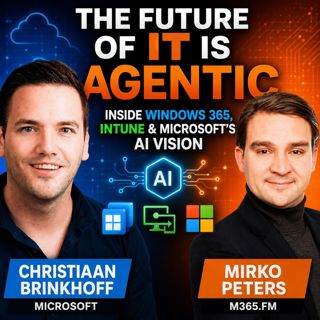
The Future of IT Is Agentic: Inside Windows 365, Intune & Microsoft's AI Vision with Christiaan Brinkhoff

The Future of IT Is Agentic: Inside Windows 365, Intune & Microsoft's AI Vision with Christiaan Brinkhoff

Christiaan Brinkhoff shares the remarkable career path that took him from speaking at community events and writing technical blogs to becoming one of the key people behind Microsoft's modern cloud des...

29 Heinä 1h 29min
How Do You Successfully Deploy Microsoft 365 Copilot Across an Enterprise?

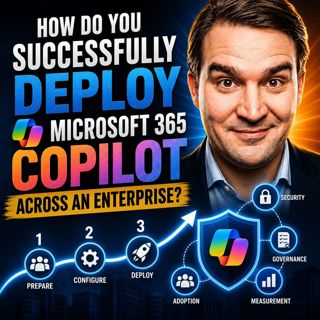
How Do You Successfully Deploy Microsoft 365 Copilot Across an Enterprise?

A successful Microsoft 365 Copilot deployment begins long before licenses are assigned. Organizations should first define measurable business outcomes, identify high-value use cases, and secure execut...

29 Heinä 1h 32min

From Pilot to Production: Building Enterprise AI That Actually Delivers with Leon Gordon [MVP]

From Pilot to Production: Building Enterprise AI That Actually Delivers with Leon Gordon [MVP]

Leon Gordon explains why most enterprise AI initiatives never reach production and introduces the concept of the Pilot Tax—the hidden cost organizations pay when AI projects remain stuck in proof-of-c...

28 Heinä 59min

Microsoft Purview is a Trap: The Hard Truth About Data Governance

Microsoft Purview is a Trap: The Hard Truth About Data Governance

Microsoft Purview is included with many Microsoft 365 subscriptions, making it incredibly easy to enable. That convenience is also its biggest danger. Because there is no procurement process or large ...

28 Heinä 1h 1min

From Excel Expert to Microsoft MVP: Empowering Millions with Data, Dashboards & AI with Karen Abecia [Microsoft MVP]

From Excel Expert to Microsoft MVP: Empowering Millions with Data, Dashboards & AI with Karen Abecia [Microsoft MVP]

aren Abecia shares the remarkable journey that transformed a passion for Microsoft Excel into a global career as one of the world's best-known Excel educators. She explains how discovering creative sp...

27 Heinä 59min
The Copilot Credit Trap- Why Your AI Economy is Already Broken

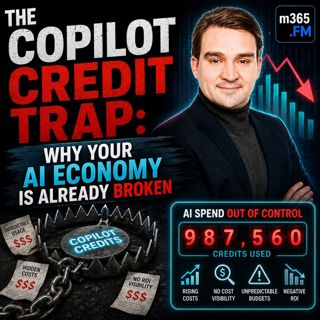
The Copilot Credit Trap- Why Your AI Economy is Already Broken

For decades, enterprise software followed a predictable financial model. Organizations purchased licenses, assigned them to users, and budgeted annual IT spending with confidence. AI changes that comp...

26 Heinä 1h 12min
The End of AI Bloat: Why Modern Agents Need Skills

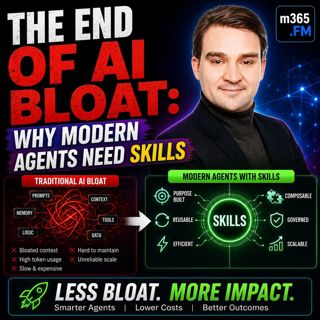
The End of AI Bloat: Why Modern Agents Need Skills

Many AI agents start out fast, responsive, and surprisingly intelligent. But after a few months of real-world use, something changes. Response times increase, costs rise, prompts become enormous, and ...

26 Heinä 1h 13min
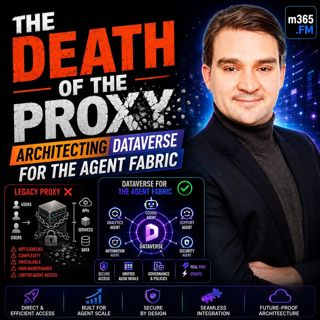
THE DEATH OF THE PROXY: Architecting Dataverse for the Agent Fabric

THE DEATH OF THE PROXY: Architecting Dataverse for the Agent Fabric

For years, Microsoft's recommended architecture for connecting AI assistants like Claude Desktop to Dataverse relied on a local STDIO proxy. It was simple, easy to install, and perfectly suited for in...

26 Heinä 59min

Suosittua kategoriassa Politiikka ja uutiset

aikalisa
rss-ootsa-kuullut-tasta
ootsa-kuullut-tasta-2
uutiscast
otetaan-yhdet
rss-vaalirankkurit-podcast
rss-seksicast
rss-podme-livebox
tervo-halme
aihe
politiikan-puskaradio
rss-girls-finish-f1rst
et-sa-noin-voi-sanoo-esittaa
linda-maria
rikosmyytit
rss-mina-ukkola
rss-raha-talous-ja-politiikka
rss-asiastudio