
Is Your Microservice Architecture a Ticking Time Bomb for Speed

Is Your Microservice Architecture a Ticking Time Bomb for Speed

You adopted microservices because you wanted speed. Faster deployments. Faster teams. Faster product delivery. But somewhere along the journey, a simple feature stopped feeling simple. What used to be one local code change now requires cross-team coordination, API reviews, rollout sequencing, schema checks, tracing updates, retry planning, and governance approvals. The old bureaucracy never disappeared. It simply moved from the org chart directly into the runtime. And increasingly, organizations are realizing the tradeoff is no longer worth it. Recent industry research shows that forty-two percent of organizations are actively consolidating microservices back into larger deployment units. That statistic alone signals something important: many teams are discovering that the operational and coordination overhead of distributed systems has started consuming the very delivery speed those systems were supposed to create. In this episode, we unpack the deeper model behind that slowdown. This is not another simplistic “monolith versus microservices” debate. This conversation focuses on how distributed architectures quietly create runtime friction, organizational drag, and delivery bottlenecks inside modern .NET environments — especially for teams that adopted service boundaries long before they truly needed them. Because once the architecture begins fragmenting the flow of change, the cost starts showing up everywhere.

THE ARCHITECTURAL ILLUSION OF PROGRESS

Microservices were sold as autonomy. The promise sounded almost perfect: split systems into independent services, give teams ownership, scale components independently, and deploy faster without coordination bottlenecks. On paper, the model looked mature. But the architecture carried assumptions many organizations skipped right past. Microservices assume:
  • Stable domain boundaries
  • Mature platform engineering
  • Strong DevOps capabilities
  • Operational readiness
  • Long-term team ownership
  • Reliable observability
  • Clear contract discipline
In many organizations, none of those conditions existed yet. And that is where the model starts fighting the organization itself. This episode explores why smaller and mid-sized engineering organizations often feel the pain first. Research consistently shows that for teams under roughly twenty to thirty engineers, coordination overhead frequently outweighs the scaling advantages of physical service separation. Instead of autonomy, teams inherit dependency chains with extra operational layers attached to every business change. We break down how:
  • One feature update becomes multiple synchronized deployments
  • Simple business logic turns into distributed coordination
  • API ownership becomes a negotiation process
  • Service boundaries create organizational silos
  • “Independent deployment” often increases release friction
  • Architectural complexity gets mistaken for engineering maturity
Because adding more boxes to a diagram does not automatically create speed. Sometimes it simply creates more places where work can stop.

THE HIDDEN TAX OF DISTRIBUTED COMPLEXITY

One of the most deceptive things about microservices is that every service can appear individually clean while the production system becomes massively heavier underneath. This episode dives into the hidden runtime tax of distributed systems inside modern .NET environments. Inside a single process, code communicates at memory speed. Across service boundaries, that same interaction becomes:
  • Network traffic
  • Serialization
  • Authentication
  • Timeout handling
  • Retry logic
  • Correlation tracking
  • Distributed tracing
  • Partial failure management
And those mechanics introduce costs that compound quickly. We explore how a simple business transaction can quietly transform into:
  • Multiple outbound HTTP or gRPC calls
  • Cascading latency chains
  • Retry storms
  • Expanded observability overhead
  • Increased debugging complexity
  • More cloud infrastructure consumption
Because the real system is not just the services. It is everything between them. This episode also examines the operational impact of observability and service mesh adoption in .NET ecosystems. Distributed tracing, telemetry, mTLS enforcement, and sidecar proxies absolutely provide value — but they also introduce measurable overhead in memory usage, latency, throughput, and operational maintenance. We discuss:
  • Istio vs Linkerd operational tradeoffs
  • Sidecar memory overhead in Kubernetes clusters
  • Observability performance costs
  • Instrumentation latency impact
  • Why distributed debugging consumes dramatically more engineering time
  • How platform complexity becomes a staffing problem
Small teams feel this pressure first because they rarely have dedicated platform engineering departments to absorb the operational load. The result is that developers stop spending most of their time building products and start spending it operating distributed infrastructure.

HOW API CONTRACTS TURN INTO DIGITAL RED TAPE

Once runtime complexity grows, the next slowdown appears in team coordination. API contracts are meant to create trust between services, but in many organizations, those contracts slowly evolve into rigid borders that require negotiation before every change.

Something as small as renaming a single field can trigger:
  • Consumer coordination
  • Schema reviews
  • Versioning debates
  • Approval workflows
  • Rollout sequencing
  • Extended backward compatibility maintenance
The technical change may take minutes. The organizational choreography around it can consume days. This episode explores how API governance frequently drifts into digital bureaucracy, especially when organizations lack strong automated contract validation pipelines.

We discuss:
  • Why low contract testing adoption creates fear
  • How brittle API governance slows delivery
  • Why teams duplicate endpoints instead of evolving interfaces
  • The dangers of over-versioning
  • Governance drift inside enterprise architecture
  • Manual review bottlenecks
  • CI-driven contract enforcement
  • How AI coding tools accelerate coding but not organizational validation


Become a supporter of this podcast: https://www.spreaker.com/podcast/m365-fm-modern-work-security-and-productivity-with-microsoft-365--6704921/support.

Tämä jakso on lisätty Podme-palveluun avoimen RSS-syötteen kautta eikä se ole Podmen omaa tuotantoa. Siksi jakso saattaa sisältää mainontaa.

Jaksot(866)

From Pilot to Production: Building Enterprise AI That Actually Delivers with Leon Gordon [MVP]

From Pilot to Production: Building Enterprise AI That Actually Delivers with Leon Gordon [MVP]

Leon Gordon explains why most enterprise AI initiatives never reach production and introduces the concept of the Pilot Tax—the hidden cost organizations pay when AI projects remain stuck in proof-of-c...

28 Heinä 59min

Microsoft Purview is a Trap: The Hard Truth About Data Governance

Microsoft Purview is a Trap: The Hard Truth About Data Governance

Microsoft Purview is included with many Microsoft 365 subscriptions, making it incredibly easy to enable. That convenience is also its biggest danger. Because there is no procurement process or large ...

28 Heinä 1h 1min

From Excel Expert to Microsoft MVP: Empowering Millions with Data, Dashboards & AI with Karen Abecia [Microsoft MVP]

From Excel Expert to Microsoft MVP: Empowering Millions with Data, Dashboards & AI with Karen Abecia [Microsoft MVP]

aren Abecia shares the remarkable journey that transformed a passion for Microsoft Excel into a global career as one of the world's best-known Excel educators. She explains how discovering creative sp...

27 Heinä 59min

The Copilot Credit Trap- Why Your AI Economy is Already Broken

The Copilot Credit Trap- Why Your AI Economy is Already Broken

For decades, enterprise software followed a predictable financial model. Organizations purchased licenses, assigned them to users, and budgeted annual IT spending with confidence. AI changes that comp...

26 Heinä 1h 12min

The End of AI Bloat: Why Modern Agents Need Skills

The End of AI Bloat: Why Modern Agents Need Skills

Many AI agents start out fast, responsive, and surprisingly intelligent. But after a few months of real-world use, something changes. Response times increase, costs rise, prompts become enormous, and ...

26 Heinä 1h 13min

THE DEATH OF THE PROXY: Architecting Dataverse for the Agent Fabric

THE DEATH OF THE PROXY: Architecting Dataverse for the Agent Fabric

For years, Microsoft's recommended architecture for connecting AI assistants like Claude Desktop to Dataverse relied on a local STDIO proxy. It was simple, easy to install, and perfectly suited for in...

26 Heinä 59min

The Death of the Pipeline: Why AI Agents are Replacing Traditional

The Death of the Pipeline: Why AI Agents are Replacing Traditional

For more than two decades, CI/CD pipelines have been the backbone of modern software delivery. Developers commit code, automated builds run, tests execute, security scans complete, someone approves th...

25 Heinä 1h 9min
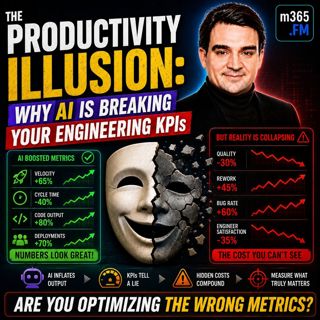
The Productivity Illusion: Why AI is Breaking Your Engineering KPIs

The Productivity Illusion: Why AI is Breaking Your Engineering KPIs

At first glance, the numbers look incredible. Deployment frequency is increasing, pull requests are being merged faster than ever, AI is generating more code, and engineering teams appear dramatically...

25 Heinä 1h 15min

Suosittua kategoriassa Politiikka ja uutiset

aikalisa
uutiscast
ootsa-kuullut-tasta-2
rss-ootsa-kuullut-tasta
rss-seksicast
otetaan-yhdet
rss-vaalirankkurit-podcast
rss-podme-livebox
tervo-halme
aihe
politiikan-puskaradio
rss-girls-finish-f1rst
rikosmyytit
et-sa-noin-voi-sanoo-esittaa
rss-mina-ukkola
rss-raha-talous-ja-politiikka
rss-asiastudio
rss-varsinaista-puhetta