Faraj Aalaei on Why AI Will Let Anyone Design a Chip — and What Happens When the Semiconductor Industry Finally Catches Up

Faraj Aalaei on Why AI Will Let Anyone Design a Chip — and What Happens When the Semiconductor Industry Finally Catches Up

In 2000, venture capitalists funded 200 semiconductor companies. By 2015, that number had fallen to single digits. The cost of designing a chip went from $33 million in the late 1990s to over $200 million today, and it takes four or more years to complete. There are not enough engineers. The timelines are too long. The investment risk is too high.


Faraj Aalaei has spent three decades watching this problem build. He co-founded Centillium Communications and took it public on Nasdaq in 1997. He co-founded Aquantia, took it public in 2017, and sold it to Marvell Semiconductors in 2019. He then spent several years investing in AI companies before recognizing that generative AI could do for chip design what it has done for software — compress timelines, reduce cost, and open the field to a much wider group of contributors.


In 2024, he founded Cognichip with a straightforward but ambitious vision: everybody should be able to be a chip designer.


Nick sits down with Faraj for a wide-ranging conversation that covers the full landscape — why the semiconductor industry has a structural problem that EDA companies like Synopsys and Cadence cannot solve alone, why generic large language models fall flat when applied to chip design, how Cognichip trains physics-informed models on proprietary synthetic data without touching any customer IP, and what actually happens to the semiconductor industry when design timelines collapse from years to months.


The implications are significant. Hyperscalers like Google, Meta, and Microsoft could design more bespoke ASICs faster and cheaper. Foundries like TSMC would see shorter cycles between customer signup and first wafer revenue. Startups that today cannot raise funding because the design cost is too high would suddenly become investable. And companies like Nvidia — which already iterate faster than anyone in the industry — could move faster still.


The conversation also covers Cognichip's differentiation from agentic workflow competitors, the fundamental reason why physics-informed models are necessary for semiconductor design in a way they are not for software, and — at the very end — the IPO question.


What we cover:

— Why chip design went from $33M to $200M+ and VC funding collapsed

— The engineer shortage and why semiconductors lose to software for talent

— Why the 6-year chip design lag is a fundamental problem for AI progress

— EDA companies and AI — complementary rather than competitive

— How Cognichip trains models without using customer IP

— Physics-informed AI vs. generic LLMs — why the distinction matters

— The vision: anyone can design a chip — what that actually means

— What happens when design timelines collapse — impact on Nvidia, startups, foundries

— Cognichip vs. agentic workflow competitors — the fundamental model difference

— Hyperscaler ASIC strategies and CapEx implications

— Manufacturing yield improvement and AI's role

— The IPO question


Disclosure: Cognichip is a private company and is not publicly investable at this time. This content is for general information only and is not individual investment advice.


chipstockinvestor.com

Tämä jakso on lisätty Podme-palveluun avoimen RSS-syötteen kautta eikä se ole Podmen omaa tuotantoa. Siksi jakso saattaa sisältää mainontaa.

Jaksot(492)

Twist Bioscience Soared — We're Still Not Buying

Twist Bioscience Soared — We're Still Not Buying

Twist Bioscience (TWST) just had a massive run-up after Anthropic's protein design results put its DNA synthesis platform in the spotlight. Here's what's really driving the stock — and whether it's st...

17 Syys 14min
The Fastest-Growing Chip Stock Is Also the Most Hated

The Fastest-Growing Chip Stock Is Also the Most Hated

We compare Credo (CRDO) against Broadcom (AVGO), Marvell (MRVL), and Astera Labs (ALAB) on revenue growth, gross margin, operating margin, and free cash flow margin — four fabless companies selling in...

15 Syys 13min
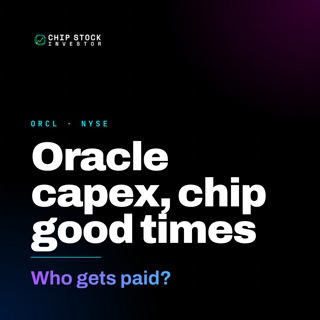
AI Data Center Spending Means Good Times For Semiconductors Continue -- Oracle ORCL Stock Analysis

AI Data Center Spending Means Good Times For Semiconductors Continue -- Oracle ORCL Stock Analysis

We break down the takeaways from Oracle's (ORCL) Q1 fiscal 2027 earnings call — what to expect through 2026 and into 2027–2028 as hyperscaler CapEx stays high but is set to slow in growth by 2027, and...

14 Syys 12min

Nvidia's Biggest Acquisition Ever: $12.9B for Hugging Face (Can It Survive Regulators?)

Nvidia's Biggest Acquisition Ever: $12.9B for Hugging Face (Can It Survive Regulators?)

Nvidia just proposed its largest acquisition ever — $12.9 billion for Hugging Face. But regulators in the US, EU, and China may have other plans.Nvidia has announced plans to acquire Hugging Face, the...

10 Syys 15min
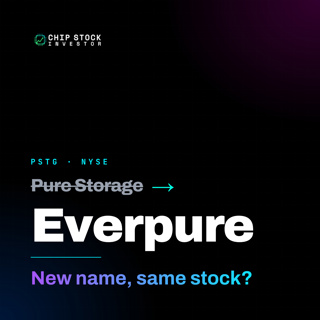
Pure Storage Is Now Everpure — and Free Cash Flow Just Went Negative (P Stock)

Pure Storage Is Now Everpure — and Free Cash Flow Just Went Negative (P Stock)

Pure Storage just rebranded to Everpure — and in the same stretch, free cash flow went negative 20% in a single quarter. Here's what's really going on.Pure Storage has officially rebranded as Everpure...

10 Syys 19min
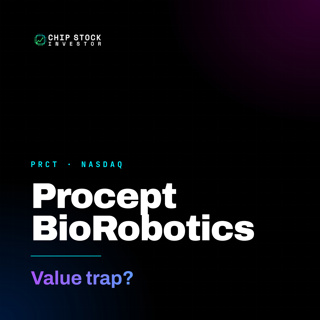
Procept Is Down 80% and the Tech Works — So Why Won't We Buy PRCT?

Procept Is Down 80% and the Tech Works — So Why Won't We Buy PRCT?

Procept BioRobotics is down roughly 80% from its 2025 highs but the technology behind its Aquablation system genuinely works. So why won't we put PRCT in our portfolio?Procept (PRCT) has one of the mo...

10 Syys 28min

Why Oscar Health's 'Great Quarter' Isn't What It Looks Like

Why Oscar Health's 'Great Quarter' Isn't What It Looks Like

Oscar Health looks like a screaming buy — growing revenue, growing members, positive free cash flow. So why does the market keep discounting it? We ran the numbers.Oscar Health (OSCR) just posted stro...

10 Syys 11min
Palo Alto Is Up 1,400% in a Decade — What Comes Next? (PANW FY2026)

Palo Alto Is Up 1,400% in a Decade — What Comes Next? (PANW FY2026)

Palo Alto Networks (PANW) has been flying high into the end of FY2026. After a decade-long 1,400% run — capped by a broader cybersecurity rally following the Anthropic "Mythos moment" in early 2026 — ...

2 Syys 14min

Suosittua kategoriassa Liike-elämä ja talous

sijotuskasti
vallattomat
rss-rahapodi
psykopodiaa-podcast
mimmit-sijoittaa
rss-oivalluksia-rahasta-elamasta
ostan-asuntoja-podcast
oppimisen-psykologia
rss-sami-miettinen-neuvottelija
rss-paasipodi
lakicast
rss-karon-grilli
rss-rahamania
rss-inderes
rahapuhetta
rss-siksi-viestinta
rss-pinnan-alle
rss-startup-ministerio
pomojen-suusta
inderespodi