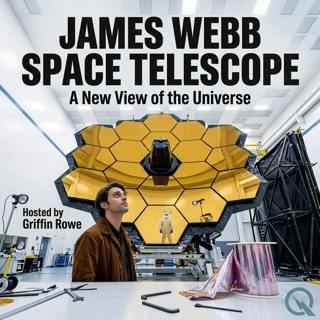
James Webb Telescope finds early Galaxies look like Surfboards, Pool Noodles, and Frisbee's

James Webb Telescope finds early Galaxies look like Surfboards, Pool Noodles, and Frisbee's

Researchers analyzing images from NASA’s James Webb Space Telescope have found that galaxies in the early universe are often flat and elongated, like surfboards and pool noodles – and are rarely round, like volleyballs or frisbees. “Roughly 50 to 80% of the galaxies we studied appear to be flattened in two dimensions,” explained lead author Viraj Pandya, a NASA Hubble Fellow at Columbia University in New York. “Galaxies that look like pool noodles or surfboards seem to be very common in the early universe, which is surprising, since they are uncommon nearby.” The team focused on a vast field of near-infrared images delivered by Webb, known as the Cosmic Evolution Early Release Science (CEERS) Survey, plucking out galaxies that are estimated to exist when the universe was 600 million to 6 billion years old. While most distant galaxies look like surfboards and pool noodles, others are shaped like frisbees and volleyballs. The “volleyballs,” or sphere-shaped galaxies, appear the most compact type on the cosmic “ocean” and were also the least frequently identified. The frisbees were found to be as large as the surfboard- and pool noodle-shaped galaxies along the “horizon,” but become more common closer to “shore” in the nearby universe. (Compare them in this illustration.) Which category would our Milky Way galaxy fall into if we were able to wind the clock back by billions of years? “Our best guess is that it might have appeared more like a surfboard,” said co-author Haowen Zhang, a PhD candidate at the University of Arizona in Tucson. This hypothesis is based partly on new evidence from Webb – theorists have “wound back the clock” to estimate the Milky Way’s mass billions of years ago, which correlates with shape at that time. These distant galaxies are also far less massive than nearby spirals and ellipticals – they are precursors to more massive galaxies like our own. “In the early universe, galaxies had had far less time to grow,” said Kartheik Iyer, a co-author and NASA Hubble Fellow also at Columbia University. “Identifying additional categories for early galaxies is exciting – there’s a lot more to analyze now. We can now study how galaxies’ shapes relate to how they look and better project how they formed in much more detail.” Webb’s sensitivity, high-resolution images, and specialization in infrared light allowed the team to make quick work of characterizing many CEERS galaxies, and model their 3D geometries. Pandya also says their work wouldn’t be possible without the extensive research astronomers have done using NASA’s Hubble Space Telescope. For decades, Hubble has wowed us with images of some of the earliest galaxies, beginning with its first “deep field” in 1995 and continuing with a seminal survey known as Cosmic Assembly Near-infrared Deep Extragalactic Legacy Survey. Deep sky surveys like these led to far greater statistics, leading astronomers to create robust 3D models of distant galaxies over all of cosmic time. Today, Webb is h This content was created in partnership and with the help of Artificial Intelligence AI.

Tämä jakso on lisätty Podme-palveluun avoimen RSS-syötteen kautta eikä se ole Podmen omaa tuotantoa. Siksi jakso saattaa sisältää mainontaa.

Jaksot(150)

James Webb Space Telescope - A New View of the Universe - Quasar Impostors and Little Red Dots

James Webb Space Telescope - A New View of the Universe - Quasar Impostors and Little Red Dots

Join your host as James Webb Space Telescope: A New View of the Universe unpacks six stunning discoveries—quasar impostors revealed as massive star-forming galaxies, ancient reionization bubbles, blac...

19 Syys 14min

James Webb Space Telescope Reveals Brown Dwarfs, Early Black Holes, and Dynamic Ring Systems in Latest Discoveries

James Webb Space Telescope Reveals Brown Dwarfs, Early Black Holes, and Dynamic Ring Systems in Latest Discoveries

# The Space Cowboy: Riding the Cosmic Range with James Webb's Latest Discoveries **Podcast Episode Description:** Saddle up for another journey across the cosmic frontier with The Space Cowboy as we...

19 Syys 9min

James Webb Space Telescope - A New View of the Universe - Fake Quasars, Neptune's Reborn Moons

James Webb Space Telescope - A New View of the Universe - Fake Quasars, Neptune's Reborn Moons

James Webb Space Telescope reveals surprises: early quasars are star-blazing galaxies, a mysterious black hole star, Neptune's moon origins, tiny trans-Neptunian objects, and a distant planet losing i...

12 Syys 10min

James Webb Space Telescope Discovers Massive Star Forming Galaxies and Exotic Exoplanet Atmospheres

James Webb Space Telescope Discovers Massive Star Forming Galaxies and Exotic Exoplanet Atmospheres

# The Space Cowboy Show: Riding Through JWST's Latest Cosmic Discoveries **Episode Description:** Saddle up for another wild ride through the cosmos! In this episode of The Space Cowboy Show, we exp...

12 Syys 11min

James Webb Space Telescope - A New View of the Universe - Black Hole Stars and Hidden Galaxies

James Webb Space Telescope - A New View of the Universe - Black Hole Stars and Hidden Galaxies

Join our AI host on James Webb Space Telescope: A New View of the Universe as we explore hidden faint stars reshaping galaxy mass estimates, a mysterious "black hole star" at cosmic dawn, an archival ...

5 Syys 12min

James Webb Space Telescope Discovers Exoplanet Atmospheres and Early Universe Black Holes in Latest Cosmic Findings

James Webb Space Telescope Discovers Exoplanet Atmospheres and Early Universe Black Holes in Latest Cosmic Findings

# The Space Cowboy: James Webb Space Telescope's Latest Cosmic Discoveries **Episode Description:** Ride along with The Space Cowboy on a journey through the universe's most fascinating recent disco...

5 Syys 11min

James Webb Space Telescope - A New View of the Universe - The Black Hole Star and Cosmic Mysteries

James Webb Space Telescope - A New View of the Universe - The Black Hole Star and Cosmic Mysteries

Host Griffin Rowe explores JWST's latest discoveries: a mysterious "black hole star" in Cetus, undercounted galaxies with hidden planet-forming potential, an "early galaxy crisis" resolved, heavy wate...

29 Elo 14min

James Webb Space Telescope Reveals Hidden Stars in Early Galaxies and Accelerates Planet Formation Timeline

James Webb Space Telescope Reveals Hidden Stars in Early Galaxies and Accelerates Planet Formation Timeline

# Episode Description **Riding the Infrared Frontier: James Webb's Latest Cosmic Discoveries** Join The Space Cowboy for an action-packed journey through the newest James Webb Space Telescope discov...

29 Elo 10min

Suosittua kategoriassa Tiede

rss-mita-tulisi-tietaa
utelias-mieli
rss-poliisin-mieli
tiedekulma-podcast
rss-hereilla
rss-duodecim-lehti
rss-luontopodi-samuel-glassar-tutkii-luonnon-ihmeita
rss-bios-podcast
docemilia
mielipaivakirja
rss-ranskaa-raakana
rss-lihavuudesta-podcast
hippokrateen-vastaanotolla
rss-radplus
radio-antro
rss-politiikasta-podcast