Babies, dogs, and the riddles of word learning
Many Minds22 Touko

Babies, dogs, and the riddles of word learning

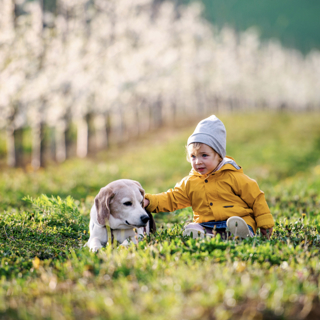
It's kind of astonishing, really, that kids ever learn words. Each one poses a little riddle. Does this sound string refer to a person? A category of things? Or maybe some other feature of the blooming, buzzing world? And yet word learning happens. In fact, we now know it begins earlier in infancy than we realized. And we now know, further, that dogs (or at least some dogs) understand words as well. So how does this happen? What do babies and dogs really know about words? And how might we go about figuring this all out?

My guests today are Dr. Elika Bergelson and Dr. Claudia Fugazza. Elika is an Associate Professor in the Department of Psychology at Harvard University, where her lab studies how infants learn language. Claudia is a Researcher at Eötvös Loránd University in Hungary, where she and her collaborators study dogs who are especially gifted word learners.

In this conversation, Elika, Claudia, and I talk about the thorny question of what it means to understand a word—and whether there are different degrees or kinds of understanding. We consider the challenges posed by different types of words—by nouns, by names, by verbs, by function words, size terms, and more. We discuss why it is that some dogs are so good at learning words, and why infants of a certain age seem to get so much better at it. We talk about learning in different contexts and situations. And we circle the question of how different word learning really is in dogs and babies.

Alright friends, before we get to it, one tiny ask: If you've been enjoying Many Minds, you can help us grow by leaving a review or comment or a rating, or by sharing us with a friend or colleague. We would greatly appreciate the support!

Without further ado, on to my interview with Claudia Fugazza and Elika Bergelson. Enjoy!

Notes

3:30 – A paper on infants' understanding of proper nouns like "Mommy."

6:00 – For our earlier audio essay on names across the animal kingdom, see here.

11:00 – For Dr. Bergelson's early study showing that 6-month-old infants already understand the meanings of some words, see here.

13:30 – For more on the "comprehension boost" in infants after age one, see Dr. Elika's paper here.

16:30 – For Dr. Fugazza and colleagues' first studies on gifted word-learning dogs, see here and here.

20:00 – See earlier studies on Rico and Chaser.

24:00 – For more on the qualitative changes that infants may undergo as they learn to learn words, see a paper by Dr. Bergelson and a colleague here.

30:00 – A study by Dr. Fugazza and colleagues comparing personality profiles and playfulness of gifted word learner dogs and typical dogs.

31:30 – A recent New York Times article consoling readers that having a "dumb" (i.e., non-gifted) dog is okay.

39:30 – A study by Dr. Fugazza and colleagues showing that dogs can extend labels of toys ("pull," "fetch") to new objects that are used in the same way.

43:00 – A study by Dr. Bergelson and a colleague on how broadly (or narrowly) infants' apply labels like "foot" or "juice." A study by Dr. Bergelson and colleagues looking at how familiarity affects infants' understanding of words.

52:00 – For an example of a study on the so-called noun bias in early word learning, see here. For work on the (lack of) a noun bias in Tseltal infants, see here. For a sample discussion of the so-called shape bias, see here.

54:00 – For Dr. Fugazza and colleagues' work on dogs' biases toward shape or texture when generalizing about objects, see here.

57:00 – For the work by Asifa Majid (former guest!) on odor words in Jahai, see here. For the work on scent-tracking in humans, see here.

1:02:00 – On "dog-directed speech" and its consequences, see here and here. For comparisons of dog- and infant-directed speech, see here and here.

1:04:00 – For the study finding that Tseltal-speaking children learn honorific terms (which are never addressed to them), see here.

1:06:00 – For the study by Dr. Fugazza and colleagues, "examining exclusion-based choice" in dogs, see here. For the study by Dr. Fugazza and colleagues showing that gifted word learner dogs can learn by over-hearing labels, see here.

1:10:00 – For the study showing that children seem to request labels for objects by pointing to them, see here.

1:12:00 – For some of the first scientific studies on the use of soundboards for communication in dogs, see here and here. For our earlier episode with Dr. Federico Rossano discussing some of this research, see here.

Recommendations

'The Invention of Language by Children,' by Lila Gleitman and Elissa Newport

'Concept-based word learning in human infants,' by Jun Yin and Gergely Csibra

'Syntactic bootstrapping as a mechanism for language learning,' by Mireille Babineau et al.

The Genius Dog Challenge YouTube channel

Many Minds is a project of the Diverse Intelligences Summer Institute, which is made possible by a generous grant from the John Templeton Foundation to Indiana University. The show is hosted and produced by Kensy Cooperrider, with help from Assistant Producer Urte Laukaityte and with creative support from DISI Directors Erica Cartmill and Jacob Foster. Our artwork is by Ben Oldroyd.

Subscribe to Many Minds on Apple, Stitcher, Spotify, Pocket Casts, Google Play, or wherever you listen to podcasts. You can also now subscribe to the Many Minds newsletter here!

We welcome your comments, questions, and suggestions. Feel free to email us at: manymindspodcast@gmail.com.

For updates about the show, visit our website or follow us on Bluesky (@manymindspod.bsky.social).

Tämä jakso on lisätty Podme-palveluun avoimen RSS-syötteen kautta eikä se ole Podmen omaa tuotantoa. Siksi jakso saattaa sisältää mainontaa.

Jaksot(162)

The inner life of the hand

The inner life of the hand

Newton saw in the human hand proof of the divine; Darwin saw a key to our species' success. Many others, too, have described the hand in hyperbolic terms, as a paragon of design, a cornerstone of huma...

7 Touko 1h 10min

From the archive: The cuttlefish and its coat of many colors

From the archive: The cuttlefish and its coat of many colors

Hi friends! We're skipping a beat to take care of some spring housekeeping tasks. We will be back in May! In the meanwhile, enjoy this listener favorite from our archives! ----- [originally aired Apri...

22 Huhti 1h 33min

Illuminating cave art

Illuminating cave art

Deep in our past, in the dark depths of caves, our ancestors did something strange and beautiful. Working by firelight, some doodled little designs. Others made hand stencils. Some saw a bulge of rock...

9 Huhti 1h 25min

What can AI teach us about the mind?

What can AI teach us about the mind?

Everyone is talking about AI these days. Often these conversations are about how AI might upend education, or work, or social life, or maybe civilization itself. But among cognitive scientists and psy...

26 Maalis 1h 21min

Mutualisms all the way down

Mutualisms all the way down

No one is an island. We all depend on each other in critical, often tangled ways. And when I say "we" and "each other" I don't just mean humans. Yes, we humans rely on other humans. But we also rely o...

11 Maalis 1h 8min

Seven metaphors for AI

Seven metaphors for AI

If you wanted a petri dish for understanding metaphors—how they emerge and evolve and jostle with each other—it would be hard to do better than the world of AI. We talk about AI systems variously as c...

26 Helmi 55min

Origins of the kiss

Origins of the kiss

Humans do some pretty weird things. Some of us will sit in searingly hot rooms or jump into icy ponds. Others risk their lives trying to climb to new heights or dive to new depths. And every once in a...

12 Helmi 1h 1min

Suosittua kategoriassa Koulutus

rss-murhan-anatomia
psykopodiaa-podcast
voi-hyvin-meditaatiot-2
kesken
rss-valo-minussa-2
rss-liian-kuuma-peruna
rss-narsisti
rss-niinku-asia-on
rss-rahamania
adhd-podi
psykologia
rss-vapaudu-voimaasi
aamukahvilla
rss-laadukasta-ensihoitoa
rss-mentalrace
rss-arkea-ja-aurinkoa-podcast-espanjasta
rss-hereilla
rahapuhetta
puhutaan-koiraa
ihminen-tavattavissa-tommy-hellsten-instituutti