
The Probability Shift: How AI is Rewriting Power Platform Design

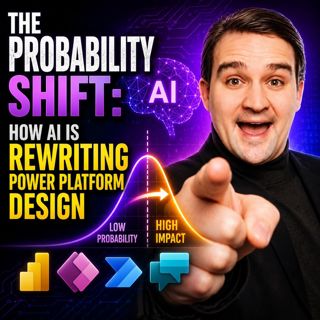
The Probability Shift: How AI is Rewriting Power Platform Design

Most Power Platform automations are failing for one simple reason: they were built for a world that no longer exists. Traditional low-code systems depend on rigid “if-then” logic, clean data, and predictable inputs. But modern enterprise data is chaotic, unstructured, and constantly changing. The result is what many organizations are experiencing right now — brittle automations that collapse the moment reality gets messy. This episode explores the massive architectural shift happening across the Power Platform ecosystem as AI transforms automation from deterministic logic into probabilistic design. Instead of asking, “Is this exactly correct?” modern systems ask, “How likely is this to be correct?” That subtle change is rewriting how enterprise workflows are designed, governed, and scaled.

THE DEATH OF DETERMINISTIC AUTOMATION

For years, enterprise automation depended on exact matches and structured logic. If a field matched perfectly, the flow continued. If a single character changed, the system failed. That worked when business data lived inside carefully structured databases. But today, most enterprise information exists in emails, PDFs, Teams chats, voice transcripts, and unstructured documents. Traditional Power Automate flows struggle in this environment because they cannot understand context or intent. A deterministic system sees “Invoice 202” and “Inv-202” as completely unrelated values. AI-powered systems see similarity instead of exactness. That shift changes everything.

KEY TOPICS COVERED
  • Why rigid low-code automations keep breaking
  • The rise of probabilistic workflow design
  • How confidence scores redefine governance
  • Why fuzzy matching matters more than exact matching
The future of automation is not about perfection. It is about resilience.

THE RISE OF CONFIDENCE-BASED ROUTING

One of the biggest changes AI introduces into Power Platform design is the concept of the confidence score. Instead of binary true-or-false logic, AI models return probabilities that quantify uncertainty. That means workflows can finally understand doubt instead of pretending certainty always exists. This episode breaks down the architecture behind confidence-based routing and explains how modern Power Platform solutions now separate actions into Green, Yellow, and Red confidence zones. High-confidence outputs move automatically. Medium-confidence results trigger human review. Low-confidence outputs are rejected or escalated before they damage production systems.

WHY CONFIDENCE SCORES MATTER
  • They expose uncertainty instead of hiding it
  • They reduce silent automation failures
  • They align business risk with automation logic
  • They enable scalable human-in-the-loop governance
This is the foundation of what the episode calls the “Approximate Enterprise” — a world where systems are designed to tolerate ambiguity instead of collapsing because of it.

FUZZY MATCHING AND SEMANTIC LOGIC

The conversation also dives deep into fuzzy matching, semantic reasoning, and the evolution from character-based automation toward meaning-based automation. Traditional systems compare syntax. AI compares concepts. That means a probabilistic system can understand that “IBM” and “I.B.M.” likely refer to the same entity, or that “Customer” and “Client” often represent identical business meaning. This dramatically increases match rates and reduces the amount of manual cleanup required to keep workflows operational. The episode explores how techniques like Levenshtein distance, semantic embeddings, and AI-powered classification are changing the way architects design resilient low-code systems capable of handling imperfect human-generated data.

BUILDING SELF-CORRECTING WORKFLOWS

AI systems are powerful, but they hallucinate. That reality forces architects to rethink reliability from the ground up. Instead of trying to eliminate every error, modern workflow design focuses on recovery, validation, and self-correction. This episode introduces the Dual-Path Validation pattern, where AI handles soft reasoning tasks while deterministic systems enforce hard constraints. Large Language Models extract intent and contextual meaning, while traditional logic validates totals, calculations, compliance rules, and financial accuracy.

MODERN SELF-HEALING DESIGN PRINCIPLES
  • Never let an LLM handle critical calculations alone
  • Separate reasoning layers from validation layers
  • Use deterministic systems as verification engines
  • Design recovery paths instead of assuming perfection
The result is a workflow architecture capable of adapting instead of crashing when the unexpected happens.

THE HUMAN-IN-THE-LOOP REALITY

One of the most important themes in this episode is that AI does not eliminate humans from automation — it changes their role entirely. Most enterprise AI workflows still require human verification, especially for medium-confidence outputs and high-risk decisions. Instead of acting as data-entry operators, humans become reviewers, governors, and exception handlers. Successful automation strategies build verification directly into the architecture instead of treating it like a temporary workaround. This shift transforms productivity models across the enterprise. Teams stop wasting time on repetitive tasks and focus instead on reviewing edge cases that genuinely require human judgment.

THE AGENTIC ENTERPRISE

The episode concludes by exploring the rise of the Agentic Enterprise — a future where AI agents become first-class digital workers operating inside orchestrated low-code environments. Instead of static flows solving narrow problems, intelligent agents dynamically evaluate context, select tools, adapt behavior, and route work autonomously. Power Platform is rapidly evolving from an app builder into an orchestration layer for AI-driven business operations. Governance, security, compliance, and automation are all becoming probabilistic systems driven by confidence, anomaly detection, and behavioral analysis. The organizations that continue building brittle “if-then” systems will spend the next decade trapped in maintenance cycles. The organizations that embrace probabilistic architecture will build workflows capable of adapting at the speed of modern business.

FINAL THOUGHTS

The probability shift is not just another AI trend. It is a fundamental redesign of how enterprise systems think, adapt, and survive uncertainty. Low-code development is moving away from rigid syntax and toward semantic understanding, confidence-driven governance, and resilient self-correcting architectures. If your Power Automate flows are constantly failing because of messy inputs, inconsistent formatting, or unstructured data, this episode provides a blueprint for building systems that bend instead of break. Follow M365FM for deeper conversations on AI architecture, Power Platform governance, automation resilience, Copilot Studio, and the future of intelligent enterprise design.

Become a supporter of this podcast: https://www.spreaker.com/podcast/m365-fm-modern-work-security-and-productivity-with-microsoft-365--6704921/support.

Tämä jakso on lisätty Podme-palveluun avoimen RSS-syötteen kautta eikä se ole Podmen omaa tuotantoa. Siksi jakso saattaa sisältää mainontaa.

Jaksot(706)

Your AI Agents Are Orphaned- The Structural Shift to Agent ID

Your AI Agents Are Orphaned- The Structural Shift to Agent ID

Artificial intelligence is changing enterprise identity faster than most organizations realize. Every week, new AI agents are being deployed across Microsoft 365 tenants, accessing SharePoint, Microso...

11 Heinä 1h 4min
The Architecture of Agility: Bicep at Scale

The Architecture of Agility: Bicep at Scale

Modern cloud platforms don't fail because Azure isn't powerful enough—they fail because governance, automation, and developer experience weren't designed to scale together. In this episode of the M365...

11 Heinä 1h 25min

Designing the Future. AI, UX, and the Next Generation of Microsoft Power Platform with Tchesco Ayih [MVP-MCT]

Designing the Future. AI, UX, and the Next Generation of Microsoft Power Platform with Tchesco Ayih [MVP-MCT]

In this episode of the M365 Podcast, Mirko Peters sits down with Tchesco Ayih, Microsoft MVP, Microsoft Certified Trainer (MCT), international speaker, mentor, and Power Platform expert. Tchesco share...

10 Heinä 50min

Azure Bicep Fundamentals for Real Projects

Azure Bicep Fundamentals for Real Projects

Learning Azure Bicep is easy. Building infrastructure that survives real-world enterprise environments is something entirely different. In this episode of the M365 FM Podcast, host Mirko Peters explor...

10 Heinä 1h 17min

Beyond Prompt a Page: Building Enterprise-Ready AI Experiences in Power Apps with Sara Lagerquist [MVP]

Beyond Prompt a Page: Building Enterprise-Ready AI Experiences in Power Apps with Sara Lagerquist [MVP]

Artificial Intelligence is changing how organizations build business applications, but moving beyond simple demos requires much more than adding a chatbot or generating code with AI. In this episode o...

9 Heinä 45min
ARM Templates Were a Mistake: Lessons from the Bicep Shift

ARM Templates Were a Mistake: Lessons from the Bicep Shift

Infrastructure as Code transformed cloud computing by replacing manual portal clicks with version-controlled, repeatable deployments. But while Azure Resource Manager (ARM) templates represented a maj...

9 Heinä 1h 19min

Can Google Sheets Beat Excel: Microsoft MVP David Benaim Settles the Debate

Can Google Sheets Beat Excel: Microsoft MVP David Benaim Settles the Debate

For decades, Microsoft Excel has been the undisputed king of spreadsheets. It powers everything from personal budgets to enterprise reporting, financial modeling, and business intelligence. But Google...

8 Heinä 52min

LinkedIn + Dynamics 365: The Architecture of Modern Selling

LinkedIn + Dynamics 365: The Architecture of Modern Selling

Modern B2B sales is undergoing a fundamental transformation. For years, organizations have treated LinkedIn and Dynamics 365 as separate systems. One platform managed relationships and professional ne...

8 Heinä 1h 14min

Suosittua kategoriassa Politiikka ja uutiset

aikalisa
uutiscast
ootsa-kuullut-tasta-2
rss-ootsa-kuullut-tasta
rss-podme-livebox
rss-seksicast
otetaan-yhdet
tervo-halme
politiikan-puskaradio
aihe
rss-vaalirankkurit-podcast
rss-girls-finish-f1rst
rss-mina-ukkola
rss-aijat-hopottaa-podcast
rss-mita-tapahtuu
rss-kaikki-uusiksi
rss-merja-mahkan-rahat
rss-tekoalyfoorumi
rss-asiastudio
rss-pinnalla