Australia claims it's 'on track' to meet its environment targets. Scientists disagree

Australia claims it's 'on track' to meet its environment targets. Scientists disagree

Australia is one of 17 "megadiverse" countries that account for 70% of Earth's biodiversity. However, Australia is unique in having the highest mammalian extinction rate in the world. That makes conservation on the island continent, where most of the wildlife is found nowhere else on Earth, all the more urgent.

Conservation and environmental scientists have come out against the Australian federal government's claim that it's "on track" to meet most of its targets under the Kunming-Montreal Global Biodiversity Framework agreed upon at the U.N. biodiversity summit in 2022. This week on the Mongabay Newscast, Euan Ritchie, a professor of wildlife ecology and conservation at Australia's Deakin University, and a councilor with the Biodiversity Council, an academic alliance in the country, argues why conservationists say the Australian government is failing its commitments.

"The short answer, unfortunately, is that Australia is doing terribly in terms of honoring its international obligations to meet those targets in the agreement. If we look at the number of threatened species in Australia, it's more than 2,200 now, and that list continues to increase," Ritchie says.

Despite being a relatively wealthy nation by gross domestic product per capita, Australia funds conservation at a diminutive scale compared to other industrialized countries. The latest annual budget allocates 0.06% of federal spending to nature. Ritchie and some 60 fellow experts suggest that it would only take about 1% of the federal budget to save most threatened species and restore soils and rivers. In 2024, the Wentworth Group of Concerned Scientists published its findings, which took six years to complete.

The Biodiversity Council has separately found that around 95% of Australians surveyed would support increased spending on the environment.

"Essentially, the federal government is ignoring a majority of Australians by not doing that," Ritchie says.

He argues the money to fund conservation already exists — or at least could easily exist by reducing subsidies for harmful industries (such as the fossil fuel industry), which currently amount to around A$26 billion ($19 billion) a year. Separately, a 25% tax on liquefied natural gas exports could generate A$17 billion ($12 billion) a year, a move nationwide polling suggests is supported by 70% of Australians.

Despite the perceived strong public support, Australian Prime Minister Anthony Albanese has ruled out a 25% tax on gas exports for the time being, which Ritchie says is very hard to understand, pointing to countries like Norway, which built its own sovereign wealth fund off similar measures. As of this writing, the Australian government has lost about A$70 billion ($50 billion) in revenue it could have collected had it taxed these resources, according to an online tracker by the Australia Institute, an independent think tank.

"We could bring in tens of billions of dollars in additional revenue if we taxed the resources that we are giving away, essentially in many cases for free," Ritchie says.

Instead of increasing direct conservation funding, the Australian government intends to close the gap by launching a "Nature Repair Market," a voluntary biodiversity offset scheme. It's essentially a way for industry and private investors to pay for the damage they cause. Research indicates this is unlikely to protect endangered wildlife and biodiversity without taxpayer funding. Other researchers from the University of Melbourne and the University of New South Wales have also weighed in, explaining that a biodiversity market is unlikely to work.

Ritchie says this is problematic for a number of other reasons, ranging from the complexity of biodiversity itself, to the way the government intends to measure environmental impacts from various projects. Currently, the national environmental standards in the Environment Protection and Biodiversity Conservation Act (EPBC) doesn't "account for cumulative impacts," Ritchie says.

"So if you imagine that you're a threatened species and you're widely distributed … Individual projects are not being assessed in relation to other projects that may also impact on that same species," he says. "So it is literally death by a thousand cuts."

Listen to a conversation on biodiversity offsets in Australia with Yung En Chee here.

Please take a minute to let us know what you think of our podcast here.

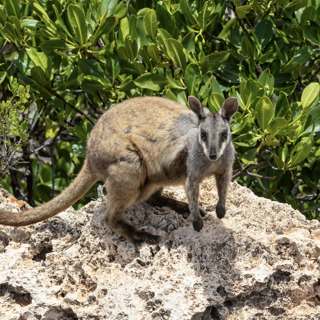
Image Credit: Black-flanked rock wallaby (Petrogale lateralis) in Cape Range National Park, Western Australia, Australia. The Australian government has classed the species as endangered under the EPBC Act. Image by Dsyzdek via Wikimedia Commons (CC BY-SA 4.0).

—-

Time codes

(00:00) 'Failing miserably' on the environment

(10:21) A 'Nature Repair Market' is not a solution

(23:47) New nature reform laws passed

(29:44) Plentiful sources of funding

(35:37) Native forest logging harms

Tämä jakso on lisätty Podme-palveluun avoimen RSS-syötteen kautta eikä se ole Podmen omaa tuotantoa. Siksi jakso saattaa sisältää mainontaa.

Jaksot(369)

Historic fire seasons are the 'new normal' without 'serious action' on climate change

Historic fire seasons are the 'new normal' without 'serious action' on climate change

Elizabeth Goldman is a co-director of Global Nature Watch, previously known as Global Forest Watch, a database measuring forest loss that's frequently cited in Mongabay reporting. She joins this week'...

11 Elo 28min

The 'quiet revolution' inspired by Delhi's urban wildlife

The 'quiet revolution' inspired by Delhi's urban wildlife

In her upcoming book, My Wild City: Finding Nature, Meaning, and Hope in India's Capital, conservation biologist Neha Sinha takes readers to the hidden and not-so-hidden ecosystems of India's largest...

4 Elo 54min

Why are forests in Liberia disappearing?

Why are forests in Liberia disappearing?

On this week's episode of the Mongabay Newscast, we speak with features writer Ashoka Mukpo, who traveled to southeastern Liberia to investigate what satellite images indicated was a spike in deforest...

28 Heinä 38min

Oil has brought destruction to the Niger Delta; women and human rights may save it

Oil has brought destruction to the Niger Delta; women and human rights may save it

On this week's episode of the Mongabay Newscast, I speak with travel writer Noo Saro-Wiwa. She has documented the violence and natural destruction that the presence of oil companies have brought to th...

21 Heinä 42min

The Mediterranean Sea's beauty hides an ecosystem under pressure

The Mediterranean Sea's beauty hides an ecosystem under pressure

The Mediterranean Sea accounts for less than 1% of the world's ocean surface water, but it contains roughly 18% of global marine biodiversity. It is home to 150 million people along its coastline (rou...

14 Heinä 33min

Wildlife crossings are having a moment

Wildlife crossings are having a moment

Nearly three years ago, Newscast guest, author and journalist Ben Goldfarb discussed his book Crossings, which is about wildlife crossings and road ecology. Wildlife crossings help reconnect habitats...

7 Heinä 37min

The radical plan to rethink work, wealth and planetary well-being

The radical plan to rethink work, wealth and planetary well-being

A group of more than 40 researchers spent 20 months devising a plan for the world to achieve ecological sustainability within planetary boundaries, all while seeing incomes rise for 98% of the global ...

30 Kesä 52min

Addressing the 'toxic legacy' of mining in Bougainville

Addressing the 'toxic legacy' of mining in Bougainville

Theonila Roka Matbob grew up next to what was — at the time — the world's largest open-pit mine in Bougainville, an autonomous island in Papua New Guinea, operated by a subsidiary of Rio Tinto. This m...

16 Kesä 33min

Suosittua kategoriassa Tiede

rss-poliisin-mieli
tiedekulma-podcast
rss-mita-tulisi-tietaa
rss-tiedetta-vai-tarinaa
docemilia
rss-duodecim-lehti
utelias-mieli
rss-kasvikutsut
rss-astetta-parempi-elama-podcast
radio-antro
rss-hereilla
rss-ammamafia
rss-tervetta-skeptisyytta
hippokrateen-vastaanotolla
rss-ranskaa-raakana
rss-radplus
filocast-filosofian-perusteet
mielipaivakirja
rss-bios-podcast
rss-ylistys-elaimille