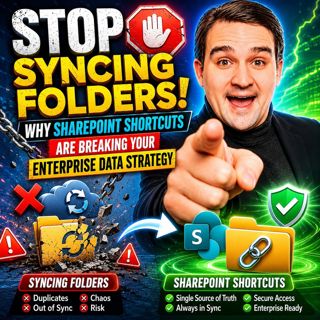

Stop Syncing Folders: Why SharePoint Shortcuts Are Breaking Your Enterprise Data Strategy

Stop Syncing Folders: Why SharePoint Shortcuts Are Breaking Your Enterprise Data Strategy

Most organizations still believe syncing SharePoint libraries directly into File Explorer is the best way to give users easy access to files. It feels familiar. It feels productive. But beneath the convenience lies one of the most overlooked architectural problems inside modern Microsoft 365 environments. Folder syncing is quietly creating data sprawl, governance chaos, security blind spots, and massive operational complexity across the enterprise. This episode breaks down why traditional sync-based collaboration models are becoming unsustainable in large-scale Microsoft 365 deployments and why SharePoint Shortcuts may actually be accelerating the problem instead of solving it.

THE HIDDEN COST OF SYNCING

At first glance, syncing folders appears harmless. Users get local access to files, offline availability, and a familiar desktop experience. But the moment organizations scale beyond a few hundred users, synchronization begins to introduce architectural instability. Every synced library creates another distributed endpoint copy of enterprise data. That means governance policies, retention rules, sensitivity labels, and compliance boundaries suddenly become much harder to enforce consistently across devices. What was originally designed for convenience slowly transforms into uncontrolled data replication.

KEY PROBLEMS COVERED
  • Data duplication across unmanaged endpoints
  • Sync conflicts and versioning chaos
  • Broken governance and retention visibility
  • Security gaps caused by distributed file access
The problem is not SharePoint itself. The problem is treating cloud-native collaboration like an old file server mapped drive.

THE SHAREPOINT SHORTCUT ILLUSION

Microsoft introduced SharePoint Shortcuts as a cleaner alternative to massive library synchronization. The idea sounds elegant: instead of syncing entire sites, users simply create shortcuts to important folders inside OneDrive. But shortcuts create their own layer of confusion. This episode explores how shortcuts blur ownership boundaries, create inconsistent user experiences, and make governance dramatically more difficult at scale. Users often lose visibility into where data actually lives, which team owns the content, and which policies apply to the files they are accessing. The result is an enterprise environment where nobody fully understands the true structure of the information architecture.

WHY SHORTCUTS CREATE STRATEGIC RISK
  • Users mistake shortcuts for actual file ownership
  • Data lineage becomes harder to track
  • Governance policies lose contextual clarity
  • Permission inheritance becomes increasingly fragile
The shortcut model optimizes convenience while quietly undermining long-term information architecture discipline.

THE ENTERPRISE DATA SPRAWL PROBLEM

One of the biggest themes in this episode is the rise of distributed data sprawl inside Microsoft 365. Every synced library, shortcut, and duplicated folder expands the organization’s attack surface. Sensitive files begin existing across unmanaged laptops, cached devices, temporary local storage, and disconnected synchronization states. Once data becomes fragmented across endpoints, organizations lose the “single source of truth” model that modern cloud collaboration was supposed to deliver. This creates major operational risks for:
  • Compliance and eDiscovery
  • Records management
  • Insider risk investigations
  • Data lifecycle governance
  • Ransomware recovery operations
Instead of centralizing information, many organizations are unintentionally recreating the chaos of legacy file shares inside a cloud platform.

WHY CLOUD-NATIVE THINKING MATTERS

The core argument of this episode is simple: most organizations migrated their files to the cloud without changing their mindset. They replaced network drives with SharePoint but continued using synchronization as the primary operating model. That creates a hybrid architecture where the organization carries all the complexity of both local storage and cloud collaboration at the same time. True cloud-native collaboration requires a shift away from endpoint-centric thinking. Instead of syncing everything locally, modern Microsoft 365 architecture should prioritize:
  • Browser-first collaboration
  • Permission-based access models
  • Centralized governance controls
  • Metadata-driven organization
  • Web-native document management
The future of enterprise collaboration is not built around folders sitting on local hard drives. It is built around intelligent, centrally managed content systems.

SECURITY AND GOVERNANCE CONSEQUENCES

The episode also explores the security implications of large-scale synchronization. When files are continuously replicated across thousands of devices, organizations dramatically increase the number of locations where sensitive data can be exposed, stolen, or encrypted by ransomware. A single compromised endpoint can become a distribution point for corrupted synchronized content. This creates dangerous governance gaps involving:
  • Data Loss Prevention enforcement
  • Sensitivity label consistency
  • Conditional Access boundaries
  • Device compliance monitoring
  • Backup and recovery integrity
The more distributed your data becomes, the harder it becomes to secure, govern, and recover.

THE FUTURE OF ENTERPRISE COLLABORATION

Modern Microsoft 365 strategy must evolve beyond folder synchronization. This episode argues that organizations need to rethink how users interact with content entirely. Instead of replicating files everywhere, enterprises should focus on creating secure, discoverable, cloud-native access patterns that preserve governance while reducing operational complexity. The future belongs to architectures that prioritize:
  • Centralized content ownership
  • Zero Trust access controls
  • Search-driven collaboration
  • Metadata over folder hierarchies
  • Intelligent content discovery
The goal is not simply easier access. The goal is sustainable information architecture.

FINAL THOUGHTS

Syncing folders solved a productivity problem for the early cloud era. But at enterprise scale, it often creates far larger problems involving governance, compliance, security, and operational resilience. SharePoint Shortcuts may simplify access for users, but they can also obscure ownership, fragment governance, and weaken the organization’s overall data strategy. If your Microsoft 365 environment feels increasingly chaotic, difficult to govern, or impossible to map cleanly, the problem may not be SharePoint itself. The problem may be the synchronization mindset behind the architecture. Follow M365FM for deeper conversations on Microsoft 365 governance, SharePoint architecture, enterprise collaboration strategy, Zero Trust security, and the future of cloud-native information management.

Become a supporter of this podcast: https://www.spreaker.com/podcast/m365-fm-modern-work-security-and-productivity-with-microsoft-365--6704921/support.

Tämä jakso on lisätty Podme-palveluun avoimen RSS-syötteen kautta eikä se ole Podmen omaa tuotantoa. Siksi jakso saattaa sisältää mainontaa.

Jaksot(706)

Your AI Agents Are Orphaned- The Structural Shift to Agent ID

Your AI Agents Are Orphaned- The Structural Shift to Agent ID

Artificial intelligence is changing enterprise identity faster than most organizations realize. Every week, new AI agents are being deployed across Microsoft 365 tenants, accessing SharePoint, Microso...

11 Heinä 1h 4min

The Architecture of Agility: Bicep at Scale

The Architecture of Agility: Bicep at Scale

Modern cloud platforms don't fail because Azure isn't powerful enough—they fail because governance, automation, and developer experience weren't designed to scale together. In this episode of the M365...

11 Heinä 1h 25min

Designing the Future. AI, UX, and the Next Generation of Microsoft Power Platform with Tchesco Ayih [MVP-MCT]

Designing the Future. AI, UX, and the Next Generation of Microsoft Power Platform with Tchesco Ayih [MVP-MCT]

In this episode of the M365 Podcast, Mirko Peters sits down with Tchesco Ayih, Microsoft MVP, Microsoft Certified Trainer (MCT), international speaker, mentor, and Power Platform expert. Tchesco share...

10 Heinä 50min

Azure Bicep Fundamentals for Real Projects

Azure Bicep Fundamentals for Real Projects

Learning Azure Bicep is easy. Building infrastructure that survives real-world enterprise environments is something entirely different. In this episode of the M365 FM Podcast, host Mirko Peters explor...

10 Heinä 1h 17min

Beyond Prompt a Page: Building Enterprise-Ready AI Experiences in Power Apps with Sara Lagerquist [MVP]

Beyond Prompt a Page: Building Enterprise-Ready AI Experiences in Power Apps with Sara Lagerquist [MVP]

Artificial Intelligence is changing how organizations build business applications, but moving beyond simple demos requires much more than adding a chatbot or generating code with AI. In this episode o...

9 Heinä 45min
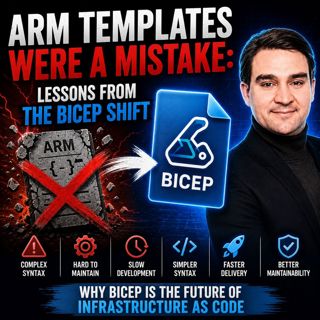
ARM Templates Were a Mistake: Lessons from the Bicep Shift

ARM Templates Were a Mistake: Lessons from the Bicep Shift

Infrastructure as Code transformed cloud computing by replacing manual portal clicks with version-controlled, repeatable deployments. But while Azure Resource Manager (ARM) templates represented a maj...

9 Heinä 1h 19min

Can Google Sheets Beat Excel: Microsoft MVP David Benaim Settles the Debate

Can Google Sheets Beat Excel: Microsoft MVP David Benaim Settles the Debate

For decades, Microsoft Excel has been the undisputed king of spreadsheets. It powers everything from personal budgets to enterprise reporting, financial modeling, and business intelligence. But Google...

8 Heinä 52min

LinkedIn + Dynamics 365: The Architecture of Modern Selling

LinkedIn + Dynamics 365: The Architecture of Modern Selling

Modern B2B sales is undergoing a fundamental transformation. For years, organizations have treated LinkedIn and Dynamics 365 as separate systems. One platform managed relationships and professional ne...

8 Heinä 1h 14min

Suosittua kategoriassa Politiikka ja uutiset

aikalisa
uutiscast
ootsa-kuullut-tasta-2
rss-ootsa-kuullut-tasta
rss-podme-livebox
rss-seksicast
otetaan-yhdet
tervo-halme
politiikan-puskaradio
aihe
rss-vaalirankkurit-podcast
rss-girls-finish-f1rst
rss-mina-ukkola
rss-aijat-hopottaa-podcast
rss-mita-tapahtuu
rss-kaikki-uusiksi
rss-merja-mahkan-rahat
rss-tekoalyfoorumi
rss-asiastudio
rss-pinnalla