
SH284: LEODSI and PETTEOT: A Systems Approach for Understanding How Diving Really Works

SH284: LEODSI and PETTEOT: A Systems Approach for Understanding How Diving Really Works

When something goes wrong in diving, people often ask “who made the mistake?”, but that question usually oversimplifies what really happened and stops us from learning. The Learning from Emergent Outcomes framework (LEODSI) takes a different approach by looking at diving as a system, where outcomes are shaped by many interacting factors rather than one person’s actions. It examines seven key elements—people, environment, tasks, equipment, external pressures, organisation, and time—to understand how decisions made sense in the moment and how conditions combined to produce the result. Instead of blaming individuals, LEODSI focuses on why events unfolded the way they did, recognising that both successes and failures come from the same system. By using this approach in everyday debriefs, not just after incidents, divers and teams can learn more effectively, improve safety, and make meaningful changes that reduce risk in the future.

https://www.thehumandiver.com/post/what-is-leodsi-petteot

Links: Learning from Emergent Outcomes course: https://www.thehumandiver.com/lfeo

Tags: Learning, Incidents & Just Culture

Tämä jakso on lisätty Podme-palveluun avoimen RSS-syötteen kautta eikä se ole Podmen omaa tuotantoa. Siksi jakso saattaa sisältää mainontaa.

Jaksot(312)

SH312: Your Body Can't Cash the Cheque Your Ego Is Writing

SH312: Your Body Can't Cash the Cheque Your Ego Is Writing

We explore how capable, motivated divers can gradually push beyond safe limits when their environment rewards risk-taking and treats near misses as successes. Using the story of a young technical dive...

7 Loka 16min
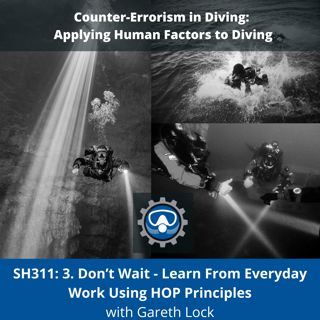
SH311: 3. Don’t Wait - Learn From Everyday Work Using HOP Principles

SH311: 3. Don’t Wait - Learn From Everyday Work Using HOP Principles

This episode explores Human and Organizational Performance (HOP), an approach to safety that starts with the idea that people will always make mistakes, so we should focus on understanding why decisio...

3 Loka 6min
SH310: 2. More Than a Deep Dive: What a WWII Bomber Recovery Can Teach Us About Human Factors

SH310: 2. More Than a Deep Dive: What a WWII Bomber Recovery Can Teach Us About Human Factors

This episode explores what really makes complex technical diving successful: not just helium, decompression and equipment, but the people using them. Using the recovery of the WWII B-24 Liberator Tuls...

30 Syys 8min
SH309: Change around Safety Culture is Really Hard

SH309: Change around Safety Culture is Really Hard

In this episode, Gareth Lock reflects on why improving diving safety requires more than telling people to follow the rules. Drawing on his experience in aviation, diving, and safety science, he explai...

23 Syys 14min

SH308: We Know, and We Say Nothing

SH308: We Know, and We Say Nothing

This episode explores why experienced divers still die in situations that seem predictable, using the tragic 2026 Maldives cave accident as a starting point. It looks at how outcome bias, the normalis...

16 Syys 17min

SH307: 1. The 2026 HF in Diving Conference - What Did You Miss?

SH307: 1. The 2026 HF in Diving Conference - What Did You Miss?

This episode explores how a restorative just culture can help the diving community respond to incidents in a way that promotes learning rather than blame. Instead of focusing only on who broke the rul...

9 Syys 15min
SH306: Restorative Just Culture: Repairing Trust After an Event

SH306: Restorative Just Culture: Repairing Trust After an Event

This episode explores the difference between a retributive approach to diving incidents, which focuses on blame and punishment, and a restorative just culture, which focuses on learning, repair, and p...

2 Syys 4min
SH305: Cause Reason. Excuse. Three Words Doing Three Very Different Things.

SH305: Cause Reason. Excuse. Three Words Doing Three Very Different Things.

This episode explores an important distinction that is often missed when discussing diving incidents: the difference between a cause, a reason, and an excuse. A cause explains what contributed to an e...

26 Elo 9min

Suosittua kategoriassa Koulutus

rss-murhan-anatomia
aamukahvilla
psykopodiaa-podcast
psykologia
voi-hyvin-meditaatiot-2
rss-arkea-ja-aurinkoa-podcast-espanjasta
rss-narsisti
rss-liian-kuuma-peruna
kesken
aloita-meditaatio
rss-hereilla
koulu-podcast-2
rss-rahamania
rss-duodecim-lehti
rss-vapaudu-voimaasi
solu-ja-molekyylibiologian-perusteet
rss-koira-haudattuna
ilona-rauhala
rahapuhetta
rss-niinku-asia-on