
Great Disciples of the Buddha - Introduction - The benefits of recollecting the Sangha | Meditation | Ajahn Moneyyo

Great Disciples of the Buddha - Introduction - The benefits of recollecting the Sangha | Meditation | Ajahn Moneyyo

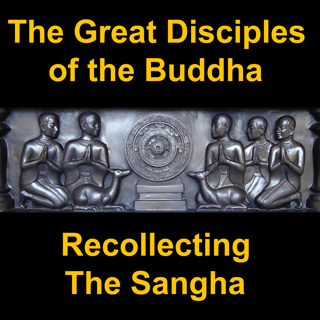
The Buddha was not only perfect in knowledge and conduct and developed supreme purity, compassion, wisdom and liberation but he was also the unsurpassable trainer of trainable people and teacher of gods and humans and as supreme teacher he had the ability to guide others to awakening.Just like the sun is not only bright and radiant only for itself, but also provides the energy for the entire ecosystem of the planet earth and all beings living on it - so too the Buddha didn't realize awakening just for his own benefit but illuminated the life of countless beings and lead them to liberation.During the 45 years when the Buddha was teaching he led several 1000 people to the realization of Arahantship - the highest spiritual attainment and the same liberation that the Buddha himself had realized and he led several 10000 people to the first stage of awakening, after which they were secure to realize the goal in at least 7 more lifetimes (streamentry). Also after the Buddha had passed away already his disciples continued to practice and realize his teaching in the last 2500 years up to the present day.Among all these noble disciples the Buddha mentions 41 monks, 13 nuns and 20 male and female lay disciples as so called "great disciples" with special outstanding qualities and encourages us to emulate them. By recollecting them we can gain a deeper understanding what it means "to practice well", why they are worthy of respect, we can get to know their qualities, follow their example and enter into the stream of Dhamma and become noble disciples ourselves.“Then there is the case where you recollect the Sangha: ‘The Sangha of the Blessed One’s disciples who have practiced well… who have practiced straight-forwardly… who have practiced methodically… who have practiced masterfully—in other words, the four types (of noble disciples) when taken as pairs, the eight when taken as individual types—they are the Sangha of the Blessed One’s disciples: deserving of gifts, deserving of hospitality, deserving of offerings, deserving of respect, the incomparable field of merit for the world.’


At any time when a disciple of the noble ones is recollecting the Sangha, his mind is not overcome with passion, not overcome with aversion, not overcome with delusion. His mind heads straight, based on the Saṅgha. And when the mind is headed straight, the disciple of the noble ones gains a sense of the goal, gains a sense of the Dhamma, gains joy connected with the Dhamma.

In one who is joyful, rapture arises. In one whose mind is enraptured, the body grows calm. One whose body is calmed experiences ease. In one at ease, the mind becomes concentrated.“Of one who does this, Mahānāma, it is said: ‘Among those who are out of tune, the disciple of the noble ones dwells in tune; among those who are malicious, he dwells without malice; having entered the stream of Dhamma, he develops the recollection of the Saṅgha.’"- The Buddha in Anguttara Nikaya 11:12


Tämä jakso on lisätty Podme-palveluun avoimen RSS-syötteen kautta eikä se ole Podmen omaa tuotantoa. Siksi jakso saattaa sisältää mainontaa.

Jaksot(499)

Ven. Sariputta - The Greatest Disciple of the Buddha foremost in wisdom | Great Disciples of the Buddha

Ven. Sariputta - The Greatest Disciple of the Buddha foremost in wisdom | Great Disciples of the Buddha

The Buddha says that every perfectly awakened one has a pair of monk disciples who are the most outstanding amongall the several thousand Arahants (completely liberated disciples).The Buddha calls the...

3 Kesä 1h 2min

Thinking in Meditation | Vitakka & Bhavana | Buddhist Meditation and Thoughts | Ajahn Dhammasiha

Thinking in Meditation | Vitakka & Bhavana | Buddhist Meditation and Thoughts | Ajahn Dhammasiha

Ajahn Dhammasiha talks about thoughts coming up while we're meditating. How can we abandon unwholesome thoughts, and can we perhaps even use thoughts to further our meditation if they are of a wholeso...

25 Touko 26min

Faith Follower vs Wisdom Follower | Saddhanusari vs Dhammanusari | Noble Disciples | Ajahn Dhammasiha

Faith Follower vs Wisdom Follower | Saddhanusari vs Dhammanusari | Noble Disciples | Ajahn Dhammasiha

Ajahn Dhammasiha is asked about the meaning of Saddhanusari and Dhammanusari. Both are considered 'Noble Individuals' by the Buddha, although they have not yet attained stream entry. However, their sp...

18 Touko 29min

Ajahn Dhammasiha Visiting Monasteries in Europe | Buddhist Monasteries in the Tradition of Ajahn Chah

Ajahn Dhammasiha Visiting Monasteries in Europe | Buddhist Monasteries in the Tradition of Ajahn Chah

Ajahn Dhammasīha describes monasteries of the Ajahn Chah tradition that he's going to visit on his travels from 13 May to 21 June. Talking about the 'Incineration Toilets' they have installed at Skipt...

11 Touko 47min

Breath Meditation: Gently Nudging Perception to Develop Contentment & Joy | Ajahn Dhammasiha | Anapanasati

Breath Meditation: Gently Nudging Perception to Develop Contentment & Joy | Ajahn Dhammasiha | Anapanasati

There is no objectively 'right' of 'wrong' way how we perceive and experience the breath in Ānāpānasati (Mindfulness of In & Out Breath) meditation. Perception of internal phenomena is entirely subjec...

8 Touko 24min

Stuck in Conventions | Transcending Social Conditioning to Realize Enlightenment | Ajahn Dhammasiha

Stuck in Conventions | Transcending Social Conditioning to Realize Enlightenment | Ajahn Dhammasiha

Have you ever deliberately broken social conventions to follow your own true conviction? We can't realize awakening by just following the norms and expectations of society. Enlightenment, realizing th...

4 Touko 32min

Entity View | Identity Formation | Anatta | Not Self | Sakkaya Ditthi | Asmi Mana | Ajahn Dhammasiha

Entity View | Identity Formation | Anatta | Not Self | Sakkaya Ditthi | Asmi Mana | Ajahn Dhammasiha

Ajahn Dhammasīha cites the following short Pali quote at the beginning of his Dhamma Talk : "Yena yena hi maññanti, tato taṃ hoti aññathā." "By whatever they conceive, that is becoming otherwise." = "...

1 Touko 39min

Suosittua kategoriassa Uskonto ja hengellisyys

yopuolen-tarinoita-2
kulttien-johdossa
lahko
voi-hyvin-meditaatiot-2
rss-lakeuden-valo
rss-valo-minussa-2
harhaoppia
rss-yopuolen-tarinoita
rss-heraamisia
rss-voi-hyvin-henkiset-vaikuttajat
rss-sinivalkoinen-islam
rss-miehen-mieli-podcast
kahvikekkerit-avaruudessa
rss-mielen-laboratorio
rss-kirkon-ihmeellisimmat-tarinat
rss-kaunis-maailma-kelttilaisia-rukouksia
rss-kirkko-ja-kaupunki-median-ikivihreimmat-jutut
rss-vapaudu-voimaasi
rss-pappina-sveitsissa
rss-rukoushetki