The Authenticity Gap: Why Containing Your True Self Is Costing You on Stage

The Authenticity Gap: Why Containing Your True Self Is Costing You on Stage

Most speakers talk about authenticity. Fewer actually practise it. There is a version of you that turns up on stage and a version of you that exists everywhere else, and for many speakers, those two people are further apart than they would like to admit.

This episode is a Pride Month episode, but the argument is not seasonal. The LGBTQ+ experience of navigating identity in public life contains lessons about presence, resilience and credibility that are directly relevant to any speaker who has ever edited themselves for the room.

In this episode:

  • Why the "is it safe to be myself here?" calculation runs differently for LGBTQ+ people and what that reveals about the cost of containment for everyone
  • The authenticity gap: the distance between who you tell people you are and who you actually show up as, and why audiences feel it even when they cannot name it
  • Why code-switching weakens your stage presence and what the cognitive cost of self-monitoring actually means for your delivery
  • How authentic living is a social act: showing up as yourself gives others permission to do the same
  • The shadow mechanism: why someone being pissed off by your authentic presence is information about them, not a verdict on you
  • Ken Rutowski's men's community, Metal, as a practical model for how small language shifts create genuine psychological safety
  • Why living unapologetically is not a Pride Month aspiration: it is a professional standard

John Ball draws on his own experience as a gay man with a public-facing business, from navigating training rooms where he was not sure he was safe, to recognising the specific cost of collusion: excusing language and behaviour that should not have been excused, and the quiet shame that comes with that.

The close is a direct challenge. Where are you still containing yourself, and how much of that is a genuine communication choice versus fear of making the wrong person uncomfortable?

CHAPTERS:

00:00 Authenticity Costs

01:26 Safety Calculations

04:42 Containment Exhaustion

08:24 Mask Versus Persona

13:20 Code Switching Costs

14:51 Modelling True Self

17:38 Mirror And Triggers

20:46 Inclusive Community Rules

24:42 Unapologetic Speaking

26:56 Your Stage Challenge

27:51 Closing And Invitation

Mentioned in this episode:

  • Metal community (Ken Rutowski): worth checking out if you are interested in a men's group designed with inclusion built in from the ground up

Connect with John:

Work on your speaker positioning with John's free positioning tool: message or email with the word "BOOKED" to receive it directly.

Join John at A Position of Authority, a small online event for speakers who need to sharpen their expert positioning: present-influence.kit.com/products/a-position-of-authority-event

FAQ SECTIONFrequently Asked Questions

Why does containing yourself on stage hurt your credibility as a speaker?

John Ball argues that a contained, edited version of yourself on stage creates an authenticity gap: a measurable distance between who you claim to be and who you actually show up as. Audiences sense this gap even when they cannot articulate it, and it prevents the genuine connection that makes a talk memorable. When a speaker asks an audience to be open and present whilst operating behind what John describes as "a wall of glass," the request rings hollow. Credibility requires congruence between what is said and who is saying it.

What is code-switching, and why does it matter for professional speakers?

Code-switching is the practice of adjusting language, tone and behaviour to fit the perceived expectations of a particular room. John Ball distinguishes between code-switching as a conscious communication choice and code-switching as a survival reflex. When it becomes a reflex, Ball argues, it weakens the speaker: softened language reads as uncertainty, hedged identity produces hedged messages, and the cognitive load of constant self-monitoring takes energy directly away from delivery and presence. Stages reward conviction and specificity, and a speaker who is managing their identity is already managing their message.

How does living authentically give permission to others to do the same?

John Ball describes authentic living as a social act rather than a purely personal one. When a speaker shows up as a full version of themselves rather than a managed, inoffensive version, they model the behaviour for the audience. Ball draws on the example of social normalisation in Spain, where LGBTQ+ visibility has been mainstreamed to the point that people are freer to express who they are. The inverse is equally true: people-pleasing reinforces the norm that people-pleasing is required, and makes the room smaller for everyone. Being willing to be disliked by the wrong people is, Ball argues, a generous act toward the right ones.

What is the shadow mechanism, and how does it apply to speakers?

The shadow mechanism is the idea that what irritates or unsettles us about others often reflects something unresolved in ourselves. John illustrates this with a personal example: an early discomfort with drag queens that a friend helped him trace back to internalised shame about aspects of his own personality. The professional application for speakers is that an audience member's discomfort with your authentic presence is information about them, not a verdict on you. The discomfort belongs to the person experiencing it, not to the speaker who prompted it.

What is Ken Rutowski's Metal community, and why does John reference it?

Metal is a men's networking community founded by Ken Rutowski, a former guest on Professional Speaking: Known. Booked. Paid. Ball cites it as a practical proof of concept for inclusive community design. The community operates with specific rules: all relationship partners are referred to as partners regardless of gender or structure, and there is zero tolerance for sexism, homophobia, transphobia and racism. Rutowski also helped establish a female counterpart group. Ball highlights the "partners" rule as an example of a small language shift that costs nothing and removes the assumptions that make some people feel like an outsider in the room.

How can professional speakers apply the lessons of Pride Month to their stage presence?

John argues that the LGBTQ+ experience of navigating identity in public life contains lessons about authentic presence that apply to any speaker. Living unapologetically does not mean living loudly: it means making choices about your presence from a place of self-acceptance rather than from fear of other people's reactions. Ball's challenge to speakers is direct: identify where you are still containing yourself, and ask honestly how much of that is a genuine communication choice versus a fear of making the wrong person uncomfortable. The speakers who move audiences most are not the ones who have edited themselves down to the lowest common denominator.

Visit https://strategic-speaker.scoreapp.com to take the 2-minute Strategic Speaking Business Audit and find out what's blocking you from getting more bookings, re-bookings, referrals and bigger fees. There's a special surprise gift for everyone who completes the quiz.

Want to get coached for free on the show? Fill in the form https://forms.gle/mo4xYkEiCjqtz9yP6, and if we think your challenge could help others, we'll invite you on.

For speaking enquiries or to connect with me, you can email john@presentinfluence.com or find me on LinkedIn

You can find all our clips, episodes and more on the Present Influence YouTube channel: https://www.youtube.com/@PresentInfluence

Thanks for listening. Rating the show 5* on Spotify helps their algo recommend the show, so please take a moment to follow the show and leave a rating.

Tämä jakso on lisätty Podme-palveluun avoimen RSS-syötteen kautta eikä se ole Podmen omaa tuotantoa. Siksi jakso saattaa sisältää mainontaa.

Jaksot(200)

Speaker Demo Reels: What They Are Actually For (and Why Most Get It Wrong)

Speaker Demo Reels: What They Are Actually For (and Why Most Get It Wrong)

Bernadette Marciniak is a video producer who works specifically with speakers and event organisers, giving her a rare dual perspective on what actually gets speakers booked. She has captured footage a...

3 Kesä 50min

Why Speakers Give Up Too Soon: The Results Lag

Why Speakers Give Up Too Soon: The Results Lag

There comes a point for almost every speaker and coach where the doubt becomes hard to ignore. You are doing the work, following good advice, showing up consistently — and nothing seems to be moving. ...

27 Touko 24min
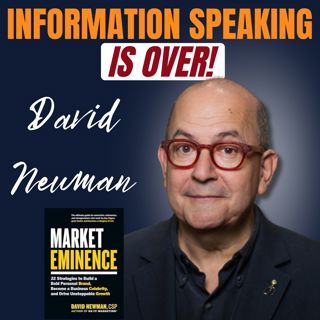
Are You Killing Your Speaking Career with "How-To" Content? | David Newman

Are You Killing Your Speaking Career with "How-To" Content? | David Newman

David Newman is a speaker, consultant, and author of four books, including Do It Speaking and Market Eminence. He's spent decades helping experts, consultants, and professional speakers build what he ...

13 Touko 53min

Your Speaker Positioning Is Not Your Topic: Why Good Speakers Stay Invisible

Your Speaker Positioning Is Not Your Topic: Why Good Speakers Stay Invisible

If you're a good speaker who isn't getting booked at the rate or fee you think you deserve, this episode is going to be uncomfortable in the right way.The problem, in most cases, isn't your speaking. ...

5 Touko 22min

Stop Trying to Be Funny: Beth Sherman on What Actually Gets Audiences to Listen

Stop Trying to Be Funny: Beth Sherman on What Actually Gets Audiences to Listen

Beth Sherman is a multi-Emmy Award-winning comedy writer who spent 30 years writing for Letterman, Jay Leno, Ellen DeGeneres, and multiple major awards shows, including the Oscars. She now works as a ...

29 Huhti 56min

What Speaker Bookers Actually Want in 2026 – Elliot Kay, Speaker Awards Founder

What Speaker Bookers Actually Want in 2026 – Elliot Kay, Speaker Awards Founder

Elliot Kay is the founder of The Speaker Awards, a seven-time author, and one of the most connected people in the UK speaking industry. In this conversation, John and Elliot dig into what's actually c...

24 Huhti 43min

Why Confident Speakers Still Don't Get Rebooked

Why Confident Speakers Still Don't Get Rebooked

Taki Moore recently wrote that conviction is a shortcut to charisma. It's a clever line. It's also only half right, and the other half is quietly costing speakers bookings.In this episode, John unpack...

22 Huhti 6min

Suosittua kategoriassa Liike-elämä ja talous

sijotuskasti
psykopodiaa-podcast
mimmit-sijoittaa
rss-rahapodi
rss-oivalluksia-rahasta-elamasta
asuntoasiaa-paivakirjat
oppimisen-psykologia
hyva-paha-johtaminen
pomojen-suusta
pari-sanaa-lastensuojelusta
rss-rahamania
rss-myynnilla-on-asiaa-kert-kenner
herrasmieshakkerit
ostan-asuntoja-podcast
rss-laakispodi
rss-kaupan-tila
rss-sisalto-kuntoon
rss-set-for-life-sijoita-ja-vaurastu
rss-paikoillenne-valmiit-laakikseen
rss-ainin-sekatoimisto