
S9 Ep33: Did the Sewing Machine Liberate Women?

S9 Ep33: Did the Sewing Machine Liberate Women?

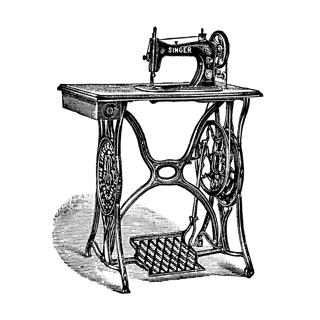
In January 1860 the New York Times gave its blessing to a new machine: the sewing machine. These "iron needle-women", it wrote, were the only invention that could be claimed “chiefly for women's benefit”. Sewing was women's work in the nineteenth century, rich or poor, and a machine could now do it in a fraction of the time. So did it set women free?

Philipp Ager and Davide Coluccia have traced the adoption of the sewing machine in Massachusetts between 1850 and 1900, using census records and digitised business directories to work out who was exposed to it, in the factory and in the home. For poorer women the machine meant work, in garment factories and in boot and shoe production; they married later, had fewer children, and many never married at all. For wealthier women, who had few acceptable jobs open to them, the hours it saved went into earlier marriage and earlier motherhood. Philipp tells Tim Phillips the story of a machine that had very different impacts in different social classes.

The research behind this episode:

Ager, Philipp, and Davide Coluccia. 2026. "Liberation Technology? The Impact of the Sewing Machine on Women." CEPR Discussion Paper No. 21496. CEPR Press, Paris and London. CEPR Discussion Papers are gated; CEPR members and subscribing institutions can download the paper at the link.

To cite this episode:

Phillips, Tim, and Philipp Ager. 2026. "Did the Sewing Machine Liberate Women?" VoxTalks Economics (podcast).

Assign this as extra listening. The citation above is formatted and ready for a reading list or VLE.

About the guests

Philipp Ager is professor of economics at the University of Mannheim, a Research Fellow of the Centre for Economic Policy Research, and an editorial board member at Explorations in Economic History. His research spans the economic history of the United States, technological change, and the long-run effects of crises and disasters; his work on the Great Fire of London of 1666 featured in an earlier episode of VoxTalks Economics.

Research and sources cited in this episode

The Song of the Shirt. Thomas Hood's poem about a destitute seamstress was first published anonymously in Punch in December 1843. Hood based it on the case of Mrs Biddell, a London widow prosecuted after pawning clothes she had been given to sew.

Godey's Lady's Book. The most widely read women's magazine in the US at the time crowned the sewing machine "the queen of inventions" in 1860, having calculated that a man's shirt took 20,620 stitches and 14 hours to sew by hand, against an hour and a quarter by machine.

Singer and the Sewing Machine: A Capitalist Romance. Ruth Brandon's 1977 biography of Isaac Singer (Google Books) is the source for both Singer quotations read in this episode. .

How the Other Half Lives. Jacob Riis, a Danish-born police reporter in New York, published his account of tenement and sweatshop life in 1890 (free at Project Gutenberg). The shirtmaker's testimony read in this episode was given to the State Board of Arbitration during the shirtmakers' strike and reported by Riis in his chapter on the working girls of New York.

The household appliance revolution. Philipp contrasts the sewing machine with the washing machines and vacuum cleaners that arrived two generations later, which economists have credited with freeing women to join the workforce; "Engines of Liberation" by Jeremy Greenwood, Ananth Seshadri and Mehmet Yorukoglu, Review of Economic Studies, 2005, covers this topic. The sewing machine saved time in the same way, but in the 1860s far fewer acceptable jobs awaited the women whose time it saved.

More VoxTalks Economics episodes

The economic effect of the Great Fire of London. Philipp Ager's previous visit to VoxTalks Economics, with Paul Sharp, on what contemporary records reveal about London's uneven recovery after 1666.

Related reading on VoxEU

Gender norms and the labour market, a VoxEU column on how norms, both internalised and enforced by peers, constrain women's labour market outcomes; the modern counterpart of the stigma that kept married women in Massachusetts out of paid work.

Tämä jakso on lisätty Podme-palveluun avoimen RSS-syötteen kautta eikä se ole Podmen omaa tuotantoa. Siksi jakso saattaa sisältää mainontaa.

Jaksot(461)

S9 Ep34: Making defence spending pay

S9 Ep34: Making defence spending pay

Defence spending is rising whether voters like it or not. The UK has committed to 2.5% of national income and aims for nearer 3.5% over the next decade, £30bn a year for each percentage point. What do...

19 Kesä 26min

S9 Ep32: The digital money supply

S9 Ep32: The digital money supply

Every day, billions of transactions settle between strangers who have no idea which bank the other uses. That lack of friction is not automatic. Nine-tenths of the money in daily circulation has been ...

5 Kesä 27min

S9 Ep31: How well does patent screening work?

S9 Ep31: How well does patent screening work?

Someone once held a patent on the swing. A piece of wood. Two ropes. The US Patent Office granted it. How often does that actually happen, and what does it cost when the system gets it wrong? Or, how ...

29 Touko 32min

S9 Ep30: Redefining the monetary standard

S9 Ep30: Redefining the monetary standard

The fiat money system has survived the Great Inflation, the global financial crisis, and a pandemic. But can it survive digital currencies?Bitcoin and the blockchain solved a genuine problem in comput...

22 Touko 26min

S9 Ep29: Guns and Butter

S9 Ep29: Guns and Butter

Europe's NATO members have pledged 3.5% of GDP to rearmament. The political argument is already about which social programmes will be sacrificed to pay for this, when the government chooses guns inste...

15 Touko 21min

S9 Ep28: Immigration and integration in Europe

S9 Ep28: Immigration and integration in Europe

More than one in eight people living in the EU today was born in another country. In fourteen of the bloc's largest economies, it is closer to one in six. For ten years, the same team of researchers h...

8 Touko 25min

S9 Ep27: The right to choose to die

S9 Ep27: The right to choose to die

Content note: this episode discusses assisted dying, end-of-life choices, and suicide. Some listeners may find the content distressing.In April 2024, Daniel Kahneman — one of the most influential psyc...

1 Touko 23min

Suosittua kategoriassa Liike-elämä ja talous

sijotuskasti
mimmit-sijoittaa
rss-rahapodi
psykopodiaa-podcast
rss-oivalluksia-rahasta-elamasta
leadcast
herrasmieshakkerit
hyva-paha-johtaminen
vapauta-supervoimasi-podcast
asuntoasiaa-paivakirjat
rss-set-for-life-sijoita-ja-vaurastu
rss-viisas-raha-podi
ostan-asuntoja-podcast
rss-rahamania
rss-porssipuhetta
rss-kaupan-tila
rss-perho-rajoilla
rss-inderes-femme
rss-ainin-sekatoimisto
rss-verkosta-vapauteen-podcast-paikka-ja-aikariippumattomia-asiantuntijayrittajahaastatteluita-sinulle