The Death of the Dropdown: Why Manual Tagging is Killing Your Governance

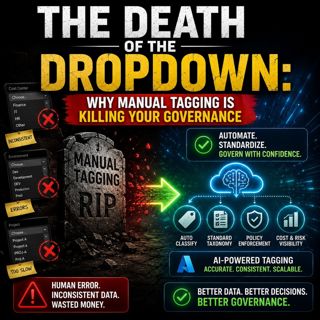
The Death of the Dropdown: Why Manual Tagging is Killing Your Governance

or years, organizations believed metadata governance was a training problem.If users understood the taxonomy better, governance would improve.If the dropdown lists were clearer, metadata quality would improve.If more communication and documentation were provided, compliance would improve.But what if the problem was never the user?What if the real problem is that governance logic was placed in the wrong layer of the architecture entirely?In this episode, we explore why manual metadata tagging has become one of the biggest obstacles to modern governance, compliance, enterprise search, and AI readiness. We examine the collapse of traditional metadata models, the rise of Graph-powered governance, and how organizations are replacing manual tagging with automated classification, contextual intelligence, and real-time metadata injection.If your governance strategy still depends on users selecting values from dropdown menus, this episode may fundamentally change how you think about Microsoft 365 governance.

THE MANUAL METADATA CRISIS

Modern work has changed.Governance models haven't.Content is now created continuously across Teams, SharePoint, OneDrive, Outlook, mobile devices, and third-party integrations. Files arrive at a pace that no human-driven classification model can realistically keep up with.Yet many organizations still rely on users to manually classify:
  • Department
  • Project
  • Content Type
  • Sensitivity
  • Retention Category
The result is predictable.Users skip fields.Users select defaults.Users guess.And governance slowly collapses under the weight of incomplete metadata.We explore why manual tagging doesn't fail because users are careless.It fails because the architecture assumes human behavior can scale indefinitely.

THE HIDDEN COST OF DARK DATA

Every untagged file creates a governance blind spot.The organization continues paying for:
  • Storage
  • Security
  • Backup
  • eDiscovery
  • Compliance Monitoring
But receives none of the governance value metadata was supposed to provide.This episode examines the concept of dark data and how millions of documents become effectively invisible despite remaining stored and protected.Learn how missing metadata impacts:
  • Search
  • Compliance
  • Records Management
  • Retention
  • Analytics
  • AI Readiness
And why many organizations are sitting on enormous repositories of information they can no longer govern effectively.

WHY DROPDOWNS ARE A DESIGN FAILURE

Most governance teams blame users.User experience research tells a different story.Dropdowns were designed to enforce consistency.Instead, they introduce friction.We discuss:
  • Decision fatigue
  • Metadata abandonment
  • Long taxonomy lists
  • User behavior patterns
  • Classification inconsistency
  • Cognitive overload
The problem isn't that people refuse to govern content.The problem is that governance interrupts the flow of work.Every additional field creates another opportunity for bad metadata.

THE COMPLIANCE IMPACT OF BAD TAGGING

Poor metadata quality isn't just inconvenient.It creates regulatory risk.This episode explores how inconsistent classification directly affects:
  • Microsoft Purview
  • Data Loss Prevention (DLP)
  • Retention Policies
  • eDiscovery
  • Records Management
  • GDPR Compliance
  • HIPAA Controls
When metadata is wrong, governance policies become unreliable.Sensitive data may be missed.Retention schedules may fail.Search results become incomplete.And compliance teams lose visibility into critical information assets.

MICROSOFT GRAPH AS THE ORGANIZATIONAL NERVOUS SYSTEM

Most organizations think Microsoft Graph is simply an API.In reality, it is a live representation of how work happens inside the enterprise.Graph understands:
  • Users
  • Teams
  • Groups
  • Files
  • Projects
  • Relationships
  • Permissions
  • Collaboration Patterns
Instead of asking users to describe content, Graph can infer context automatically.We explore how Graph provides the foundation for a completely different governance model where metadata is generated from organizational signals rather than manual input.

CONTEXT-AWARE GOVERNANCE

Traditional metadata is static.Context is dynamic.A file's meaning depends on:
  • Who created it
  • Where it was created
  • Which project it belongs to
  • Who can access it
  • How it is being used
This episode explains how governance systems can derive metadata automatically using Graph relationships rather than relying on user declarations.The result is richer, more accurate metadata that evolves as content moves through its lifecycle.

AI-POWERED CLASSIFICATION

Manual tagging isn't the only alternative.Modern AI services can classify content automatically.We explore:
  • Microsoft Syntex
  • AI Builder
  • Machine Learning Classification
  • Natural Language Processing
  • Document Understanding
  • Pattern Recognition
  • Sensitive Information Detection
Learn how AI-driven classification improves consistency, reduces cost, and scales across millions of files.

ARCHITECTING THE MIDDLEWARE LAYER

One of the most important concepts discussed in this episode is the governance middleware layer.Think of it as a customs checkpoint for content.Before files are stored, middleware:
  • Intercepts uploads
  • Queries Microsoft Graph
  • Applies classification logic
  • Injects metadata
  • Assigns labels
  • Triggers governance policies
All without requiring user interaction.We break down how Azure Functions, Microsoft Graph, webhooks, and event-driven architectures combine to make this possible.

AZURE FUNCTIONS AND EVENT-DRIVEN GOVERNANCE

Modern governance should happen at the moment content is created.Not months later during an audit.This episode explains how organizations are using:
  • Azure Functions
  • Microsoft Graph SDK
  • Webhooks
  • Delta Queries
  • Event Grid
  • Managed Identity
To build real-time governance platforms that classify and enrich content automatically.The user saves the file.The platform handles governance.

DYNAMIC PROPERTY INJECTION

Metadata doesn't need to be manually entered.It can be generated.We explore how middleware automatically injects:
  • Project Codes
  • Department Ownership
  • Content Categories
  • Sensitivity Levels
  • Retention Schedules
  • Governance Attributes
Using:
  • Property Bags
  • Schema Extensions
  • Open Extensions
  • Graph Metadata
This creates a living metadata layer that remains accurate as content evolves.

GOVERNANCE AT THE POINT OF ACTION

Traditional governance is reactive.Modern governance is preventative.Rather than discovering problems months later, governance occurs at the exact moment content is created, modified, or shared.We discuss:
  • Real-time classification
  • Immediate policy enforcement
  • Automated retention assignment
  • Continuous metadata enrichment
  • Event-driven governance
This shift fundamentally changes the economics of compliance and information management.

SEARCH THAT ACTUALLY WORKS

Most enterprise search failures are metadata failures.Search engines can only work with the information they receive.When metadata is incomplete, search becomes unreliable.This episode examines how automated metadata dramatically improves:
  • Microsoft Search
  • SharePoint Search
  • Knowledge Discovery
  • Content Discovery
  • Enterprise Findability
  • Information Retrieval
The difference between searchable content and invisible content is often metadata.

AI READINESS STARTS WITH GOVERNANCE

One of the most important messages in this episode is simple:AI readiness is metadata readiness.Microsoft Copilot, AI agents, and retrieval systems depend on accurate content classification.Without metadata:
  • AI hallucinates more often
  • Search quality declines
  • Context is lost
  • Knowledge becomes fragmented
With metadata:
  • AI retrieves better information
  • Recommendations improve
  • Summaries become more accurate
  • Organizational knowledge becomes accessible
The future of enterprise AI depends on the quality of the governance layer beneath it.

BUILDING YOUR AUTOMATION ROADMAP

Moving beyond manual tagging requires a phased strategy.We walk through a practical implementation roadmap:Phase 1: AuditUnderstand your metadata gaps.Phase 2: Taxonomy DesignDefine the minimum metadata that drives governance.Phase 3: PilotAutomate one content type and one team.Phase 4: ScaleExpand automation across Microsoft 365.Phase 5: OptimizeImprove models, classifications, and governance policies over time.The goal isn't eliminating governance.The goal is removing governance from the user experience.

Become a supporter of this podcast: https://www.spreaker.com/podcast/m365-fm-modern-work-security-and-productivity-with-microsoft-365--6704921/support.

Tämä jakso on lisätty Podme-palveluun avoimen RSS-syötteen kautta eikä se ole Podmen omaa tuotantoa. Siksi jakso saattaa sisältää mainontaa.

Jaksot(655)

From SharePoint Developer to Power Platform Architect: Building Secure and Scalable Solutions with Michel Mendes [MVP]

From SharePoint Developer to Power Platform Architect: Building Secure and Scalable Solutions with Michel Mendes [MVP]

In this episode of the M365 Podcast, Mirko Peters sits down with Microsoft MVP Michel Mendes to explore his remarkable journey from traditional SharePoint development to becoming a leading Power Platf...

16 Kesä 44min
STOP BUILDING SILOED AGENTS: The Logic App Nervous System

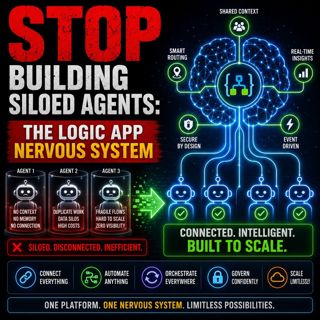
STOP BUILDING SILOED AGENTS: The Logic App Nervous System

Everyone is building AI agents.Very few organizations are building agent architectures.Across Microsoft 365, Copilot Studio, Azure OpenAI, Power Platform, and custom AI solutions, enterprises are raci...

16 Kesä 1h 18min

Building Multi-Agent AI Systems with Copilot Studio: From Ideas to Intelligent Automation with David Lorenzo Lopez  [MVP]

Building Multi-Agent AI Systems with Copilot Studio: From Ideas to Intelligent Automation with David Lorenzo Lopez [MVP]

Artificial Intelligence is rapidly evolving from simple chatbots into sophisticated multi-agent systems capable of automating complex business processes, collaborating across services, and delivering ...

15 Kesä 54min

The Rise of Private LoRA: Architecting Secure AI on Proprietary Data

The Rise of Private LoRA: Architecting Secure AI on Proprietary Data

Everyone is talking about AI adoption. Far fewer are talking about AI sovereignty. Organizations have rushed to deploy Microsoft Copilot, Azure OpenAI, ChatGPT Enterprise, Claude, Gemini, and dozens o...

15 Kesä 1h 22min
Cryptographic Agility: The Only Defense Against Quantum

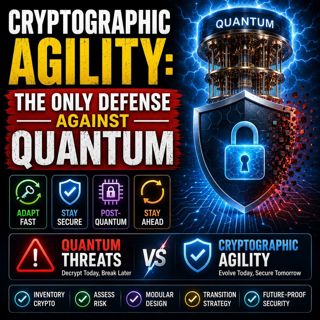
Cryptographic Agility: The Only Defense Against Quantum

Most discussions about quantum computing focus on a single question:When will quantum computers break encryption?The better question is this:How quickly can your organization replace encryption when i...

13 Kesä 1h 27min

Microsoft Purview in the Age of AI: Securing Copilot with Peter Rising [Microsoft]

Microsoft Purview in the Age of AI: Securing Copilot with Peter Rising [Microsoft]

As organizations race to adopt Microsoft 365 Copilot, AI Agents, and Generative AI, one critical question continues to emerge: is your data ready for AI? In this episode of M365 FM, Mirko Peters sits ...

12 Kesä 59min
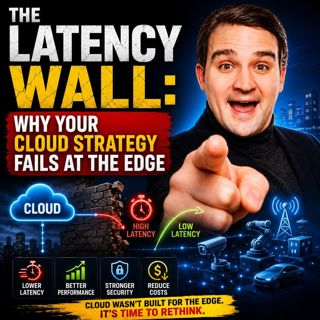
The Latency Wall: Why Your Cloud Strategy Fails at the Edge

The Latency Wall: Why Your Cloud Strategy Fails at the Edge

For years, organizations have followed a simple rule: move everything to the cloud.The strategy worked brilliantly for collaboration, analytics, business intelligence, and productivity workloads. Micr...

12 Kesä 1h 20min

Suosittua kategoriassa Politiikka ja uutiset

uutiscast
aikalisa
politiikan-puskaradio
ootsa-kuullut-tasta-2
rss-ootsa-kuullut-tasta
rss-podme-livebox
rss-asiastudio
otetaan-yhdet
tervo-halme
rikosmyytit
rss-vaalirankkurit-podcast
the-ulkopolitist
rss-girls-finish-f1rst
rss-ulkopoditiikkaa
rss-diet-woke
aihe
et-sa-noin-voi-sanoo-esittaa
rss-sinivalkoinen-islam
rss-kaikki-uusiksi
rss-merja-mahkan-rahat