Decoding the BOAT: GRB 221009A and the Hunt for High-Energy Neutrinos

Decoding the BOAT: GRB 221009A and the Hunt for High-Energy Neutrinos

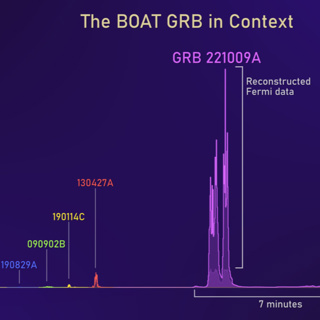
In this episode, we dive into the astrophysics behind GRB 221009A, an event widely known as the Brightest-Of-All-Time (BOAT) gamma-ray burst. Detected in October 2022, this extraordinary explosion shattered records by producing ultra-high-energy photons exceeding 10 TeV.


We discuss a recent multi-messenger study that models the burst's very-high-energy (VHE) afterglow using a Gaussian structured jet expanding into an interstellar medium. We explore how this smooth, angular jet structure explains the extreme TeV output observed at a mildly off-axis viewing angle, cleanly resolving the "energy crisis" that standard uniform (top-hat) jet models face.


Finally, we tackle the mystery of the missing neutrinos. Despite the immense energy of the BOAT, observatories like IceCube have not detected any coincident neutrinos. We break down the calculations for photo-hadronic ($p\gamma$) neutrino production and explain why the expected flux still falls below the sensitivity limits of even the next generation of detectors, like IceCube Gen2 and GRAND200k.


Key Takeaways:

  • The BOAT GRB: GRB 221009A was a remarkably luminous and relatively nearby event, offering an unprecedented opportunity to test emission models and ultra-high-energy cosmic ray acceleration.
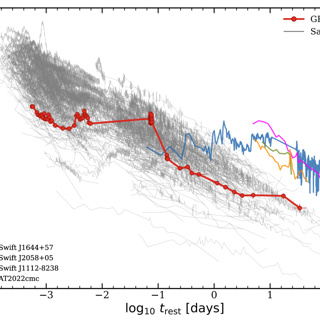
  • The Power of a Gaussian Jet: By using a Gaussian structured jet model, scientists can accurately reproduce the burst's gradual light curve steepening and immense brightness without requiring physically unrealistic energy budgets.
  • A Mildly Off-Axis View: The study reveals that the optimal way to interpret the data is a mildly off-axis viewing geometry, which allows the observer to receive intense early-time emission from the jet's core.
  • Neutrino Non-Detection Explained: Mathematical models of the photo-pion decay channel show that even under highly optimistic microphysical parameters, the predicted muon neutrino events remain below current and future detection limits, confirming that the null results from IceCube are consistent with the physics.


Reference to the Article Discussed:

Mondal, T., Razzaque, S., Joshi, J. C., Majumder, S., & Bose, D. (2026). Multi messenger study of GRB 221009A with VHE gamma-ray and neutrino Afterglow from a Gaussian structured jet. Journal of High Energy Astrophysics, 53, 100636.


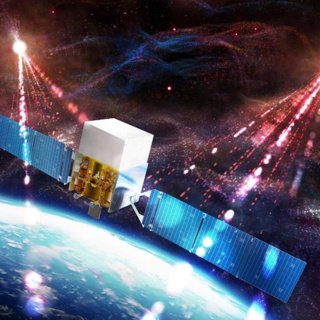
Acknowledements: Podcast prepared with Google/NotebookLM. Illustration credits: NASA's Goddard Space Flight Center and Adam Goldstein (USRA)

Tämä jakso on lisätty Podme-palveluun avoimen RSS-syötteen kautta eikä se ole Podmen omaa tuotantoa. Siksi jakso saattaa sisältää mainontaa.

Jaksot(112)

Peering Through the Ice: The Milky Way’s High-Energy Neutrino Signal

Peering Through the Ice: The Milky Way’s High-Energy Neutrino Signal

Peering Through the Ice: The Milky Way’s High-Energy Neutrino Signal Episode Summary: In this episode, we explore a major breakthrough in astrophysics: the IceCube Neutrino Observatory has established...

31 Heinä 20min

The Schmidt Observatory System unlocking the Transient Universe

The Schmidt Observatory System unlocking the Transient Universe

In this episode, we dive into the Eric and Wendy Schmidt Observatory System, a groundbreaking initiative designed to pioneer a new paradigm for astronomical research through rapid development, modular...

27 Heinä 21min

GUANO, NITRATES, and GLIMPSE: The Pipelines Powering Multi-Messenger Astronomy

GUANO, NITRATES, and GLIMPSE: The Pipelines Powering Multi-Messenger Astronomy

In this episode, we dive into the cutting-edge of time-domain and multi-messenger astrophysics with a deep look at BAT-GLIMPSE, a revolutionary new open-source pipeline developed for the Neil Gehrels ...

20 Heinä 20min

The Dynamic Radio Sky: Unveiling Transients with the SKAO

The Dynamic Radio Sky: Unveiling Transients with the SKAO

Welcome to a deep dive into the fast-paced, explosive universe of time-domain astronomy! In this episode, we explore how the upcoming Square Kilometre Array Observatory (SKAO) will revolutionize our u...

13 Heinä 19min

X-Raying the Earth: Neutrino Tomography at the South Pole

X-Raying the Earth: Neutrino Tomography at the South Pole

Welcome back to the podcast! Today, we are exploring a groundbreaking new way scientists are looking deep inside our planet. For a century, our understanding of the Earth's interior has relied almost ...

8 Heinä 23min

SVOM's First Year: From Gamma-Ray Bursts to Blazars

SVOM's First Year: From Gamma-Ray Bursts to Blazars

In this episode, we dive into the exciting early results from the SVOM (Space-based multi-band astronomical Variable Objects Monitor) mission, which launched in June 2024. Originally designed to hunt ...

6 Heinä 20min

SN 2024jlc: Bridging the Gap Between Supernova Classes

SN 2024jlc: Bridging the Gap Between Supernova Classes

In this episode, we dive into the fascinating discovery of SN 2024jlc, one of the closest and least luminous super-luminous supernovae (SLSNe) ever found. We explore how this extraordinary event is ch...

3 Heinä 20min

Cosmic Accelerators: Unlocking the Secrets of Microquasar GRS 1915+105

Cosmic Accelerators: Unlocking the Secrets of Microquasar GRS 1915+105

In this episode, we dive into the extreme and fascinating world of microquasars—binary systems where a compact object, like a black hole, feeds off a companion star and launches powerful, relativistic...

26 Kesä 20min

Suosittua kategoriassa Tiede

rss-poliisin-mieli
tiedekulma-podcast
rss-mita-tulisi-tietaa
rss-tiedetta-vai-tarinaa
docemilia
rss-duodecim-lehti
utelias-mieli
rss-kasvikutsut
rss-astetta-parempi-elama-podcast
radio-antro
rss-hereilla
rss-ammamafia
rss-tervetta-skeptisyytta
hippokrateen-vastaanotolla
rss-ranskaa-raakana
rss-radplus
filocast-filosofian-perusteet
mielipaivakirja
rss-bios-podcast
rss-ylistys-elaimille