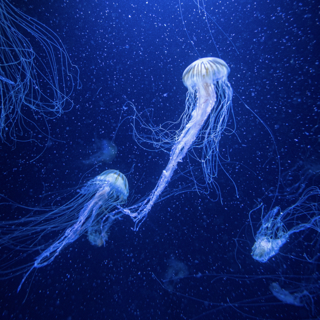

The sparkling deep
Many Minds20 Kesä

The sparkling deep

It's tempting to see bioluminescence as an oddity, one of those rare eccentricities of life on earth. And, on land, maybe that's true. But our planet is mostly water, and out in the open ocean bioluminescence is utterly commonplace. Creatures of all shapes and sorts sparkle and glow, glitter and pulse. But what are these displays for? Why did they evolve? How did light become the currency of the deep?

My guest today is Dr. Sönke Johnsen. Sönke is a Distinguished Professor of Biology at Duke University, where he and his research group study the visual ecology of the ocean. He's the author of a number of books: most recently Into the Great Wide Ocean, about life in the pelagic realm, and The Radiant Sea, a photographic tour of bioluminescence and color, written in collaboration with Dr. Steven Haddock.

Here, Sönke and I talk about the open ocean: the most common habitat on our planet, yet one that many people will never experience. We consider the curious distribution of bioluminescence— rare on land, exceptionally prevalent in the ocean, and all but absent in freshwater. We talk about how bioluminescence seems to have evolved—many, many times over in fact. We survey the functions of making light in the deep—from counter-illumination to courtship to revenge. Finally, we consider what Sönke takes to be the biggest remaining puzzle about bioluminescence at sea.

Alright friends, if you're enjoying Many Minds, we ask (humbly) if you would think about rating us, reviewing us, leaving us a comment, boosting us on social media, or perhaps haranguing your friends—relentlessly—until they give us a listen.

Without further ado, onto my conversation with Dr. Sönke Johnsen. Enjoy!

Notes

3:30 – The scientific report by Dr. Johnsen and colleagues describing the bioluminescent octopus, Stauroteuthis syrtensis.

12:00 – A popular article on the bristlemouth. The article reports a scientist's estimate of "as many as a dozen [bristlemouths] per square meter of ocean."

15:00 – A recent discussion of the "burglar alarm hypothesis."

18:00 – The website for the Johnsen Lab at Duke University.

24:00 – A chart and discussion of the depth zones of the ocean.

29:30 – A study by Séverine Martini and Steven Haddock quantifying the prevalence of bioluminescence at different depths. A popular write-up of the same study.

33:00 – A popular article on vertical migration in the ocean, also called "diel vertical migration." A recent scientific study of the phenomenon.

39:00 – A recent article on the evolution of bioluminescence.

45:00 – For detailed scientific discussion of the physical basis of bioluminescence, fluorescence, and other phenomena we discuss, see Dr. Johnson's book, The Optics of Life.

52:00 – For previous episodes on the use of sound in the animal kingdom, see here and here. For our previous episode on electroreception and electric ecology (including in marine organisms), see here.

57:00 – For more on the functions of bioluminescence, see here. For a report of a recently discovered function of bioluminescence, see here.

1:03:00 – An article by Dr. Johnsen about the different colors of bioluminescence present in the deep sea.

1:05:00 – A video of ostracod mating displays.

1:08:00 – For our recent episode on cave art, see here.

1:16:00 – For our earlier episode on firefly synchronization, see here.

Recommendations

Website and review article by Steven Haddock

The lab of Todd Oakley

Below the edge of darkness, Edie Widder

Tile art credit: Image by Georgi Kalaydzhiev via Unsplash

Many Minds is a project of the Diverse Intelligences Summer Institute, which is made possible by a generous grant from the John Templeton Foundation to Indiana University. The show is hosted and produced by Kensy Cooperrider, with help from Assistant Producer Urte Laukaityte and with creative support from DISI Directors Erica Cartmill and Jacob Foster. Our artwork is by Ben Oldroyd.

Subscribe to Many Minds on Apple, Stitcher, Spotify, Pocket Casts, Google Play, or wherever you listen to podcasts. You can also now subscribe to the Many Minds newsletter here!

We welcome your comments, questions, and suggestions. Feel free to email us at: manymindspodcast@gmail.com.

For updates about the show, visit our website or follow us on Bluesky (@manymindspod.bsky.social).

Tämä jakso on lisätty Podme-palveluun avoimen RSS-syötteen kautta eikä se ole Podmen omaa tuotantoa. Siksi jakso saattaa sisältää mainontaa.

Jaksot(172)

Island of the tool users

Island of the tool users

Tool use is rare in the animal kingdom—but maybe not as rare as we once thought. Since Jane Goodall famously observed a chimpanzee fishing for termites, many new examples of animals using tools have c...

9 Loka 1h 26min

Cognitive offloading and its consequences

Cognitive offloading and its consequences

For thousands of years—maybe for as long as we've been human—we've offloaded our thinking. We've counted on our fingers. We've carved tallies into bone. We've invented a long series of tools to help u...

25 Syys 1h 15min

Coming of age in Ngogo

Coming of age in Ngogo

It's a familiar story in many ways. A child is born, and for years afterward is adored and indulged and anchored to home and family. But then the child grows up and starts crossing that long threshold...

11 Syys 1h 34min

The natural history of linguistic diversity

The natural history of linguistic diversity

Thousands of languages are used around the world today, and this linguistic diversity is a precious part of our human heritage. But it's also more than that. Linguistic diversity provides clues—a vast...

28 Elo 1h 32min

From the archive: Electric ecology

From the archive: Electric ecology

Hi friends! We're still taking a bit of a summer pause. We'll be back at the end of August—in the meanwhile, enjoy this listener favorite from our archives! ----- [originally aired September 19, 2024]...

17 Elo 1h 33min

From the archive: Varieties of childhood

From the archive: Varieties of childhood

Hi friends! We're taking a bit of a summer pause. We'll be back soon—in the meanwhile, enjoy this listener favorite from our archives! ----- [originally aired July 10, 2025] Childhood is a special tim...

31 Heinä 1h 28min

From the archive: Philosophers on psychedelics

From the archive: Philosophers on psychedelics

Hi friends! We're taking a bit of a summer pause. We will be back soon—in the meanwhile, enjoy this listener favorite from our archives! ----- [originally aired May 14, 2025] Some call it the "psyched...

17 Heinä 1h 40min

The origins of Darwin's ideas

The origins of Darwin's ideas

No discipline, no sphere of intellectual life, has been untouched by the work of Charles Darwin. He died in 1882 but his ideas are very much alive; they're now central to how we understand the natural...

3 Heinä 1h 19min

Suosittua kategoriassa Koulutus

rss-murhan-anatomia
aamukahvilla
psykopodiaa-podcast
voi-hyvin-meditaatiot-2
rss-duodecim-lehti
psykologia
rss-liian-kuuma-peruna
rss-rahamania
kesken
aloita-meditaatio
rss-uskonto-on-tylsaa
ihminen-tavattavissa-tommy-hellsten-instituutti
rss-hereilla
rss-luonnollinen-synnytys-podcast
rss-arkea-ja-aurinkoa-podcast-espanjasta
rss-suomen-aa-podcast
rahapuhetta
adhd-podi
koulu-podcast-2
rss-niinku-asia-on


















