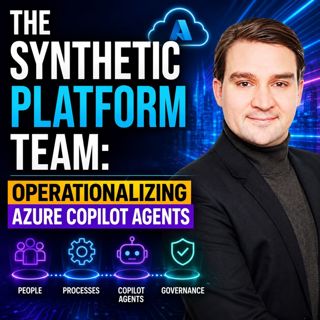

The Synthetic Platform Team: Operationalizing Azure Copilot Agents

The Synthetic Platform Team: Operationalizing Azure Copilot Agents

Modern cloud environments are becoming increasingly difficult to manage. Organizations are collecting more telemetry, logs, metrics, traces, recommendations, security signals, and cost data than ever before. Azure Monitor, Azure Cost Management, Azure Advisor, Application Insights, Service Health, and countless other tools provide valuable insights, yet many platform teams continue to struggle with the same challenge: understanding what matters and acting quickly enough to make a difference.In this episode, we explore how Azure Copilot Agents are transforming cloud operations and why many organizations are beginning to move beyond traditional dashboards toward a new model known as Agentic Operations. Rather than treating migration, deployment, optimization, observability, troubleshooting, and resiliency as separate disciplines, Azure introduces a coordinated ecosystem of intelligent agents working together as a Synthetic Platform Team.The discussion examines how AI-powered operational agents can continuously reason across infrastructure, correlate data from multiple sources, identify patterns humans often miss, and assist engineers in making faster and more informed decisions across the entire cloud lifecycle.

WHY DASHBOARDS ARE NO LONGER ENOUGH

For years, organizations have invested heavily in monitoring, observability, and reporting platforms. The assumption was simple: more visibility would lead to better operations.The reality has been very different.Today's cloud teams often find themselves switching between multiple dashboards just to understand a single incident. Cost anomalies appear in one system. Performance degradation appears in another. Deployment history exists somewhere else. Security findings are often hidden in entirely separate portals.This creates a fragmented operational experience where engineers spend significant amounts of time gathering information instead of solving problems.
In this segment we discuss:
  • The hidden cost of dashboard overload
  • Why cloud complexity continues to outpace human capacity
  • The growing challenge of context switching
  • How operational fragmentation impacts productivity
  • Why visibility alone does not create understanding
The conversation highlights why modern cloud operations require a reasoning layer capable of connecting information across multiple systems and transforming raw telemetry into actionable intelligence.

UNDERSTANDING THE AGENTIC OPERATIONS MODEL

Agentic Operations represents a fundamental shift in how organizations manage cloud environments.Unlike traditional automation that relies on static rules and predefined workflows, Azure Copilot Agents continuously analyze signals, understand context, build hypotheses, and recommend actions based on changing conditions.Rather than reacting to individual alerts, these agents operate across multiple domains simultaneously and reason about relationships between infrastructure, applications, deployments, costs, security posture, and business objectives.The episode explores how organizations can move from reactive cloud management to continuous operational intelligence and why this transition may be as significant as the original move from on-premises infrastructure to cloud computing.

INTRODUCING THE SYNTHETIC PLATFORM TEAM

One of the most fascinating concepts discussed in this episode is the idea of the Synthetic Platform Team.Instead of relying solely on human operators to perform migration assessments, deployment reviews, troubleshooting investigations, optimization exercises, and resiliency planning, organizations can augment their platform teams with specialized AI agents.These agents work together as a coordinated operational fabric, sharing context and collaborating across domains.The result is not a collection of disconnected tools but a unified operational model capable of supporting platform teams at scale.
Topics covered include:
  • Specialized operational agents
  • Shared context across cloud services
  • Cross-domain reasoning
  • Continuous operational awareness
  • Human-in-the-loop governance
The discussion emphasizes that the goal is not replacing engineers but multiplying their effectiveness.

MIGRATION AGENTS AND CLOUD MODERNIZATION

Cloud migrations remain one of the most challenging initiatives for many organizations.Legacy systems often contain undocumented dependencies, hidden integrations, and years of accumulated technical debt. Traditional migration planning requires extensive workshops, discovery sessions, architecture reviews, and manual assessments.Azure Migration Agents aim to change that process.By automatically discovering workloads, mapping dependencies, assessing compatibility, and generating migration recommendations, these agents help organizations accelerate migration initiatives while reducing operational risk.
The episode explores how migration agents can:
  • Discover hidden application dependencies
  • Assess Azure readiness
  • Identify modernization opportunities
  • Prioritize migration waves
  • Generate migration strategies
This dramatically reduces the time required to move from discovery to execution.

DEPLOYMENT AGENTS AND THE WELL-ARCHITECTED FRAMEWORK

Infrastructure deployment is often where architecture becomes reality.Even the best migration plan can fail if infrastructure is deployed incorrectly. Security gaps, networking errors, governance violations, and inconsistent configurations can introduce operational risks long before applications go live.Deployment Agents leverage Azure Well-Architected Framework principles to generate production-ready infrastructure using Infrastructure as Code approaches such as Terraform, Bicep, and ARM templates.The discussion examines how these agents help organizations build environments that are secure, reliable, scalable, and cost efficient from day one.Special attention is given to governance, automation, repeatability, and security-by-design principles.

CONTINUOUS OPTIMIZATION IN THE CLOUD ERA

One of the most expensive challenges facing cloud teams is resource sprawl.Workloads evolve over time. Applications change. Usage patterns shift. Infrastructure that was appropriately sized on deployment day often becomes overprovisioned or inefficient months later.Optimization Agents continuously analyze cloud environments and compare actual resource utilization against deployed capacity.Rather than relying on quarterly optimization reviews, organizations can adopt continuous optimization strategies that operate every day.
The episode explores:
  • Cost optimization
  • Resource right-sizing
  • Storage lifecycle management
  • Sustainability improvements
  • Cloud financial operations (FinOps)
Listeners will learn how organizations can reduce operational waste while maintaining performance and reliability.

OBSERVABILITY, TELEMETRY, AND REAL-TIME REASONING

Modern applications generate enormous amounts of operational data.Logs, traces, metrics, events, and application telemetry provide valuable insights but often remain disconnected from one another.Observability Agents act as correlation engines capable of connecting signals across multiple systems.Instead of presenting isolated alerts, these agents build narratives that explain what happened, why it happened, and which systems were affected.The conversation explores how AI-powered observability can significantly reduce mean time to detection and accelerate operational decision-making.Real-world examples demonstrate how agents identify root causes that would otherwise remain hidden across fragmented monitoring platforms.

BUILDING RESILIENT CLOUD ARCHITECTURES

Reliability and resiliency are not the same thing.Reliable systems are designed to avoid failure. Resilient systems are designed to survive failure.This episode examines how Resiliency Agents help organizations strengthen disaster recovery strategies, backup architectures, failover capabilities, redundancy planning, and business continuity initiatives.
Topics discussed include:
  • Availability zones
  • Disaster recovery planning
  • Backup validation
  • Business continuity
  • Ransomware resilience
The discussion emphasizes proactive risk reduction rather than reactive incident management.

TROUBLESHOOTING AT DIGITAL SPEEDE

very organization experiences incidents.Applications fail. Databases slow down. Services become unavailable. Performance degrades.The real challenge is not finding alerts. The challenge is identifying root causes quickly enough to minimize business impact.Troubleshooting Agents dramatically reduce investigation time by automatically correlating telemetry, deployment history, configuration changes, performance metrics, and application logs.Rather than spending hours manually piecing together evidence, engineers receive a complete timeline of events and a detailed explanation of likely root causes.This transforms incident response from detective work into informed decision making.

Become a supporter of this podcast: https://www.spreaker.com/podcast/m365-fm-modern-work-security-and-productivity-with-microsoft-365--6704921/support.

Tämä jakso on lisätty Podme-palveluun avoimen RSS-syötteen kautta eikä se ole Podmen omaa tuotantoa. Siksi jakso saattaa sisältää mainontaa.

Jaksot(697)

The PowerShell Ceiling: Why You Need Bicep

The PowerShell Ceiling: Why You Need Bicep

Every IT professional eventually reaches a point where automation stops feeling like freedom and starts becoming a burden. What begins as a handful of PowerShell scripts quickly grows into dozens of a...

7 Heinä 1h 9min

Beyond the Prompt: Architecting Multi-Agent AI Solutions with Microsoft Copilot & SharePoint with Reshmee Auckloo [MVP]

Beyond the Prompt: Architecting Multi-Agent AI Solutions with Microsoft Copilot & SharePoint with Reshmee Auckloo [MVP]

Artificial Intelligence is rapidly moving beyond simple chatbots and prompt engineering. Today's enterprise AI solutions must reason, collaborate, orchestrate multiple agents, securely access business...

6 Heinä 1h
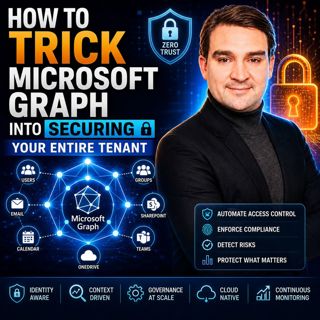
How To Trick Microsoft Graph Into Securing Your Entire Tenant

How To Trick Microsoft Graph Into Securing Your Entire Tenant

Most Microsoft 365 administrators believe their tenant is secure because every dashboard is green, policies are enabled, and alerts appear to be flowing normally. Unfortunately, modern security doesn'...

6 Heinä 1h 12min
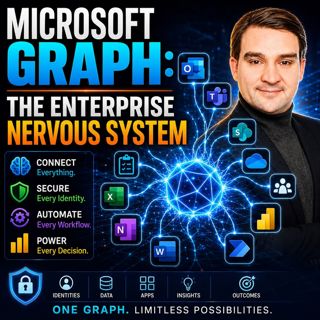
Microsoft Graph: The Enterprise Nervous System

Microsoft Graph: The Enterprise Nervous System

Enterprise IT has reached a tipping point. Organizations now manage millions of identities, files, applications, permissions, policies, and AI-powered workloads across Microsoft 365. Yet many IT depar...

5 Heinä 1h 11min

Beyond the Script: The Architect's Guide to Microsoft Graph Platforms

Beyond the Script: The Architect's Guide to Microsoft Graph Platforms

Automation has become a cornerstone of digital transformation, yet many organizations unknowingly create more complexity than they eliminate. What starts as a simple PowerShell script or Power Automat...

5 Heinä 1h 10min
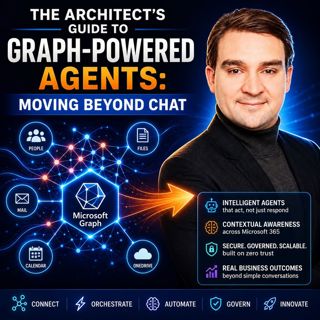
The Architect's Guide to Graph-Powered Agents: Moving Beyond Chat

The Architect's Guide to Graph-Powered Agents: Moving Beyond Chat

Artificial Intelligence has rapidly evolved from simple chatbots into sophisticated enterprise agents capable of reasoning, orchestrating workflows, and executing business processes. Yet many organiza...

4 Heinä 1h 20min

The Hidden Logic of Microsoft Graph

The Hidden Logic of Microsoft Graph

Most Microsoft 365 professionals know Microsoft Graph as the API behind users, groups, Teams, and SharePoint. But beneath those familiar endpoints lies a much larger reality. Microsoft Graph has evolv...

4 Heinä 1h 11min

Everything Microsoft Didn't Tell You About Teams with Everything Microsoft Didn't Tell You About Teams with Josh Blalock [MVP]

Everything Microsoft Didn't Tell You About Teams with Everything Microsoft Didn't Tell You About Teams with Josh Blalock [MVP]

Microsoft Teams has evolved from a simple collaboration platform into the digital workplace at the heart of modern business. But behind every successful Teams meeting lies far more than software. In t...

3 Heinä 45min

Suosittua kategoriassa Politiikka ja uutiset

aikalisa
uutiscast
ootsa-kuullut-tasta-2
rss-ootsa-kuullut-tasta
rss-podme-livebox
rss-vaalirankkurit-podcast
tervo-halme
otetaan-yhdet
politiikan-puskaradio
aihe
rss-kaikki-uusiksi
rss-asiastudio
the-ulkopolitist
et-sa-noin-voi-sanoo-esittaa
rss-mina-ukkola
rss-aijat-hopottaa-podcast
rss-kovin-paikka
rss-raha-talous-ja-politiikka
rss-girls-finish-f1rst
rss-ulkopoditiikkaa